Can’t sleep? Feeling blue? Seven things women must avoid doing at 2 a.m!
And now for a bit of wise humour, courtesy of the always creative Christine Miserandino at one of my favourite websites, But You Don’t Look Sick?
“We all have been there. It is 2 a.m, you can’t sleep, you have a lot on your mind – and let’s face facts, you are depressed. After doing all of the wrong things to combat depression, I thought I would pass on some of my knowledge to you. Hopefully you can find better things to do with your time at 2 a.m. than I did. Why only seven things? I fell asleep, and I was too depressed to think of 10… (more…)
The ’18 Second Rule’: why your doctor missed your heart disease diagnosis
The trouble with Dr. Jerome Groopman‘s book, How Doctors Think, is that the docs who really need it won’t read it. But patients will, thanks to word-of-mouth buzz since it was published in 2007.
As a patient who has experienced a life-threatening misdiagnosis while having a heart attack, my own favourite part of the book is Dr. Groopman’s review of physicians who take “cognitive shortcuts’ during patient visits.
This means that doctors can jump to conclusions about diagnosis or treatment options, and then can’t budge even when contradictory evidence subsequently emerges. “Blame the 18 Second Rule!” advises Dr. Groopman, professor of medicine at Harvard. ”That’s the average time it takes a doctor to interrupt you as you’re describing your symptoms. By that point, he/she has in mind what the answer is, and that answer is probably right about 80% of the time.”
You may be saying by now: “Well, Carolyn, being right 80% of the time sounds like a pretty darned good track record, even if the doctor has jumped to conclusions and interrupted me after just 18 seconds!” This may be true, unless of course you happen to be one of the poor misdiagnosed schmucks in that 20% group. “It’s not that doctors lack sufficient clinical knowledge, but are rather tripped up by their biases,” writes Dr. Groopman.
Here’s how things can escalate once inaccurate bias comes into play. “Doctors are stumped by symptoms all the time,” explains Dr. Groopman, “By prescribing the wrong medication, for example, they often worsen the problem or even create a new one. Worse, misdiagnoses lead to an astounding 40,000-80,000 hospital deaths every year according to the American Medical Association, plus an uncounted number due to mistakes in the doctor’s office. Some 5% of autopsies find a condition missed by doctors that, if treated, might have saved the patient’s life.” Alarmingly, he describes the reality, actually researched at Johns Hopkins, that when doctors develop a dislike of a particular patient, they tend to shut down and close their minds. “It’s a set up for misdiagnosis - you do not get good care.” (more…)
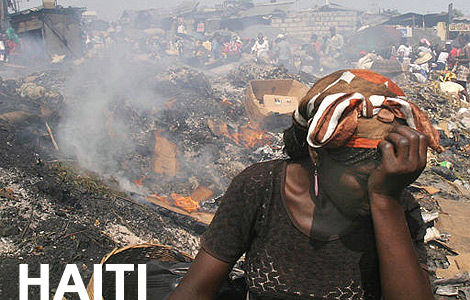
Médecins Sans Frontières at work in Haiti, Chile, India and Pakistan
“We were forced to buy a saw in the market to continue amputations. We don’t have any more morphine to manage pain for our patients. It is like working in a war situation.” Dr. Rosa Crestani, MSF medical coordinator for Choscal Hospital, Port-au-Prince
NEWS UPDATE: February 27, 2010 – Médecins Sans Frontières (Doctors Without Borders) medical teams have already arrived in Chile following the catastrophic earthquake that struck the country this past weekend. Find out more.
NEWS UPDATE: August 13, 2010 – Médecins Sans Frontières (Doctors Without Borders) is bringing in 200,000 litres of clean water every day to Pakistan’s Swat Valley following massive flooding this month that has disrupted power to water treatment plants, meaning no access to safe, clean drinking water and increased dangers of waterborne disease to flood victims. “We have identified a water spring and in agreement with the local community, we are able to extract, filter, chlorinate and distribute the water,” said Azzura Dinca who is in charge of water and sanitation for MSF in Swat. Find out more.
Médecins Sans Frontières (also known as Doctors Without Borders) is the world’s leading independent international medical relief organization. MSF is now recruiting medical professionals for their stand-by roster of international volunteers for future deployment in Haiti following this month’s catastrophic earthquake.
Médecins Sans Frontières was established in 1971 by a small group of French doctors who had worked in Biafra. When they returned home, they were determined to find a way to provide rapid and effective medical help for those caught in armed conflicts, disease epidemics, famine, and natural disasters like this month’s earthquake in Haiti – all with complete independence from political, economic and religious influences.
MSF is currently recruiting medical professionals in Haiti and other disaster sites, including:
- Physicians
- Registered Nurses/Nurse practitioners
- Nurse-midwives (URGENT)
- Mental Health specialists
- Laboratory specialists and technicians
- Surgeons
- Anaesthesiologists (URGENT)
- Dieticians/Nutritionists
- Obstetricians/Gynecologists (URGENT)
- Epidemiologists
In addition, team members for Haiti deployment should:
- speak French or Creole
- have prior international experience
- be available for at least four weeks of service (more…)
Ten helpful things to say to a sick friend
After my heart attack, while I did appreciate kind-hearted friends and family who said: “Just call me if there’s anything at all that I can do for you!” – I knew that I was not going to call them to ask: ”Can you come over and change the kitty litter?” That was just never going to happen. By comparison, I found it truly helpful when people phoned and said something like: “I’m at the grocery store – what can I pick up for you while I’m here?”
Dr. Elvira Aletta might agree. I particularly liked her essay called Ten Things To Say To A Sick Friend, originally inspired by author and speaker Lisa Copen, founder of Invisible Illness Week (and coincidentally my fellow inductee named by ‘Our Bodies, Ourselves’ as one of their 20 Women’s Health Heroes for 2009) who asked her Twitter followers: “What would be a good thing to say to a sick person?”
Dr. Aletta compiled a sampling of these 10 suggestions taken from Lisa’s Twitter community’s helpful tips: (more…)
‘Heartbeats’ – free weekly heart health tips, plus a contest to win a VIP trip to Toronto
To help you make those New Year’s resolutions stick throughout the year- and take care of your heart health – the Heart and Stroke Foundation offers Heartbeats. It provides a free year-long dose of weekly lifestyle tips designed to reduce women’s risk of heart disease and stroke all year long. Each tip is incremental and achievable for women of all health and fitness levels. If you incorporate each small improvement into your lifestyle every week, you’ll see your health and energy levels improve day by day. Tips can be delivered to you via text message, email or RSS. (more…)