Archive | May, 2012

Why aren’t more doctors like Dr. Bernard Lown?

31 May

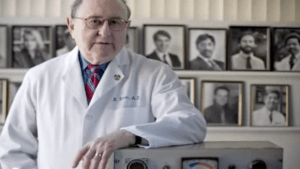
Dr. Bernard Lown is the author of The Lost Art of Healing: Practicing Compassion in Medicine, and has been a practicing physician for over 62 years. He’s also the co-founder of the medical organization called International Physicians for the Prevention of Nuclear War, which was awarded the 1985 Nobel Peace Prize.

Dr. Lown presented this talk at a Cambridge, Massachusetts medical conference called Avoiding Avoidable Care on April 26, 2012. The lofty goal of this unique conference was no less than the transformation of health care culture from one focused on volume and quantity to one centered on value and quality. Here’s the profoundly important message of Dr. Lown to his colleagues:   Continue reading 

11 fascinating facts about your heart

27 May

by Carolyn Thomas

1. Matters of the heart

The hardest-working muscle in your body is your heart, according to the Library of Science. It pumps out two ounces of blood at every heartbeat, adding up to at least 2,500 gallons daily. The heart has the ability to beat over 3 billion times in a person’s life.  See also: How Many Times Has Your Heart Beaten So Far?

2. Too much sitting or driving could be trouble

If you want to stay heart healthy, it might make sense to cut back on sitting down, driving and watching the tube. In one analysis of data from nearly 30,000 people in 52 countries, those who owned both a car and TV had a 27% higher risk of heart attack than those who owned neither. However, the researchers caution that lack of physical activity is the culprit, not just what you’re doing while sitting. See also: Are you reading this sitting down? Don’t! Continue reading 

Did you really need that coronary stent?

23 May

by Carolyn Thomas

A New York study has revisited the issue of stent-happy cardiologists implanting the tiny metal devices that help prop open – or revascularize – blocked coronary arteries. Essentially, this study suggests that two-thirds of the justifications for this procedure in non-emergency patients were either “uncertain” or “inappropriate“. For any heart patient who has ever been told by those with the letters M.D. after their names that this type of cardiac intervention was recommended, it’s yet more troubling news. And the fact that this issue simply will not go away makes me wonder why cardiologists themselves are keeping suspiciously mum about the controversy.

When cardiologists do speak up, not surprisingly, many hasten to pre-emptively defend their interventional colleagues. An editorial that accompanied this study’s publication in the Journal of the American College of Cardiology, for example, explained:

“There are certain to be patients rated as ‘inappropriate’ for which almost all competent cardiologists would recommend intervention.”

In other words, pay no attention to the man behind the curtainContinue reading 

Khan Academy’s crash course on heart disease

19 May

,

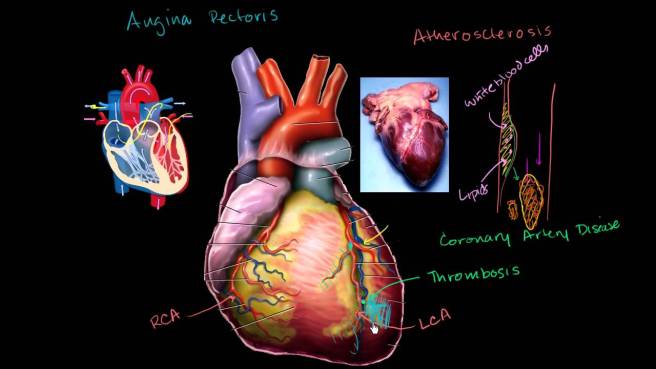
Sal Khan has done it again with this exquisitely simple yet compelling look at how a heart attack happens. This MIT graduate’s Khan Academy is a non-profit educational organization, created in 2006 with the stated mission of “providing a high quality education to anyone, anywhere”.

This video on heart disease is just one of over 3,000 brilliant (and free!) online micro-lecture tutorials at Khan Academy. So watch it already.

l

Those curious cardiac enzymes

15 May

by Carolyn Thomas

When I showed up in the Emergency Department with textbook heart attack symptoms – chest pain, nausea, sweating, and pain radiating down my left arm – the hospital staff snapped to work and immediately ordered a flurry of cardiac tests. These included an EKG, blood tests and a treadmill stress test. But all test results came back “normal”. I was then told that I was in the “right demographic” for acid reflux before being sent home – less than five hours after the onset of symptoms.

I left hospital that morning feeling terribly embarrassed for having made such a fuss over just a little case of indigestion.  It was only much later – after finally being correctly diagnosed, taken directly from the E.R. to O.R. and admitted to the cardiac care unit for a myocardial infarction (heart attack) caused by a fully occluded Left Anterior Descending coronary artery - when I learned that my “normal” blood tests may have been “normal” that day because I had been sent home too soon.  Continue reading 

A motherless Mother’s Day

13 May

This month marks both the occasion of my mother’s birthday (she would have turned 84 on May 7th) and, of course, Mother’s Day – the first Mother’s Day in living memory that I didn’t send my Mom a card and flowers. That’s because she died this year on February 21st. Last month, she missed the birthdays of her first child (me) and her first grandchild (my own son Ben) – but since the cruel diagnosis of vascular dementia invaded her brain cells some time ago, she’d long been unable to keep track of things like family birthdays anymore.

As Christopher Buckley wrote in his memoir, Losing Mum and Pup, when the last of your parents dies, you are an orphan:

“But you also lose the true keeper of your memories, your triumphs, your losses. Your mother is a scrapbook for all your enthusiasms. She is the one who validates and the one who shames, and when she’s gone, you are alone in a terrible way.”   Continue reading 

“What Was That?” A poem for heart attack survivors

11 May

Loyal British reader Lorraine Gradwell responded to a recent post here (Heart Disease Within “The Comfort of Denial) by revealing that its post-heart attack emotional roller coaster message had resonated with her. Like many other women, this 58-year old Manchester mother of two felt frightened and confused after surviving what doctors call a “widow maker” heart attack last fall. And like many other women, her cardiac symptoms (crushing fatigue, light-headedness along with chest, neck, arm and shoulder symptoms) had been initially misdiagnosed as panic attacks. 

Lorraine explains:

“I had my heart attacks early last October; I didn’t know what was happening and this left me frightened that I could have more. I began a creative writing course the same week and wrote this poem.”   Continue reading 

Follow

Get every new post delivered to your Inbox.

Join 1,959 other followers