Emotions of the wounded heart

by Carolyn Thomas  ♥  @HeartSisters

“We connect with each other through our wounds.”

Rachel Naomi Remen

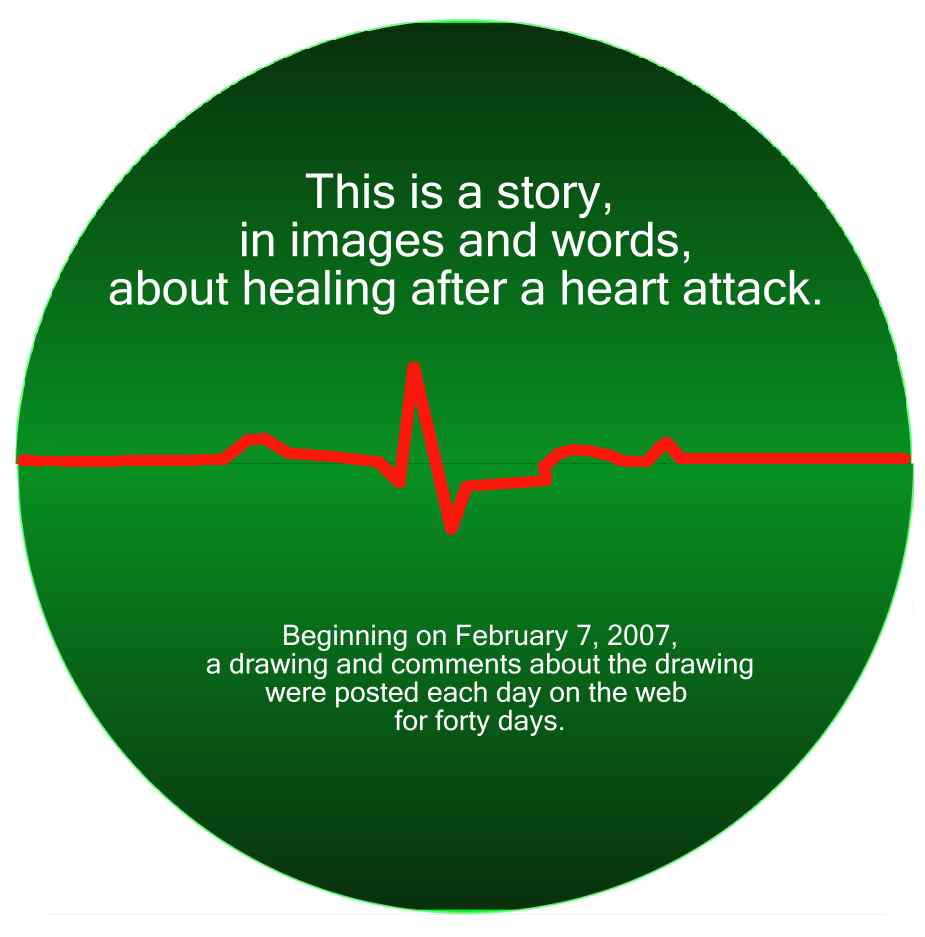
Right after his heart attack, Dr. Stephen Parker began an impressive project as part of his healing journey. The result is a compelling series of images that the Alaska clinical psychologist created over a 40-day period of recuperation.  The 40 drawings came first, and then his accompanying commentary, which then became a blog, and the blog then became a touring art exhibit called “Healing after a Heart Attack: Images of the Psyche”, and ultimately a book called Heart Attack and Soul.
Continue reading “Emotions of the wounded heart”

Inside your heart – as captured by National Geographic

Here’s how your heart looks during a coronary angiography procedure. The white/yellow blood vessels are bringing oxygenated blood to the working muscles of the heart.  (See link below to the whole slide show).

Coronary angiography (also called cardiac catheterization) is sometimes referred to as the ‘gold standard’ of diagnostics for heart patients. The procedure involves threading a tiny catheter through an artery in the wrist or groin and pushing it up, up, up right into the beating heart. It’s considered to be an invasive procedure, but not surgical. Patients are sedated, but usually awake throughout.

The catheter is guided through the artery with the aid of a special x-ray machine. Contrast material (dye) is injected through the catheter and x-ray movies are created as the contrast material moves through the heart’s chambers, valves and major vessels.

The interventional cardiologists in the ‘cath lab’ then watch your beating heart up on the monitor, where they can spot any coronary arteries that are blocked or narrowed, and evaluate your heart function. If significant blockages are seen, further procedures like balloon angioplasty, stent implants or coronary artery bypass graft (CABG) – commonly known as bypass surgery – may be attempted to restore blood flow to the threatened heart muscle.

I’ve undergone two of these invasive cardiac procedures – the first an emergency catheterization and stent implant when I was hospitalized for a heart attack, the second 15 months later to investigate ongoing cardiac symptoms. And I can tell you that it is freakishly fascinating to lie on the cath lab table, sedated yet very awake, and watch your own beating heart on the overhead monitor.   Continue reading “Inside your heart – as captured by National Geographic”

Warning: watching too much TV can be really, really bad for your heart

by Carolyn Thomas

Every hour you spend watching television each day increases your risk of dying from heart disease by almost a fifth, say scientists in Australia.

The findings were reported last month in Circulation, the Journal of the American Heart Association.

Prof. David Dunstan, the study’s lead researcher from the Baker IDI Heart and Diabetes Institute in Victoria, Australia, had this message for members of the public:

In addition to doing regular exercise, avoid sitting for prolonged periods and keep in mind to ‘move more, more often’. Too much sitting is bad for health.”

Couch potatoes were warned that their lifestyle also increased the risk of death from other causes including cancer.  Continue reading “Warning: watching too much TV can be really, really bad for your heart”

“Take two aspirins and Tweet me in the morning!”

You woke up feeling sick today. Your throat is scratchy, your head is imploding, and you just don’t think you can even leave your bed. You might have the flu. What do you do?

If you live in the Brooklyn borough of New York City, you stagger over to your computer and log in to your doctor’s office website at Hello Health to schedule an online Instant Messaging visit. Very soon, during that IM chat, your regular doctor asks some questions and confirms that it’s a virus. She tells you there’s nothing to worry about just yet, to drink plenty of fluids, and take Tylenol™ for the fever. Oh, and she’ll contact you tomorrow.

Feeling better now?  In the olden days before the Hello Health concept, the traditional time spent dragging your sorry flu-addled self out of bed and all the way downtown to your doctor’s office, including two aching and feverish hours spent shivering in the waiting room infecting other patients, would have been about four hours of your life that you’d never get back.

But time spent with your Hello Health doctor’s visit?  Less than one hour, without even brushing your teeth, changing out of your sweaty jammies, or leaving home. 

Indeed, across our health care system, from large hospital networks to patient support groups, new media tools like blogs, IM platforms, video chat, and social networks like Twitter and Facebook are re-engineering the way doctors and patients interact.   Continue reading ““Take two aspirins and Tweet me in the morning!””