
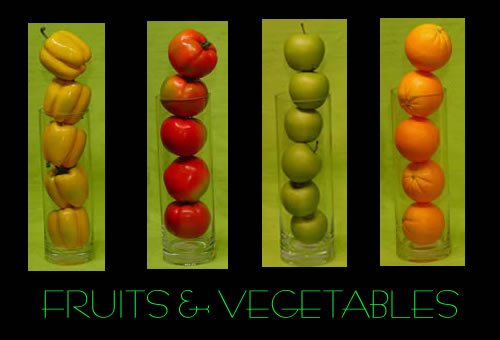
Thirty heart-healthy ways to love your veggies (and fruit!)

by Carolyn Thomas

We’re supposed to eat 2-4 servings of fruit plus 3-5 servings of vegetables every day. It’s a full-time job, especially for those of us raised in Ukrainian families where dill pickles were considered an ideal veggie serving. Fewer than one third of us eat even those lower limits.

And we’re fussy eaters.

Potatoes, for example, represent 44% of our fresh vegetable diet here in Canada. That doesn’t includes a significant increase, according to Statistics Canada, in our consumption of processed potatoes in the form of potato chips and frozen potato products. But carrots, lettuce, onions and tomatoes represent just 27% of the Canadian diet of fresh vegetables, a decrease of 9% compared to 2005 numbers. On the other hand, we’re apparently eating three times more sweet potatoes now compared to 20 years ago. Wonder if that’s entirely due to the growing popularity of sweet potato fries . . .

The editors of Consumer Reports Healthasked:How exactly are you supposed to get healthy produce servings into your life?” and then came up with these 30 great tips.   Continue reading “Thirty heart-healthy ways to love your veggies (and fruit!)”

Cats or dogs: which pet is better for your heart health?

by Carolyn Thomas  @HeartSisters

I adopted my little Lily*, world’s cutest and most affectionate feline, three months after my heart attack. My daughter Larissa, who helped us pick out Lily at the shelter, gave me strict instructions about the kind of cat needed for cardiac recovery: a calm and snuggly lap cat (quite unlike the psycho-special needs-high-anxiety – yet adorable – Lucy who had been my last pet).

About 38% of Canadian households now include a cat like Lily, while 35% of us are dog owners.

But apparently, owning a cat may also reduce your risk of cardiovascular disease by nearly one-third, researchers told delegates to the International Stroke Conference recently. Their study findings provoked a mixed reaction from heart experts and veterinarians.  And probably dog lovers, too.   Continue reading “Cats or dogs: which pet is better for your heart health?”

Welcome to your new country

by Carolyn Thomas       Heart Sisters on Blue Sky

My family doctor once compared my uneasy adjustment since surviving a misdiagnosed heart attack to being like a stressful move to a foreign country.

I used to be pretty comfortable in my old country, pre-heart attack.

In my old country, I was a healthy, active, outgoing former distance runner. I had a wonderful family and a whack of close friends, a meaningful career I really loved, a crazy-cute cat, longtime community volunteer roles, a condo renovated top to bottom in a charming leafy neighbourhood of the most beautiful city in Canada – and a busy, happy, regular life.

Then on May 6, 2008, after being misdiagnosed and sent home from the Emergency Department despite textbook cardiac symptoms, I was finally admitted to the same hospital with a diagnosis of myocardial infarction – what doctors still call the “widowmaker” heart attack.

And that was the day I moved far, far away to a different country.  Continue reading “Welcome to your new country”

What women with heart disease can learn from “pinkwashing”

by Carolyn Thomas  @HeartSisters

In this month of all months, in Pinktober, in the holy month of All Things Pink out there, author and cancer patient Mary Elizabeth Williams dared to post a brave if not downright shocking perspective in Salon she called The Smug Morality of Breast Cancer Month.

She included this jibe at a pink ribbon campaign that she describes as an increasingly pervasive branding opportunity”:

“Perhaps it’s time to consider what this glut of pink says about our attitudes about the meritocracy of disease, and the ways in which we dispense compassion.

This year lung cancer will kill triple the number of people that breast cancer does. Ovarian, cervical and prostate cancer will kill more individuals than breast cancer. And alcoholism, addiction and depression will this year continue to kill not just via the overt channels of overdose and suicide, but in their brutal toll on overall health.”

And let’s not forget to add to Mary Elizabeth’s deadly list heart disease, the #1 killer of women.  It was only after my own heart attack that I learned heart disease kills more women than ALL forms of cancer combined.  But targeting any disease as a “branding opportunity” is not about being anti-pink.  Instead, as Mary Elizabeth Williams warns us:

“We run the risk of ennobling those with certain sicknesses while stigmatizing others.”

Continue reading “What women with heart disease can learn from “pinkwashing””