
by Carolyn Thomas ♥ @HeartSisters

Scar image: Defective Heart Girl
Each surgical scar on my body tells a story. The big long one that tracks across my lower right abdomen tells of an appendix that ruptured on my 16th birthday – and the subsequent month I spent in hospital seriously ill with peritonitis and creepy drainage tubes. Two scars on my right knee tell of surgery after an unfortunate slide down a big pile of gravel. Another meandering zig zag tells of a nasty piece of broken glass once embedded into my left palm, its evidence exquisitely masked by the skilled plastic surgeon who sewed my hand back up.
Women who have survived open heart surgery sometimes have traumatic stories to tell about their very noticeable chest scars, and mixed emotions about whether “to hide or not to hide” this evidence of their cardiac history, particularly in the early weeks and months post-op.
Consider, for example, 45-year-old Myra from New Jersey, who tells this story:
“I had a double bypass open heart surgery five months ago. I feel so sad and stressed about my scar. Sometimes I cry when I’m in the shower, or if I try to wear a shirt and can’t wear it because it shows.
“I watch my friends at the pool wearing bathing suits while I’m sitting on the side watching them, wearing a t-shirt and shorts. I feel out of the group, just don’t want to be there. I wish I could remove my scar. I’m so very stressed about it.”
Another heart patient observes:
“My illness has created more scars than just the physical ones, and these were far worse. I couldn’t – wouldn’t – believe I looked just fine.”
What these women have undergone is called a sternotomy (and keep on reading to learn more about how this surgical procedure works).
You might be surprised to learn that not all patients hate their scars.
One woman, for example, described the long sternotomy scar on her chest from her heart bypass surgery as:
“A map of illness and recovery.”
Another wrote this:
“My scar shows the world what I have survived and overcome. They say this body is far from perfect – but it’s mine.”
And another woman added:
“They are my battle scars earned and gloriously celebrated as such.”
Or this, from a 17-year old girl:
“When I was 18 months old, my twin brother and I had to have open heart surgery. As I grew up, my scar grew with me. It’s about six inches long and very noticeable with low-cut shirts.
“I have lived with the scar my whole life. I am now 17 and it is hard for me having to tell friends and boyfriends how I got the scar. But I’m proud because I am living, so it’s like a battle wound, and I know that it does not matter.
“Scar or no scar, it has made me the person I am today. We should be proud of overcoming, no matter how we got these scars.”
I loved this story from a 44-year old bypass surgery survivor whose chest scar has sometimes attracted unwanted public attention:
“A gentleman walked past me at a local Target. He was staring at my chest pretty intently.
“Well, I ran into this guy at least another two times while shopping, with him walking towards me staring openly at my chest. I think he was trying to get a better look at the scar.
“By the third time, I pointed directly at it and said to him: ‘Bear attack!’ He was VERY embarrassed – and walked away quickly!”
Perhaps the longer we live with our battle scars, the easier it can become to accept them – no matter what the source of those scars. For example:
“I have a scar on my chest from when I had heart surgery as a child. It saved my life. And I have stretch marks from my first pregnancy which I always hated until a friend told me: ‘Yes, but they were created by your son!’ It made me totally re-think my view on them.
“Years later I got a C-section scar after giving birth to Son #2. My scarred-up tummy is beautiful and a reflection of two wonderful little boys and a life saved to have them.
“I may not be wearing crop tops or bikinis now, but I love my scars!”
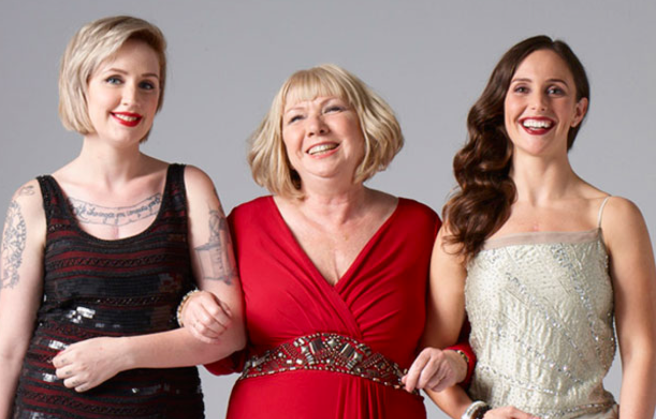
This trio of U.K. heart patients (pictured above) have interesting stories to tell about how they managed to adjust to their own scars. Shell Williams (left) found that showing her scar in a fundraising calendar helped her come to terms with it. Valerie Johnson (centre) went from hating her scar to seeing it as a sign of the life she’s lived. Michelle Houston (right) had heart surgery in her 20s and learned to view her scar as a sign of bravery.
♥
Now, I promised you an explanation of what creates those scars during your open heart surgery while you’re snoozing away in the O.R. – and here goes:
 Your heart rests beneath the sternum – the organ’s skeletal chest armor and the central bone to which ribs are attached. Cracking this bone running down the centre of the chest requires pressure, power and precision, according to Popular Mechanics (yes, you read that right) and their very useful if unlikely guide Extreme How-To: Step By Step Heart Surgery – one of the clearest explanations of this procedure that I’ve seen yet.
The most common type of saw used in heart surgery is an oscillating saw, which moves up and down at a rapid speed and works like a jigsaw, enabling the fine blade to cut curved lines. Sometimes – especially on patients who have had heart procedures done before – surgeons will use a saw that’s like the one used to remove casts. It stops immediately when it senses tissue. Very comforting concept.
Surgeons cut through the sternum either completely or partially, straight down the middle, but they don’t remove it. They then slowly spread apart the cut halves of the sternum with retractors, something similar to a brace. This allows the entire chest and heart to be open before them.
The standard approach to open heart surgery means the entire rib cage is opened and the heart muscle beneath is fully exposed. The patient is then placed on a heart-lung bypass machine which allows oxygenated blood to circulate throughout the body while bypassing the heart, thus allowing the surgeon to stop the heart and perform surgery while the heart muscle is not moving.
In the modified approach, the cardiac surgeon performs the surgery on a beating heart without the use of the heart lung machine, using instead a stabilizing instrument – sometimes used even for multi-vessel bypass surgery – without the need of the heart lung machine. This is sometimes an option for a patient with a good, strong heart muscle because the surgery itself places stress on the heart.
A partial sternotomy can be performed when limited exposure is adequate, frequently used for heart valve surgery. Or some heart patients may be good candidates for Minimally Invasive Direct Coronary Artery Bypass (MIDCAB), a surgical approach that involves a small incision usually on the left anterior portion of the chest wall between the third and fourth or fourth and fifth ribs. In most cases, this incision is made through, not under, the breast.
Once the surgical procedure is completed (replacing blocked coronary arteries, repairing or replacing wonky heart valves, heart transplant), surgeons use customized plates and screws (they used to use wires) to hold the sternum and ribs in place as they heal. Fortunately, because heart surgeons break more bone than even orthopedic surgeons do, repairing the sternum has been the focus of many surgical advances in the past few decades.
BEST RESOURCE EVER! Here are some practical tips from Elizabeth Dole on managing your open heart surgery scar once you get home.
Big or small, let’s let the last word on scars fall to a heart patient who said:
“A scar is never ugly. We must see all scars as beauty. Because take it from me, a scar does not form on the dying. A scar means: I survived!”.
♥
Q: Have you been able to make peace with a major scar?
Scar image from Defective Heart Girl…
I wrote more about adjusting to scars and other cardiac issues in my new book, “A Woman’s Guide to Living with Heart Disease” (Johns Hopkins University, November 2017).

- Britain’s Princess Eugenie shows off her back surgery scar on her Royal Wedding day (October 2018)
 Heart Sisters
I always win when we compare scars. I had a keloid on my chest. My doctor refused to let me have it removed. It looked like a huge worm on my chest. Ten years later it has flattened out – now it’s a large concave scar. I thought that they let the med students close me up. Only upper 2/3 was the keloid.
LikeLike
Hi Carol – I’ve often heard from my readers that keloid scars are most common on the chest ( or shoulders, chin, neck, lower legs and ears!) Apparently, “a keloid scar usually grows for months or years and becomes bigger than the original wound” (yoiks!)
“While it’s growing, it may feel itchy or painful. This usually stops once it’s finished growing…”
The gift that just keeps on giving… 😉
My mastectomy scar, by comparison, doesn’t look like it’s going to develop a keloid, but the incision looks remarkably lumpy and bumpy and bruised (surgery was in late November, so only 3 months ago). My surgeon assured me in our post-op follow-up appointments that the incision looks “perfect” and after one year, will look just fine. I’ll believe that when I see it – thanks for your reassuring story!
Take care. . . ❤️
LikeLike
I was 58 when I had emergency open heart surgery 14 years ago. Maybe I’d feel differently had I been younger, but, as many others have commented, I view my scar as a testament to survival, resilience, and my extraordinary good fortune to be alive.
LikeLike
Hi Helen – I have often observed that most of my readers who have shared their own perspectives about their open heart surgery scars express the same sentiment – some version of “My scar shows the world what I have survived and overcome. They say this body is far from perfect – but it’s mine.”
LikeLiked by 1 person
3 months since my third open heart surgery ❤️🩹. I’m glad to be alive. I have a story that I would love to share. 🥹
LikeLike
Hi Amanda – 3 open heart surgeries!? Wow – that’s a serious surgical history! You can share your story by sending it in another comment (as you’ve just sent) or if it’s a longer story, you can write it on the CONTACT ME form that directly goes to my email account – your choice!
Take care. . . ❤️
LikeLike