
 by Carolyn Thomas ♥ @HeartSisters
The late Dr. Jessie Gruman was a beloved pioneering activist in the person-centered care movement, the founder of the Center for Advancing Health (CFAH) and the author of the book AfterShock: What to Do When the Doctor Gives You — Or Someone You Love — A Devastating Diagnosis. She once defined the concept of patient engagement as “the actions people take to support their health, and to benefit from their health care” – a simple yet accurate definition. In 2014, I was interviewed for a CFAH report on patient engagement – a document I later described as “interesting, illuminating and frustrating” in my follow-up essay called Patient Engagement (As Described by 31 Non-Patients). I learned back then that how patients view patient engagement and how non-patients view it can be miles apart. And a new paper published this month may help to explain how this gap can affect patients themselves.
The paper is called “Reflections on Patient Engagement by Patient Partners: How It Can Go Wrong“, published in the journal Research Involvement and Engagement.
Lead co-authors of this “Reflections” paper are Dr. Dawn Richards and Sabrina Poirier. They and their team of patient partners explain the reality of partnering patients with healthcare professionals, researchers and other non-patients:
“We celebrate the joyful experiences – yet the ones that take a toll on patient partners aren’t often discussed even though they’re known to patients – and they have a cost.
“Based on our experiences as patient partners in Canada, we presented a number of examples we have experienced where patient engagement has been ineffective, demoralizing and even harmful to patients.
“Our ask of readers is to reflect on these situations to see how they may best recognize these, learn from these, and strive to avoid these in their own work, so we can collectively move the field of patient engagement forward.”
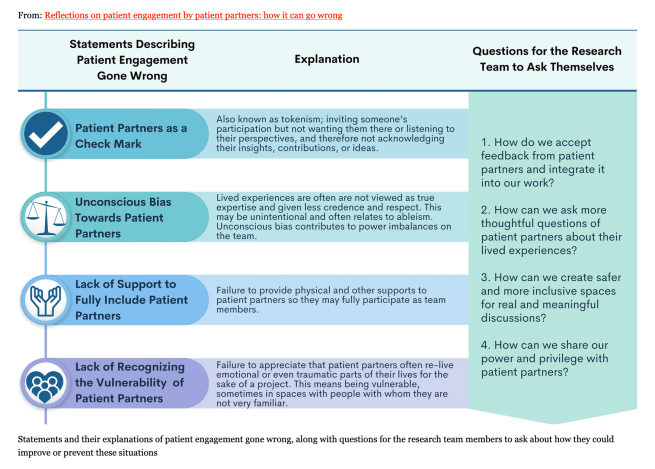
Those examples were summarized in four commonly reported statements by patient partners that also rang true for me in my own history of participating in meaningful patient engagement projects.
A few years after my 2008 heart attack, for example, I began volunteering with a newly-formed organization called Patient Voices Network (PVN).* Their broad goal is to foster patient engagement that “connects patients, family members and caregivers with projects led by teams within health authorities, health organizations and non-profits that seek to include patients’ perspectives.”
I love this kind of pro-active healthcare engagement concept. My volunteer PVN assignments over the years have ranged from participating in focus groups that enlist patient opinions about healthcare concerns to meeting with researchers or other healthcare stakeholders who have requested a patient partner’s perspective. The goal in all interactions is to help improve healthcare.
Here’s a recent PVN example: earlier this month, I was invited to volunteer for a 1-hour Zoom call with four nursing students in Vancouver whose group project was to interview a patient partner about personal experiences with hospital nurses. I shared with them some favourite stories of my wonderful (and not-so-wonderful) nursing encounters, and I was so impressed by the quality of their questions and the wisdom of their reactions to each story. I loved every minute of our time together. The nursing students learned from me – and I learned that the future of nursing care is in good hands.
Like this interview, most of my other PVN encounters have been mutually positive, but when I read the recent paper from Dr. Richards and her team, I could also relate to those four statements they listed – because I’ve encountered them, too. They were:
1. Patient partners as a check mark: also called tokenism – essentially “inviting patient partners to participate but not wanting them there or listening to their perspectives”
I recall one PVN assignment invitation from a group of provincial government employees who were working on a slide presentation for an upcoming public event on women’s heart health. Because none of them had experience with heart disease, they specifically requested a heart patient partner to review their slides. The first thing I noticed when they turned on the slide show was that it was already a completely finished project (very little room for patient input if it’s already a sewn-up done deal). My only role there seemed to be to tell them how great the slides were, so they could check off the “Patients Included” tickbox. And when I pointed out an obvious spelling mistake on their very first slide title, the group seemed annoyed about having to go back into the draft version to make the correction. By the time we got to the 10th slide, I already had a list: punctuation, construction and factual errors. The early high-fiving mood in the room had now evaporated.
But why waste a patient’s time asking for feedback if you don’t really want feedback?
2. Unconscious bias toward patient partners: “The lived experiences of patients are often given less credence and respect, and are not viewed as true expertise.”
In 2018, I volunteered for my first (and last) PVN “external” (third party) assignment. This involved a site visit to an upscale downtown Victoria ad agency which had landed a plum contract to create a new patient website for our provincial Ministry of Health. At first, this assignment seemed like a natural fit for me because of my long career in public relations and communications – which had included creating and launching a number of websites. The (very young) hipsters who worked in the ad agency wanted to know if the average patient could easily navigate the new website they were ready to launch. The hipsters sat me down at a computer in one of their brick-lined offices and handed me a printed list of search challenges. Their navigation site map was cumbersome (requiring multiple clicks to reach any given target topic). But since I was already there, I also checked out their site page that featured alphabetical listings of medical conditions. I typed “heart disease” into the search box under H.
Nothing! No results! I could find hay fever, and hemorrhoids, and hepatitis – but not our #1 killer. Nothing under C for “cardiovascular” either. When I pointed out this omission, the hipsters just stared at me. It was a crazy-making volunteer experience for me, because I realized that the 90 minutes I’d just spent trying to improve their site was in fact protecting the hipsters from being embarrassed by sloppy work before submitting their final project invoice to us taxpayers. (I wrote more about this specific patient partner assignment in How a $5 Tim Hortons Gift Card Changed My Life).
3. Lack of support to fully include patient partners: “Support to fully engage patient partners on teams may range from something as seemingly simple as the time of day meetings are hosted, to having a budget to reimburse expenses, or training for patient partners, or technology supports.”
At one memorable PVN workshop, patients were asked the question: “Should patient partners be financially compensated for their participation?” The discussion was lively, except when those patients who spoke in favour of supporting compensation were repeatedly interrupted by the two (paid) PVN facilitators with questions like: “But wouldn’t it be INSULTING to patients if we offered you money?” It almost seemed that the actual purpose of this workshop was for facilitators to somehow stickhandle the vote against future compensation. At one point, an exasperated patient partner in our group finally stood and said to the pair up front: “Go ahead! PLEASE INSULT ME!”
4. Lack of recognizing the vulnerability of patient partners: “Trained professionals on research or healthcare teams may not have experienced healthcare in the same ways that patient partners have. But patient partners must usually work much harder to have their lived experiences valued.”
Every PVN assignment that I’ve ever accepted included one basic condition: that I would be able to participate in morning assignments only. I had to learn this painful lesson about pacing myself years earlier – because I’m a heart patient with ongoing daily symptoms of coronary microvascular disease (chest pain, shortness of breath, crushing fatigue). I usually need to explain to project organizers that I’m like a balloon with a tiny pin hole in it. I tend to feel remarkably perky and almost symptom-free in the early hours of the day, but by late-morning, the balloon is swiftly deflating. Yet despite this disclaimer that safeguards my health, I’ve had morning meetings changed to late afternoon (convenient for paid staff) or evening focus groups (ditto) or revised project plans that would have required an impossibly exhausting car/ferry/public transit out-of-town day trip ordeal from my island home to the mainland and back. That’s the pesky thing about inviting patient partners: patients often feel awful.
As this month’s publication of the “Reflections” paper concluded:
“The experiences we describe are unfortunately a little-discussed part of patient engagement. They can leave mostly invisible impacts on patient partners, e.g.
- mental and physical exhaustion
- worsened health
- questions about the worth of engagement
- a feeling of failure (e.g., failed the team, failed patient communities, and failed overall to achieve personal goals or motivations)”
This paper was written by six authors, each with lived experience of partnering with healthcare professionals: Dr. Dawn Richards (Toronto), Sabrina Poirier (Halifax); Vina Mohabir (The Hospital for Sick Children, Toronto); Laurie Proulx, Canadian Arthritis Patient Alliance (Ottawa); Sue Robins, Bird Communications (Vancouver); and Jeffery Smith, Patient Partner for Myalgic Encephalomyelitis Research (Toronto).
♥
* Patient Voices Network is administered in my province of British Columbia, Canada by the B.C. Patient Safety & Quality Council, whose goal is a lofty one indeed: “to shift culture, improve clinical practice and advance person- and family-centred care to support high-quality care for every person in our province.”
.
Q: What kind of experiences have you had as a patient partner volunteering among non-patients?
.
♥ NOTE FROM CAROLYN: I wrote more about the mutual benefits of patient partnerships in my book A Woman’s Guide to Living with Heart Disease (Johns Hopkins University Press). You can ask for this book at your local library, your neighbourhood bookshop (please support your favourite independent booksellers) or order it online (paperback, hardcover or e-book) at Amazon. And if you order it directly from Johns Hopkins University Press, you can save 30% off the cover price by using their code HTWN when you make your purchase.
 Heart Sisters
A very interesting exploration of this topic. Thank you for sharing!
LikeLike
Glad you liked it, Wayne!
LikeLike
I have to say that sometimes I feel that every encounter with a new physician is me, as a patient partner, volunteering among non-patients. I have at various times experienced all 4 of the statements you mention:
… I have felt checked off on the list of appointments my doctor had for that day
… I have felt bias against my wealth of knowledge as a patient with health care experience
… I have felt a lack of support for the time and effort I put in to tests, appointments, consults procedures etc.
… I, like you, have a window of time 11am-3pm where my medications are most effective and my fatigue is the least. A window where tests procedures and appointments are often not available.
Don’t get me wrong. Every encounter with a new physician is not this way. But it often feels like when a doctor or even another health care worker walks into the room they feel that what THEY need as far as information or THEIR time or THEIR routine, are all much more important than mine. Sometimes it has even felt that just my being there was interfering with their day!
Each individual health care provider, or researcher. or software developer, whether alone or in a group, needs to start by seeing ‘the patient” as a human being and be truly interested in that person’s welfare rather than their own.
It all boils down to a single issue that affects every aspect of society:
Selfishness versus Selflessness
LikeLiked by 1 person
Hello Jill – I love that analogy of you meeting a new doc as the patient walking into an encounter of non-patients!
Not only are you a patient with a wealth of knowledge but you’re a retired nurse who comes with all that built-in health care experience. I used to assume that if a nurse or doctor get sick, they’ll somehow automatically get preferential treatment compared to the rest of us great unwashed out here. But I’ve heard of many healthcare professionals who say just the opposite e.g. Dr. Itzhak Brook‘s book “My Voice” about his own experience as a physician facing throat cancer and a laryngectomy. He writes about his own helplessness:
“On one occasion, I asked a senior resident to clean my obstructed tracheotomy tube. He reluctantly complied, but did it without using a sterile technique and flushed the tube using tap water. The tube he wanted to place back was still dirty, and when I asked him to clean it better, he abrasively responded: ‘We call the shots here!’ and left my room.”
I don’t know whether that example of pure cruelty is based on some kind of twisted turf war or not, but there’s a patient who indeed felt that bias against his “wealth of knowledge”.
So it’s not just me who notices that selfishness and entitlement and blatant privilege seem to be running rampant these days. . . *sigh*
Take care. . . ♥
LikeLike
The truth is medical doctors are not taught how to clean tracheotomy tubes. The resident’s answer should have been “I am sorry, I have not been taught how to care for tracheostomy tubes. I will go find a nurse who can take care of it properly for you.”
THEN he should have stayed and watched how it’s done!
LikeLiked by 1 person
I agree completely – that’s what the resident SHOULD have said, but honestly I don’t hold out much hope that a person who says “We call the shots here!” to a distressed patient will ever be that enlightened. . . 😦
LikeLike
I’m thinking every doctor and every nurse needs a hands-on course called “Understanding the Patient Experience”
Including such things as sitting in an office trying to explain their pain to someone who doesn’t believe them. . .and lying in a bed with IVs in both arms, restraints, a catheter and the inability to speak or reach the call light that fell on the floor.
Many people do not seem to have the ability to empathize unless they have had the direct experience themselves.
LikeLiked by 1 person
Hi Jill – I suspect that all medical and nursing schools will claim that compassionate communication skills are very very important to teach their students. But researchers tell us that empathy scores in med students generally tend to decline by 3rd year no matter how they start off.
I have heard about smaller schools (like Brody School of Medicine at East Carolina University) which is nationally ranked #1 in graduating doctors who go on to practice family medicine in rural and under-served areas. I may be biased – maybe I would just like to believe that deciding to practice in rural and under-served areas might mean you’re a more naturally empathetic clinician.
And I do like your “Understanding the Patient Experience” class idea! ♥
LikeLike
Whoops! Sorry for all the spelling issues. Thank you for the corrections. I guess I’m not fully functioning yet! LOL
LikeLiked by 1 person
Can’t help myself – I’m an obsessive spelling tidy-er! ♥
LikeLike
Thank you!
LikeLiked by 1 person
You’re welcome, Joan!
LikeLike