by Carolyn Thomas ♥ @HeartSisters
In the last half of the last century when I was working in corporate public relations, I was invited to speak at a marketing conference for female entrepreneurs in the city of Kamloops, B.C.
During my 45-minute presentation, the audience response was terrific – lots of nodding and smiling throughout, and several thoughtful questions at the end – all clues that signal a speaker’s messages are landing as planned. On the plane heading home to Victoria from Kamloops after the conference, I pulled out the pile of audience feedback forms that I’d been given (old school: hand-written!) and I settled back in my seat to read them during my flight. One after another, the reviews were so nice. (One woman even wrote: “I want to marry Carolyn Thomas!”) The last review I read, however, was one that stopped me cold: .
“Her presentation was boring – a complete waste of my time. Not even close to what the conference program described. I learned nothing from her that I didn’t already know.”
That day, I had over 150 glowing audience reviews in my briefcase. But which one do you think I focused on afterwards?
Carrie Fox of Mission Partners wrote recently in her series called Finding the Words that we all want the words we use publicly to be heard, understood and maybe even remembered. She cites Oprah Winfrey’s 25-year TV talk show career – and her 37,000 interviews – including with some of the most famous people in the world:
“After every one of those 37,000 interviews concluded, the first question to Oprah from her guest (and often whispered) was almost always this one:
“Did that go okay?”
Carrie Fox believes that even for the most experienced public speakers, our reaction of “Did I do a good job? Did my message land as I’d hoped it would? Was I able to connect with my audience?” is a universal one.
I spent decades during my public relations career working in corporate, government and non-profit sectors while honing my public speaking skills on behalf of the organizations I was representing. I’d also taught public speaking classes at our local college, been an active Toastmasters member since 1987, and was a frequent judge at public speaking competitions. Which is merely to say: loads of speaking experience here!
But it was only after my heart attack and subsequent WomenHeart Science & Leadership patient advocacy training at Mayo Clinic in 2008 that I approached public speaking with a genuine fire in my belly.
What I learned at Mayo (essentially, how female heart patients are significantly more likely than our male counterparts to be under-diagnosed, and worse, even under-treated when appropriately diagnosed) – made that fire burn hotter. While many of my 44 Mayo classmates that year planned to lead ongoing WomenHeart support groups for heart patients once they returned home, I knew my own future would be speaking to groups of women on what I’d just learned about our #1 killer.
Since then, my heart presentations have evolved into three basic types of presentations:
1. Pinot & Prevention parties
A few weeks after returning to Canada from Mayo Clinic, I started what I called “Pinot & Prevention” talks – free 90-minute Friday evening potluck events where I covered women’s unique cardiac risk factors, symptoms, treatments and outcomes with 15-20 (or more) women in the living rooms of friends, neighbours and colleagues.
The P&P invitations that our hosts forwarded to their guest list requested just two things:
- “Wear red!”
- “Bring wine or a heart-healthy appetizer to share! “
Almost immediately, these Friday night P&P potlucks were booked up 3-4 months in advance – through word of mouth alone.
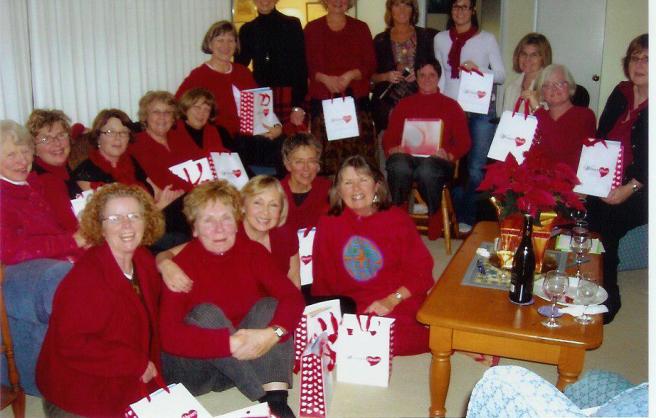
I loved doing these talks, yet could still scarcely believe that any woman would drive across town on a dark and stormy night to listen to somebody talk about heart health!
These talks were highly interactive, packed with the new info I’d learned at Mayo, and surprisingly fun. One reviewer described them as “Part cardiology bootcamp – and part stand-up comedy!”
But during that first year of P&P events, I was not only a heart patient who had survived a misdiagnosed “widow-maker” heart attack. Now, I had also been diagnosed with the increasingly debilitating symptoms (chest pain, shortness of breath and crushing fatigue) of coronary microvascular disease.
 All I knew was that it was getting harder to force myself out the door on each scheduled evening, lugging boxes of WomenHeart information handouts packed into our spiffy Red Bags of Courage, then getting through 90 minutes of heart stuff, packing up the boxes, bone-weary by now – and worse, feeling wiped out for the next two days.
I realized after one dreadful P&P evening that I was no longer able to continue doing my evening talks. That fateful night, I was already feeling exhausted when I first arrived, and I just couldn’t keep the audience engaged. One of the women, for example, changed the subject entirely because she wanted to tell us all about her husband’s medical condition. Despite my repeated efforts to guide the evening’s topic back to wome n’s heart health – the reason we’d all shown up! – I knew I was losing the group. I finally dragged myself back out to the car, and I cried all the way home. It had been many years (at a memorable after-dinner speech to hundreds of drunken Rotarians) since I’d encountered what is every public speaker’s basic nightmare: losing your audience.
Well, I didn’t exactly “realize” right away that I couldn’t do this anymore – until the day after the dreadful P&P event, when my friend Heather asked me directly:
“What are you trying to prove?
“You’re a heart patient with ongoing symptoms! Why do you keep saying YES to these late night invitations to speak?”
Why indeed?
At that moment, I made a decision (thank you, Heather!) to cancel all future evening talks I’d already booked, and to focus only on morning presentations – when my brain actually seems to still function relatively well. See also: Why “NO” is a complete sentence
Saying “NO!” to evening invitations turned out to be a wise self-care decision that led to my second most common type of presentation:
2. Community presentations
From then on, I started presenting free daytime-only talks I called Heart-Smart Women, which I delivered to women’s groups, service club meetings, healthcare professionals, community organizations, workplace Lunch & Learns, etc.
I also learned right away that it takes the same amount of energy for me to speak to a big crowd in a big auditorium as it does to small groups of women in small living rooms – and in fact, often far LESS energy. An audience of hundreds can somehow create its own fun crowd buzz even before I walk onstage. And since my primary goal has always been to share what I’d learned about women’s #1 killer with as many women as possible, speaking to larger audiences makes sense.
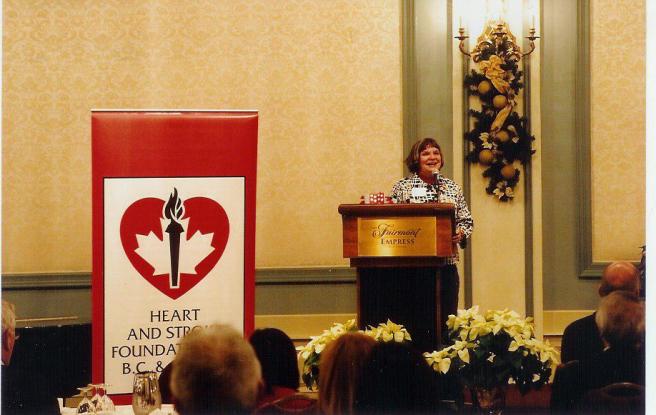
For five consecutive years, for example, one of my favourite examples of this was an annual Saturday morning coffee-and-muffins public talk I presented at the University of Victoria every February to celebrate Heart Month. We called it Cardiac Café. I learned over the years that many women were returning every February for this event!
3. Zoom Conferences
At the beginning of the COVID pandemic, public presentations were of course cancelled early on. Enter the online Zoom presentation.
Zoom presentations lack what I love most about public speaking: the live connection between me and my audience. I still have trouble “reading the room” of tiny faces on a screen. Sometimes, I too wonder afterwards:
“Did that go okay?”
Zoom did, however, open up a new kind of audience event: big conferences. I started getting invitations to virtually share my patient perspective as part of conference discussion panels – typically, panels had 3-4 professionals speaking – plus me, the heart patient.
As a panelist, I’ve also had opportunities to observe these cardiologists, academics and researchers delivering their presentations online.
The most remarkably consistent feature – especially with general public audiences – is this: almost all of these professionals speak as if they believe the women in the audience have been to medical school. Hence the first rule of public speaking: KNOW YOUR AUDIENCE!
For example, at one Heart Month presentation, I heard a cardiologist repeatedly using terms like “lipid panel” to our general public audience – instead of simply translating that medical-ese to patient-friendlier terms like “cholesterol tests.”
NOTE FROM CAROLYN: In case you do want to know what a lipid panel is, visit my 9,000+ word jargon-free glossary of common (yet often confusing) cardiac terms.
Getting our message across matters – from healthcare conference presentations to MC’ing your cousin’s wedding. No matter the audience or the topic, there’s a key message waiting to land. And as Carrie Fox reminds us, we all want the words we use publicly to be heard, understood – and maybe even remembered.
Megaphone image: Mohamed Hassan, Pixabay
♥
NOTE FROM CAROLYN: In my book A Woman’s Guide to Living with Heart Disease, I shared what I learned during my Mayo Clinic training, plus interesting patient narratives and emerging research since then. You can ask for this book at your local library or favourite bookstores (please support your local independent booksellers!) or order it online (paperback, hardcover or e-book) at Amazon – or order it directly from my publisher Johns Hopkins University Press (use their code HTWN to save 30% off the list price when you order).
.
Q: What was the best – or the worst! – public speaking experience you’ve had?
.
♥ Here’s a 4-minute clip on women’s priorities from one of my free Heart-Smart Women presentations
♥ Toastmasters International is a non-profit organization that helps us become better speakers, listeners and thinkers. Here are their tips on what makes a successful speech.
 Heart Sisters
When I read your article the first thing jumped out at me was the part about “dragging yourself” to that last meeting before you said No.
It brought back memories of a once a month service project I was in charge of – a Saturday morning gathering of 15-20 people making 500 burritos for a homeless shelter. It involved me purchasing and delivering to the site 500 tortillas, 6 gallons of salsa, 15 lbs of shredded cheese and 7 industrial cans of refried beans. Then opening them and putting them in bowls etc.
WHAT WAS I THINKING? I couldn’t leave my house for days afterwards I was so exhausted.
Turning the project over to someone else was one of the best days of my life!
I am not a natural large group speaker but prefer small groups and one-on-one.
When I was an assistant professor of nursing, I would be sleepless the night before a lecture on a new topic that I hadn’t given before. My greatest fear was that someone would ask me a question I couldn’t answer. It was years before I realized that there will always be a question I can’t answer and it’s okay to say I don’t have an answer but I can get back to you.
Blessings! ❤️
LikeLike
Hello Jill – Wow! I had to go have a wee lie-down just reading about you dealing with 6 gallons of salsa, 15 lbs of shredded cheese and 7 industrial cans of refried beans. I think most people don’t truly appreciate how much dedicated WORK goes on behind the scenes for hours to make what they might consider to be a simple lunch!
Not being able to leave the house for days afterward while recuperating from that generous commitment should have been our first clue – loud and clear – for both of us that this kind of workload was just TOO MUCH! I suspect that I told myself that I “need” to keep going no matter the personal cost because this was “my” project! It amazes me that the world managed to continue spinning on its axis even after I started saying NO. 😉 And every time we say NO to something that’s sucking the life right out of us means we have time and energy for something better.
I really like your observation that OF COURSE there will always be audience questions we can’t answer “but I can get back to you!” That takes the pressure off in case we start believing we must be perfect!
Thanks for sharing your unique perspective!
Take care . . .❤️
LikeLike
Yes, the thought that we are sooooo special and irreplaceable to our students and projects is certainly a misplaced sense of pride and ego on our part.
After all we are of no use to anyone if we are dead from exhaustion! LOL
LikeLike
Completely true! It’s like the classic poem about pushing your hand into a bucket filled with water to find out if you are indispensable or not…
🙂
LikeLike