

by Carolyn Thomas ♥ Heart Sisters (on Blue Sky)
A study published by Swiss researchers suggests that a culture of kindness in health care has a positive impact on healthcare organizations, healthcare staff, and – best of all! – patients.(1) If we’re very lucky, many of us already know those benefits because of our lived experience with kind healthcare professionals. One of my own favourite examples of a small kindness that left a huge impression was the cardiac nurse who trotted alongside my hospital gurney – from the Emergency Department to the elevator taking us up to the cardiac cath lab during my 2008 heart attack – with her hand gently resting on my shoulder all the way. She assured me: “You’re in the right place now. We’re going to take good care of you.” If only every hospital patient was greeted that way.
In my limited experience as a breast cancer patient so far, I’ve observed healthcare professionals at either extremes of that culture of kindness.
I’ve encountered compassion at our Urgent Care Clinic which was so much more than expected that I was moved to tears of pure gratitude. And I’ve also encountered medical staff for whom basic compassion was clearly a foreign concept, coldly exhibited in a personality-free zone.
Speaking of compassion, it just so happens that last week, I was scheduled for a follow-up heart scan at the Nuclear Medicine clinic in our local hospital, a regularly scheduled appointment for me ever since I was diagnosed with invasive ductal carcinoma last spring.
But my last scan in that particular clinic back in August was such an unpleasant experience that I dreaded going back there, ever.
The most dreadful part for me during my August appointment had been the staff’s utter lack of effort in providing even minimal comfort during an extremely uncomfortable procedure. It required lying absolutely still on a plastic table (not a bed, not a gurney, but a hard plastic table). As a person living with painful arthritis, staying motionless for 60-90 minutes from start to finish on that cold surface was punishing. No pillows. No blankets. Not even a “Good Morning!” from the tech assigned to do my scan that day. The only thing he said to me were these two stern words of warning before starting:
“DON’T MOVE!”
By the time that August scan was finished, I was utterly exhausted by the relentless pain in my shoulders, in my back, and in both arms (which I’d been told to keep elevated overhead for the whole appointment). When it was finally over, it took two full days to recover from the arthritis flare.
No wonder I dreaded going back to that clinic room last week.
And that is why I phoned the clinic four days before my scheduled next appointment. I needed to clarify minor but important accommodations that the staff might be willing and able to provide in order to prevent the same pain I’d experienced in August. It made no sense to me, for example, that I wasn’t offered even the thinnest of blankets – so I thought I’d better step up to find out why.
I spoke to a very pleasant woman on the phone who listened carefully, and empathized with my painful issues during the August scan. She even asked what suggestions I might have to make my next appointment less distressing for me and for other future clinic patients. She enthusiastically assured me: “We never want any patient to dread coming into our clinic!” She also advised me that she would be forwarding my list of potential suggestions to all clinic staff. So here’s how I started my suggestion list as requested:
- Please provide an appropriate clinic space to minimize discomfort and maximize personal consideration (especially for patients suffering from arthritis or other mobility restrictions)
- If for some unknowable reason you MUST use a hard table instead of a proper bed, make sure you offer several cushy pillows and lots of soft blankets to counter the extreme discomfort of lying on a hard bare surface.
- if the procedure requires the patient to keep both arms raised overhead for the whole appointment, please come up with an appropriate way to comfortably support both arms of the patient to reduce severe joint pain.
- Because I have a port implanted in my chest (to replace the need for I.V.s), please contact the Nursing Department in advance to schedule a nurse who is trained and experienced in port access to meet me in the clinic for that procedure – which is the protocol for every other scan I’ve had in this clinic.
But when I arrived bright and early at 7:15 a.m. at the clinic last week, here’s what greeted me:
- No Nurse: Instead of seeing a nurse, I listened to a detailed explanation from the clinic supervisor about why the techs are not trained or able to access implanted ports. (Port patients already know all of this, of course – which is why I’d phoned the clinic four days earlier as usual to confirm the presence of a trained nurse on my appointment day).
- No list: As soon as I arrived for my appointment last week, the staff advised me they had no clue what “list” I was talking about. I explained my phone call with the friendly woman in their clinic four days ago who had assured me she would forward my notes to her colleagues. For some unknowable reason, she had not forwarded any notes to any staff.
- I knew that for many cancer patients already suffering relentless side effects of their treatment, pain relief and comfort mean everything. So why was minimal patient comfort not even on that clinic’s radar?
- Just when you might be feeling shocked by the way last week’s scan appointment was progressing (or not), here comes the surprise ending – and here’s the photographic evidence that made my day:
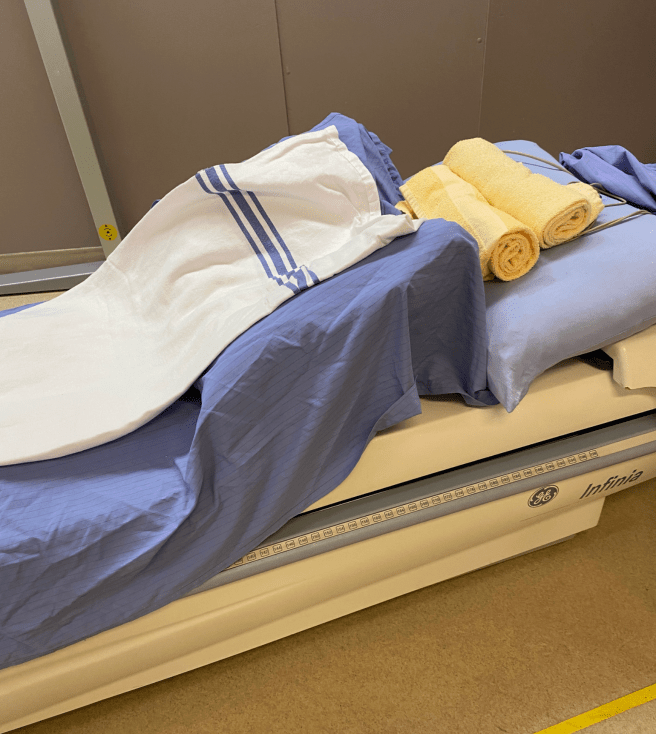
How kind healthcare professionals transformed an inappropriate table into a comfy pain-free appointment with a pile of blankets, pillows and towels. Thank you, techs!
Not only did the clinic staff provide pillows, warm blankets and rolled-up towels for extra padding on that hard table as I’d requested, but the supervisor dropped some shocking news: the only part of the scan that actually requires patients to lift both arms overhead was the final 10 minutes of the procedure.
The final 10 MINUTES!? Why on earth had I (and every other scan patient) been told during countless previous clinic appointments that patients must hold up both arms overhead during the entire scan? I suspect it’s the commonly known practice of “this is how we’ve always done it.” Somebody dropped that ball – and that ball needs to be recovered. Yesterday!
When healthcare staff start asking themselves the small question:“Do I want my patients to be comfortable or uncomfortable?” – that’s the culture of kindness that sees big results from small efforts to help every one of their future patients- not just the ones who speak up to point out gaps in care.
And as the Swiss researchers concluded:
“Studies across different settings have found that senior healthcare leaders need to foster not only technical and organizational skills, but also social skills such as empathy and kindness. The benefits of kindness include better patient outcomes, as well as a humanized work environment which also helps to prevent stress and burnout among healthcare staff.”
And that, dear reader, is what patient-centred care is about. Most hospitals have blanket warmers on every floor. Let’s move those warm blankets out of the warmers and onto more sore bodies whenever possible.
-
Greco A.et al. What’s the role of kindness in the healthcare context? BMC Health Services Research. 2025 Feb 5;25(1):207.
♥
Q: What small kindness has meant the most to you?
♥
NOTE FROM CAROLYN: In my book, “A Woman’s Guide to Living with Heart Disease“ (Johns Hopkins University Press), I wrote more about the power of kindness and compassion – no matter the diagnosis. You can ask for this book at your local library or bookshop (please support your favourite independent booksellers!) or order it online (paperback, hardcover or e-book) at Amazon, or order it directly from Johns Hopkins University Press. Use their code HTWN to save 30% off the list price when you order.
 Heart Sisters
The night nurse who cared for me after my surgery to ablate cardiac arrhythmia stands out for kindness and competence. She checked my femoral artery sites every hour, once calling her supervisor to double check her assessment.
Her touch was gentle but quite firm as it had to be and she announced early in the night, “You’re not going to bleed out on my shift!” I remember she was wearing scrubs with peace signs which amused me because I’d gone to nursing school in the days of pinstripes and pinafores. In nursing school, we’d been sent home from the ward if we were caught wearing small pierced earrings so the change over 50+ years was both significant and insignificant–the competence was the important thing. I’d been a hippie anti-war protestor so the peace signs amused me. I felt so safe with her.
LikeLike
Hello Sara – when a “hippie anti-war protestor” meets a nurse wearing peace sign scrubs, you know it was meant to be! I love a nurse or doctor who calls in experts when possible just to make sure the consult is accurate. Better safe than sorry – and it beats the alternatives, when doctors or nurses may not know but don’t want to admit they don’t. I wish The Emerg doc who confidently told me “You’re in the right demographic for acid reflux!” before sending me home with a misdiagnosed heart attack had only bothered to Google my symptoms. . . Since that fateful day, I find it very reassuring whenever another smart person is called in to discuss my condition! I’m glad you encountered that gentle-but-firm night nurse!
Take care. . .❤️
LikeLike
Over the years I have had a plethora of scans, procedures and hospitalizations. I don’t remember any of them being outstandingly unkind.
However, the small act of kindness that immediately comes to mind is from a 2-week stay in rehab after I broke my left shoulder. I had long hair then and every evening the CNA would come in and twist my hair into a top knot and clip it in place. So I was able to sleep without hot sticky hair clinging to my neck.
It was such a small thing that meant the world to me as I tolerated the pain of my arm and only being able to sleep on my back sitting up.
LikeLike
Hi Jill – I love that example: a patient who really needs help when she’s so uncomfortable – and a rehab staffer who offers to provide that help. It may have seemed like a small gesture to the casual observer, while you must have breathed a sigh of relief every evening!
Take care. . .❤️
LikeLike