
“You’ve done the right thing by coming here today”

by Carolyn Thomas  ♥  @HeartSisters

One of the most upsetting things about being misdiagnosed with acid reflux in mid-heart attack was the sense of pervasive humiliation I felt as I was sent home from the Emergency Department that morning. I had just wasted the very valuable time of very busy doctors and nurses working in emergency medicine. I left the hospital feeling apologetic and embarrassed because I had made a big fuss over NOTHING.

And such embarrassment also made me second-guess my own ability to assess when it’s even worth seeking medical help. Worse, feeling embarrassed kept me from returning to Emergency when I continued to be stricken with identical symptoms: central chest pain, nausea, sweating and pain down my left arm. But hey! At least I knew it wasn’t my heart, right?

I now ask those in my women’s heart health presentation audiences to imagine what I would have done had my textbook cardiac symptoms been happening to my daughter Larissa instead of to me. General audience opinion is that I, like most Mums, would have likely been screaming blue murder, insisting on appropriate and timely care for my child. But as U.K. physician Dr. Jonathon Tomlinson pointed out recently, even parents can feel insecure about their own ability to know what is a real medical emergency – and what is not – when it comes to their children. For example:     Continue reading ““You’ve done the right thing by coming here today””
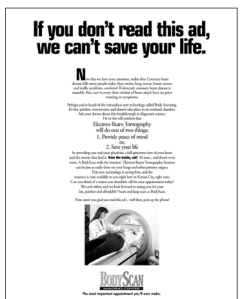
Heart scans: the triumph of profit over science

by Carolyn Thomas  @HeartSisters

This kind of ad is part of a growing marketing strategy to cash in on your fears. They’re run by for-profit hospitals, medical centres, and sometimes just non-professional entrepreneurs who park their huge mobile body imaging vans in church, community or big box store parking lots.

For example, an ad from the Heart Hospital of Austin in Texas reads:

“Find a new way to tell Dad you love him! Show your love with a HeartSaver CT Scan!”

The website Track Your Plaque warns:

“The old tests for heart disease were wrong – dead wrong. Heart scans are the most important health test you can get!”

A radio ad for the Princeton Longevity Center in Princeton, New Jersey asks:

“Does your annual physical use the latest technology to prevent heart disease before it strikes?”

And this center’s website further promises that its full-day exams – which include heart scans and usually are not covered by health insurance plans – can detect the “silent killers that are often missed in a typical physical exam or routine blood tests.”

Yet most major health agencies (like the American Heart Association, the American College of Radiology, the American Cancer Society) do not recommend routine use of heart scans in low-risk people without heart-related symptoms.  Continue reading “Heart scans: the triumph of profit over science”

Why patient stories actually matter

Most of our medical visits start with some variation of this opening question: “Why are you here today?” Connecting with and understanding patients thus requires doctors to listen to what’s called the patient narrative.  The importance of really hearing this narrative is beautifully described by U.K. physician Dr. Jeff Clark, writing in the British Journal of General PracticeBut the problem, as Dr. Clark reminds his peers, is that patients and doctors see the world in very different ways.  He also warns that the stories patients tell their physicians about why they’re seeking medical care may all too often be seen by doctors as merely a time-wasting distraction from “getting to the bottom of things.

The urge to get to the bottom of things may also help to explain what’s known as “The 18-Second Rule”.
Continue reading “Why patient stories actually matter”

Misdiagnosis: is it what doctors think, or HOW they think?

As a heart attack survivor who was sent home from the E.R. with a misdiagnosis of indigestion despite presenting with textbook symptoms (central chest pain, nausea, sweating and pain radiating down my left arm), I’m pretty interested in the subject of why women are far more likely to be misdiagnosed in mid-heart attack compared to our male counterparts.

Dr. Pat Croskerry is pretty interested in the subject of misdiagnosis, too. He’s an Emergency Medicine physician, a patient safety expert and director of the critical thinking program at Dalhousie University Medical School in Halifax. In fact, he implemented at Dal the first undergraduate course in Canada about medical error in clinical decision-making, specifically around why and how physicians make diagnostic errors. Every year, he gives a deceptively simple critical thinking quiz to his incoming first-year med students.*

So here’s your chance to practice thinking like a doctor. Try answering these yourself, but as Dr. Croskerry advises, don’t think too hard. If you were an Emergency Department physician, paramedic or first responder, he warns, you’d have only seconds to size things up and make a decision. Don’t read ahead to peek at the answers! Now, here are your questions:   Continue reading “Misdiagnosis: is it what doctors think, or HOW they think?”