

The days are long, but the years are short: being present is good for your heart and your life

by Carolyn Thomas    @HeartSisters

New York City writer Gretchen Rubin is author of the Happiness Project, an account of the year she spent test-driving every imaginable published study or popular theory about how to be happier.

She also created this short yet touching film, part exquisite photo tour of New York City, but part important life lesson as well. It’s the simple yet profound story of a mum taking her little girl to school on the bus.  Like me, you’ll want to forward this to every parent you know.

The life lesson here, however, is not just important for parents.

As a woman living with ongoing cardiac symptoms, I’ve had to learn and re-learn this lesson the every day, over and over. More than mere ‘stop and smell the roses’ sentiment, Rubin’s tiny slide show urges us to be present for even the smallest task of daily life – yes, even the ones we dread doing.

Please watch The Days Are Long, But The Years Are Short

(Originally published on Heart Sisters on December 22, 2009)

NOTE FROM CAROLYN:   My book, A Woman’s Guide to Living With Heart Disease is available at your local library or favourite bookstore (please support your local neighbourhood shops!) You can also order it online (paperback, hardcover or e-book) at Amazon – or order it directly from Johns Hopkins University Press (and use their code HTWN to save 30% off the list price).

.

Denial and its deadly role in surviving a heart attack

by Carolyn Thomas       @HeartSisters

Dr. John Leach is one of the world’s leading experts on what’s known as survival psychology. He likes to tell a story about London’s King’s Cross underground station fire in 1987. As the fire spread, trains kept on arriving in the station, and hurried commuters headed right into the disaster.

Officials unwittingly directed passengers onto escalators that carried them straight into the flames. Many commuters followed their routines despite the smoke and fire, almost oblivious to the crush of people trying to escape – some actually in flames! Thirty-one people perished in the King’s Cross fire, and incredibly, the Underground staff never sprayed a single fire extinguisher or spilled a drop of water on the fire.

Dr. Leach, who teaches at Lancaster University, has a name for this phenomenon. It’s called the incredulity response. He explains that people simply don’t believe what they’re seeing. So they go about their business, engaging in what’s known as normalcy bias which is incredibly powerful and sometimes even hazardous. People can act as if everything is okay, and they underestimate the seriousness of danger. Some experts call this analysis paralysis.

What he’s describing is precisely how I felt while undergoing two weeks of increasingly debilitating cardiac symptoms before being finally hospitalized. Although all signs clearly pointed to a heart attack – crushing chest pain, nausea, sweating and pain radiating down my left arm – I seemed fatalistically determined to go about my life acting as if everything was fine, just fine until – when symptoms became truly unbearable – I finally returned to the Emergency Department that had sent me home two weeks earlier with an acid reflux misdiagnosis. Continue reading “Denial and its deadly role in surviving a heart attack”

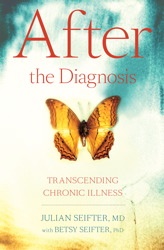
“After The Diagnosis”: two books, same title, one hope

by Carolyn Thomas    ♥  @HeartSisters

A never-married Catholic priest offers marriage counselling to couples. A childless shrink spouts advice on how to raise toddlers. Oprah Winfrey talks about money problems. “You have no clue!” – I want to scream at them. As a heart attack survivor, I now tend to gravitate towards those who are able to practice what they preach based on actual personal experience – not what they have learned at arm’s length. Clinical psychologist Dr. Elvira Aletta, for example, has been diagnosed with not one but two chronic diseases. Dr. Stephen Parker is a cardiac psychologist who is also a heart attack survivor.

And recently, I’ve come across two authors of books on coping with chronic illness that, ironically, share the same main title, After The Diagnosis:

  • Kidney specialist and Harvard prof Dr. Julian Seifter was diagnosed with Type 1 diabetes when he was a young medical intern.
  • Dr. JoAnn Le Maistre received her PhD in clinical psychology, delivered a baby daughter, and learned she had multiple sclerosis  – all within a few months.

What these authors have to share with heart attack survivors and others diagnosed with a chronic illness is quite profound. Here’s why: Continue reading ““After The Diagnosis”: two books, same title, one hope”

“Stress creep”: are you like the frog in the pot of boiling water?

Guest post, originally broadcast on WBFO Radio by Dr. Elvira Aletta:

“I’m sure you’ve heard that if you boil a pot of water and throw in a live frog, that frog will hop right out, saving his life to croak another day. If, on the other hand, you place a frog in a pot of cold water and turn the heat up slowly, that frog will stay in the pot. The frog will not jump out.

“Instead, he will slowly get used to the increasingly hot water until it boils to death. Truth or urban legend? To prove it, I’d have to cook a live frog – and that’s not going to happen! It sounds true,  so it should be because of what it teaches us.   Continue reading ““Stress creep”: are you like the frog in the pot of boiling water?”