Handling the homecoming blues: the third stage of heart attack recovery

by Carolyn Thomas  @HeartSisters

Today we look at the third stage of The Four Stages of Heart Illness from Dr. Wayne Sotile’s excellent book called Thriving With Heart Disease, a must-read for all heart attack survivors and those who love them. Dr. Sotile, a cardiac psychologist, describes the heart patient’s journey through a series of “separate, identifiable stages”.  He believes that your recovery will have fewer surprises if you are familiar with these four stages and know what to expect.*


Stage 3:  Handling the homecoming blues: You’re suddenly on your own, reality sets in, and the whole team must adapt to its new normal.

You’re now home from the hospital, and you’re expected to surf a bewildering wave of emotions, anxieties and procedures. No longer are nurses and doctors checking, monitoring and calming you.  Now you have to decide what you can and cannot do, and you may feel under-qualified for the job.

What used to be simple is suddenly unbearably complex.  Making the bed, a doctor’s appointment or even a tuna sandwich can overwhelm you and bring you to tears. You feel childish and emotional and terribly alone – no matter how many people surround you at home.   Continue reading “Handling the homecoming blues: the third stage of heart attack recovery”

Surviving the crisis: the first stage of heart attack recovery

by Carolyn Thomas  ♥  @HeartSisters

How I wish I’d discovered Dr. Wayne Sotile’s wonderful book Thriving With Heart Disease while I was still a patient in our hospital’s Coronary Care Unit following my heart attack.

A large hint: if you or somebody you care about ever experiences a cardiac event, get your hands on a copy of this book before discharge from hospital.

The book’s second chapter is called The Four Stages of Heart Illness. Dr. Sotile, a cardiac psychologist, describes the heart patient’s journey through a series of four “separate, identifiable stages”.

These stages don’t always proceed neatly in sequences, but Dr. Sotile believes that your recovery will have fewer surprises if you are familiar with them and know what to expect.

Over the next few weeks, I’ll be exploring each of these four stages along the cardiac journey.

Stage 1:  Surviving The Crisis:  Illness strikes, and patient and family begin the journey.   Continue reading “Surviving the crisis: the first stage of heart attack recovery”

Emotions of the wounded heart

by Carolyn Thomas  ♥  @HeartSisters

“We connect with each other through our wounds.”

Rachel Naomi Remen

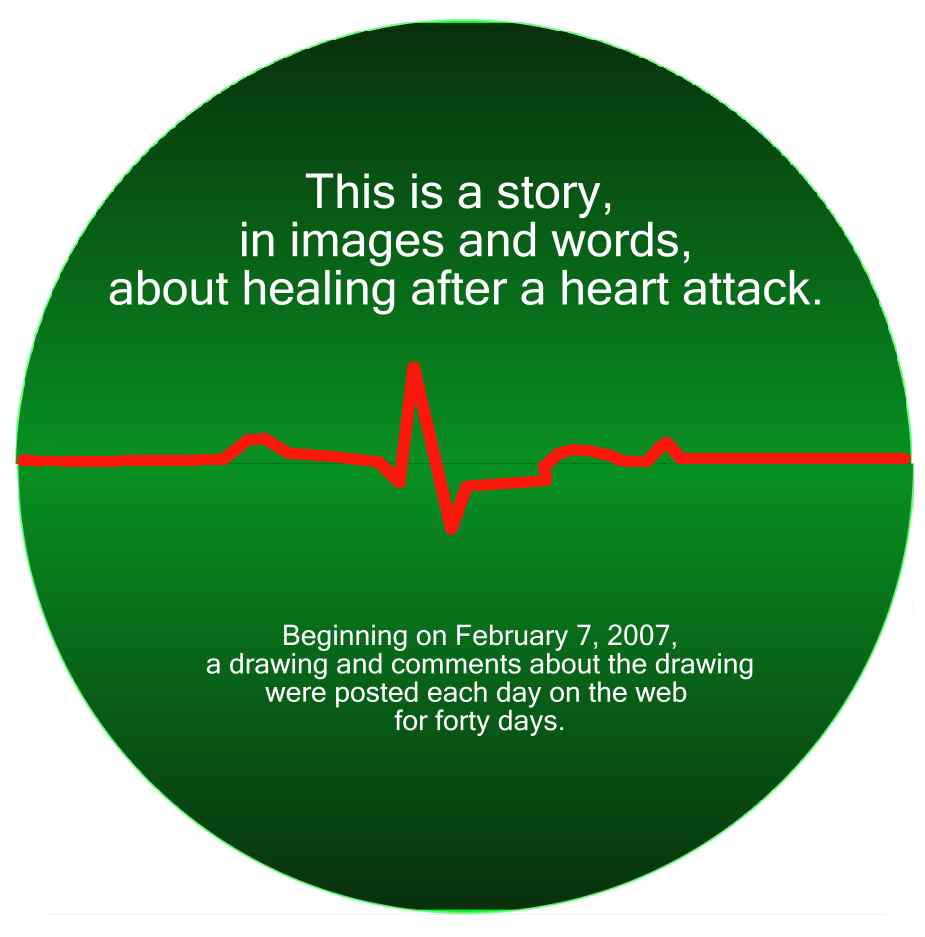
Right after his heart attack, Dr. Stephen Parker began an impressive project as part of his healing journey. The result is a compelling series of images that the Alaska clinical psychologist created over a 40-day period of recuperation.  The 40 drawings came first, and then his accompanying commentary, which then became a blog, and the blog then became a touring art exhibit called “Healing after a Heart Attack: Images of the Psyche”, and ultimately a book called Heart Attack and Soul.
Continue reading “Emotions of the wounded heart”

Got a minute? Try this mini-relaxation exercise for your heart health

by Carolyn Thomas  @HeartSisters

You’re waiting nervously in the dentist’s chair, or white-knuckling a bout of aircraft turbulence, or getting ready to deliver that big presentation at work – or even just wondering how you’ll remain sane given all you need to do between now and Christmas! – and you can already feel the stress tightening its death grip on your whole body, thus increasing the levels of stress hormones that are now coursing through your bloodstream. Not good for your heart!

Instead of tensing up, practise three mini-relaxation techniques, courtesy of Harvard University Medical School’s newsletter Healthbeat, so that you’ll be ready to try them even when time is tight.

When you have only 1 minute:

  •  Place your hand just beneath your navel so you can feel the gentle rise and fall of your belly as you breathe. Breathe in slowly. Pause for a count of three. Breathe out. Pause for a count of three. Continue to breathe deeply for one minute, pausing for a count of three after each inhalation and exhalation.

When you have only 2 minutes:

  • Count down slowly from 10 to zero. With each number, take one complete breath, inhaling and exhaling. For example, breathe in deeply saying “10” to yourself. Breathe out slowly. On your next breath, say “nine,” and so on. If you feel lightheaded, count down more slowly to space your breaths further apart. When you reach zero, you should feel more relaxed. If not, go through the exercise again.

When you have only 3 minutes:

  •  While sitting down, take a break from whatever you’re doing and check your body for tension. Relax your facial muscles and allow your jaw to fall open slightly. Let your shoulders drop. Let your arms fall to your sides. Allow your hands to loosen so that there are spaces between your fingers. Uncross your legs or ankles. Feel your thighs sink into your chair, letting your legs fall comfortably apart. Feel your shins and calves become heavier and your feet grow roots into the floor. Now breathe in slowly and breathe out slowly. Each time you breathe out, try to relax even more.


See also:   McGill University’s Centre for Studies on Human Stress for several tools to help cope with chronic stress.

NOTE from CAROLYN:   I wrote more about how chronic stress affects your heart in my book, A Woman’s Guide to Living with Heart Disease.  You can ask for it at your local library or bookshop, or order it online (paperback, hardcover or e-book) at Amazon – or order it directly from my publisher, Johns Hopkins University Press (use their code HTWN to save 30% off the list price).

.

Q: What has helped you cope with daily stress?