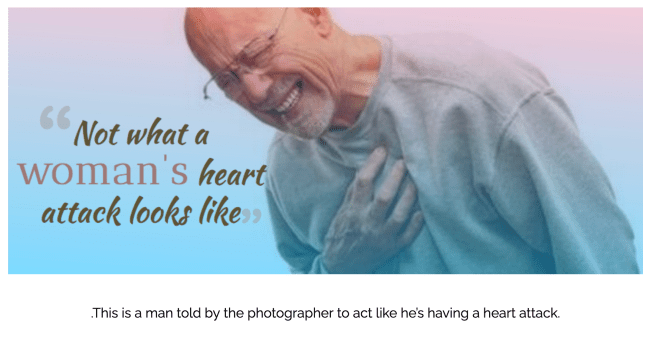

What I wish I knew back then: “Am I having a heart attack?” Part 1 in a new summer series

by Carolyn Thomas    ♥    @HeartSisters

Part of what made my “widowmaker” heart attack so frightening at the time was simply how much I did not know about what was happening to me. Like many women, if I ever thought about heart disease – which was approximately NEVER! – I considered it to be a man’s problem. And as a healthy woman in my 50s (and a distance runner for 19 years), becoming a heart patient one day was never on my radar.

“What I Wish I Knew Back Then”  is a new back-to-basics summer series of posts here on Heart Sisters that will revisit some of the most frequently asked questions from brand new heart patients. Today, we kick off the series with the very basic question that accompanies almost all frightening cardiac symptoms: “Am I having a heart attack?”         . Continue reading “What I wish I knew back then: “Am I having a heart attack?” Part 1 in a new summer series”

Patient partners share what can go wrong with patient engagement

by Carolyn Thomas    ♥   @HeartSisters

The late Dr. Jessie Gruman was a beloved pioneering activist in the person-centered care movement, the founder of the Center for Advancing Health (CFAH) and the author of the book AfterShock: What to Do When the Doctor Gives You — Or Someone You Love — A Devastating Diagnosis.  She once defined the concept of patient engagement as “the actions people take to support their health, and to benefit from their health care” – a simple yet accurate definition. In 2014, I was interviewed for a CFAH report on patient engagement – a document I later described as “interesting, illuminating and frustrating”  in my follow-up essay called Patient Engagement (As Described by 31 Non-Patients).  I learned back then that how patients view patient engagement and how non-patients view it can be miles apart. And a new paper published this month may help to explain how this gap can affect patients themselves. Continue reading “Patient partners share what can go wrong with patient engagement”

Women’s heart disease: is it time to hang up the Red Dress?

by Carolyn Thomas   ♥   @HeartSisters 

We were driving home around dusk when I noticed that the fountain at our beautiful provincial legislature buildings here in downtown Victoria was illuminated in bright purple light. I immediately guessed that the lights must be part of some kind of awareness-raising campaign – but awareness of what? I asked my friends in the car, but none of us knew why the fountain was now purple.

So I looked up “landmarks lit up with purple”.  I learned that lighting a landmark in purple raises awareness of pancreatic cancer – but that’s not all.  It’s also the colour that’s supposed to raise awareness of Alzheimer’s Disease, epilepsy, ADHD, domestic violence, lupus, testicular cancer, Crohn’s Disease – and probably many other such causes.
.
So how does seeing a PURPLE fountain really help to raise my awareness about anything?

Continue reading “Women’s heart disease: is it time to hang up the Red Dress?”

Did you learn about CPR from TV shows like Grey’s Anatomy?

by Carolyn Thomas  ♥  @HeartSisters 

Before my heart attack, much of what I knew about CPR (cardiopulmonary resuscitation) was learned by watching TV medical dramas like Grey’s Anatomy.  Researchers who study how television has impacted public opinion suggest that TV actors following their cardiac arrest scripts are heroically brought back to life by another TV actor pretending to perform CPR over 70 per cent of the time. (1)  Pulse restored, smiles of relief all around, and the cheerful patient and family heading for home while waving in gratitude to the brilliant hospital life-savers.

For real-life heart patients, however, we know that most people whose hearts suddenly stop don’t survive. Only about one-quarter make it out of the hospital alive. Of those survivors, the American Heart Association reports that nearly one-third are seriously disabled.(2) Continue reading “Did you learn about CPR from TV shows like Grey’s Anatomy?”