
 by Carolyn Thomas ♥ @HeartSisters
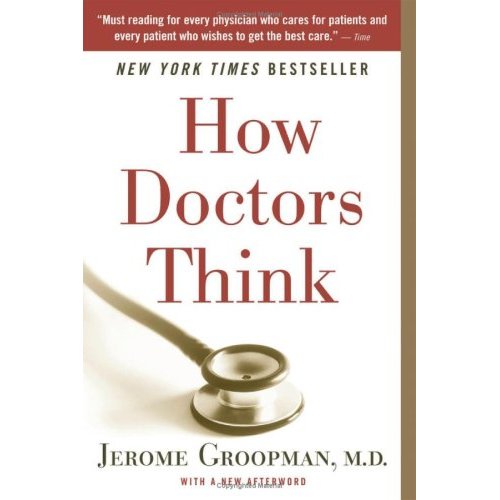
The trouble with Dr. Jerome Groopman‘s book, How Doctors Think, is that the docs who really need it won’t read it. But patients will, thanks to word-of-mouth buzz since it was published in 2007.
As a patient who has experienced a life-threatening misdiagnosis while having a heart attack, my own favourite part of the book is Dr. Groopman’s review of physicians who take cognitive shortcuts during patient visits.
This means that doctors can jump to conclusions about diagnosis or treatment options, and then can’t budge even when contradictory evidence subsequently emerges. “Blame the 18 Second Rule!” advises Dr. Groopman, professor of medicine at Harvard.
” That’s the average time it takes a doctor to interrupt you as you’re describing your symptoms. By that point, he/she has in mind what the answer is, and that answer is probably right about 80% of the time.”
Interruption is a pervasive communication style with doctors, adds Dr. Juliet Mavromatis, writing in ACP Internist. She cites two corroborative studies: one is a well-known 1984 study by Beckman and Frankel published in the Annals of Internal Medicine in which patients were allowed to complete their opening statement expressing their agenda in its entirety in only 23% of physician interviews. The average time to interruption was 18 seconds. This study’s findings have been replicated by several others. In a subsequent 2001 study of primary care residents published in Family Medicine, patients were allowed to speak for only 12 seconds on average before they were interrupted. Female patients experience interruption more frequently than males.
You may be saying by now:
“Well, Carolyn, as Dr. Groopman says, being right 80% of the time sounds like a pretty darned good track record, even if the doctor has jumped to conclusions and interrupted me after just 18 seconds!”
This may be true, unless of course you happen to be one of the poor misdiagnosed schmucks in that 20% group. Dr. Groopman adds:
“It’s not that doctors lack sufficient clinical knowledge, but are rather tripped up by their biases.”
Here’s how things can escalate once inaccurate bias comes into play, according to Dr. Groopman:
“Doctors are stumped by symptoms all the time. By prescribing the wrong medication, for example, they often worsen the problem or even create a new one. Worse, misdiagnoses lead to an astounding 40,000-80,000 hospital deaths every year according to the American Medical Association, plus an uncounted number due to mistakes in the doctor’s office. Some 5% of autopsies find a condition missed by doctors that, if treated, might have saved the patient’s life.”
Alarmingly, he describes the reality, actually researched at Johns Hopkins, that when doctors develop a dislike of a particular patient, they tend to shut down and close their minds.
“It’s a set up for misdiagnosis – you do not get good care.”
He uses the word ‘anchoring’ to describe one common form of misdiagnosis, and confesses his own telling example: as a young medical resident, he once made a hasty (and wrong) diagnosis of acid reflux for a female patient who presented with heart attack symptoms. In spite of her protests that his diagnosis wasn’t correct, the acid reflux diagnosis was now ‘anchored’ in his mind as he scooted her out the door. Two weeks later, he was paged when the same woman was admitted to hospital for emergency cardiac surgery.
This example, incidentally, is frighteningly similar to my own initial misdiagnosis of acid reflux, despite presenting with textbook heart attack symptoms like crushing chest pain, nausea, sweating and pain radiating down my left arm. Just as Dr. Groopman had experienced as a medical resident, the ER doctor decided immediately that my problem was merely acid reflux. “You’re in the right demographic for GERD!” he confidently pronounced.
I was sent home from the ER that morning, feeling very embarrassed about having made a fuss over nothing, with instructions to ask my family physician for indigestion meds. Two weeks of increasingly debilitating symptoms followed (but hey! at least I knew it was not my heart!) until I too was admitted to hospital for emergency treatment of a newly revised diagnosis of ‘significant heart disease’.
Dr. Perri Klass is one doctor who actually did read How Doctors Think, and wants other docs to read it, too. The professor of journalism and pediatrics at New York University says:
“I wish I had read this book when I was in medical school. Every reflective doctor will learn from this book – and every prospective patient will find thoughtful advice for communicating successfully in the medical setting and getting better care.”
Other errors occur when a patient is irreversibly classified with a particular syndrome, what Dr. Groopman calls “diagnosis momentum, like a boulder rolling down a mountain, gaining enough force to crush anything in its way.”
How Doctors Think is mostly about how doctors get it right, and about why they sometimes get it wrong.
Attribution errors happen when a doctor’s diagnostic cogitations are shaped by a particular stereotype. It can be negative, Dr. Klass explains, when doctors, for example, fail to diagnose an endocrinologic tumor causing peculiar symptoms in “a persistently complaining, melodramatic, menopausal woman who quite accurately describes herself as kooky.”
 But positive feelings can also get in the way, too, Dr. Klass says. A hospital Emergency Department doctor misses unstable angina in a forest ranger because “the ranger’s physique and chiseled features reminded him of a young Clint Eastwood – all strong associations with health and vigor.” In cardiac circles, we know that this kind of positive misdiagnosis is distressingly common. For example, research tells us that one in every 50 heart attack patients (both male and female) is misdiagnosed and sent home from Emergency. But if you’re a young woman suffering a heart attack, you are seven times more likely to be misdiagnosed and sent home with:
“You’re too young to have heart disease!”
Dr. Klass appreciated that the book’s patient stories are told with Dr. Groopman’s customary attention to character and emotion.
“There is great care and concern for the sense of life-and-death urgency in analyzing the well-intentioned thought processes of the highly trained, the ‘superspecialized’ – the doctors on whom the rest of us depend.”
What is it with medical specialists that make them prone to these ‘ambiguities’? Dr. Klass has a theory:
“Specialization in medicine confers a false sense of certainty. ‘How Doctors Think’ helped me understand my own thought processes and my colleagues’ – even as it left me chastened and dazzled by turns.”
So what does Dr. Groopman recommend to patients like me who are faced with a diagnosis that just doesn’t make sense – like that acid reflux error? He advises us to ask questions of the doctor, such as:
- ‘What else could it be?’ (especially if the problem is not going away)
- ‘Could two things be going on at the same time?’ (you can have both acid reflux and heart disease)
- ‘Is there any test result so far that might contradict your first impression?’
Stephen Dubner, author of Freakonomics, sums up his take on the book: “You’ll never look at your own doctor in the same way again – for better or worse.”
*Terrible, Horrible, No-Good Very Bad UPDATE: July 2, 2018:
In a new study published today in the Journal of General Internal Medicine, a research team led by Mayo Clinic’s Dr. Victor Montori found that in 67% of encounters in which clinicians elicited patient concerns, the clinician interrupted the patient after a median of 11 seconds! It’s getting worse – not better!
♥
NOTE FROM CAROLYN: I wrote much more about doctor-patient communication in my book “A Woman’s Guide to Living with Heart Disease“ (Johns Hopkins University Press). You can ask for this book at your local bookshop, or order it online (paperback, hardcover or e-book) at Amazon – or order it directly from Johns Hopkins University Press (use their code HTWN to save 30% off the list price when you order).
See also:
Misdiagnosis: the Perils of “Unwarranted Certainty”
When You Fear Being Labelled a “Difficult” Patient
Seven Ways To Misdiagnose a Heart Attack
Women’s Cardiac Care: is it Gender Differece – or Gender Bias?
Heart Attack Misdiagnosis in Women
.
 Heart Sisters
Great post – I always look forward to Sunday mornings and your weekly wisdom. Thanks Carolyn.
LikeLike
It’s not just women, but young people in general. As a 26 year old male going through serious cardiac symptoms at the moment, I’m not getting taken seriously at all, they are making it extremely difficult to get the tests that I need, and it feels like the tests that I have taken are given barely a glance.
LikeLike
You’re correct, Robert. While women are far more likely to be under-diagnosed (and under-treated even when appropriately diagnosed) compared to our male counterparts, men have told me that they too have sometimes felt unheard when reporting their own symptoms. One reader (a very fit firefighter) was dismissed by his own physician who simply refused to believe that such a big strong healthy man could be that sick.
Try keeping a symptom journal, noting the time of day/description of symptoms, what you were doing in the hours leading up to the symptoms, what made the symptoms ease up, etc. This will be a concrete report to show your doctor next time, and patients often recognize clear patterns in such a journal that can aid diagnosis. Good luck to you…
LikeLike
How frighteningly similar to your story, Carolyn!
I hope doctors read this book, and I hope too that we, as patients, recognize the importance of communicating our symptoms effectively to our doctors, and being advocates for our own health. Doctors are human after all, and we’re the ones who may not know what’s going on with our bodies, but know how we FEEL.
Another great article, C. 🙂
LikeLike
Hi Paula – I too wish that doctors would read this book – and patients, too. It would help all parties understand each other a bit better. It’s not only important to communicate our symptoms to our docs, but it’s even more important to educate ourselves about our own health, to pay attention to what feels “normal” vs. what doesn’t, and then not to take NO for an answer if we are not satisfied with our care.
Thanks again!
LikeLike
Tell me about it – if I had listened to the “Intern” the first time I went to the ER, I might not be here today!
LikeLike
Well, it’s a good thing you DIDN’T listen to that intern then! Trouble is, many of us (like me) take even a misdiagnosis very seriously if it comes from a person with the letters M.D. after his/her name.
LikeLike