

Once you visit Sal Khan‘s website, you’ll abandon Heart Sisters as well as all other sites you love, and may never come back. His Khan Academy is the thinking person’s version of those addictive cute kitty time-wasters on YouTube.
It all started a few years ago when the brainy and engaging young Sal was asked to help out his 6th grade cousin Nadia with her math.
.
He agreed to do some remote tutoring with her by putting together a helpful video for her to watch, using just colourful blackboard sketching and his own voice-over.
.
One helpful video led to another then another for the versatile Sal (who holds three MIT degrees as well as an MBA from Harvard Business School).
.
Before long, he had quit his plum job as a hedge fund manager and was working full-time producing these simple yet effective educational exercises and videos covering everything from arithmetic to physics, finance, and history – including this one I really like that explains heart attacks.
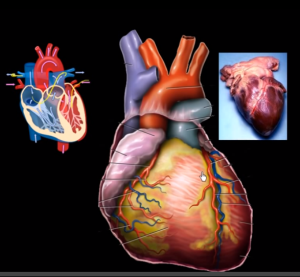 I’ve read and watched countless explanations of heart attacks designed for both professionals and patients – and this is one of the best.
 .
How does Khan do it? He apparently masters the specific subjects himself, and then teaches them! And one of the biggest fans of his free online school is one Bill Gates, who told Bloomberg Business Week:
.
“I see Sal Khan as a pioneer in an overall movement to use technology to let more and more people learn things. It’s the start of a revolution.”
The Khan Academy is a not-for-profit organization with the mission of providing a world-class education to anyone, anywhere.
.
♥ Need a translator for some of these cardiology terms? Visit my Heart Sisters patient-friendly, no-jargon glossary.
.
Q: What’s your take on this Khan Academy teaching video?
.
See also:
.
Why does your arm hurt during a heart attack?
How a heart attack turned me into an “information flâneuse”
Is sudden cardiac arrest the same thing as a heart attack?
Do you know the difference between V.T. and T.V? (my patient-friendly glossary of complex cardiology terms
 Heart Sisters
Nice tips shared. I believe fitness and diet play key roles in solving women’s heart problems. This information is adding great value to my health care.
LikeLike
Thanks for this post Carolyn. I am a visual learner so have been relying on Khan Acadamy for years….for any topic. It is available on my TV like Netflix, Amazon Prime channels. And free. His wife is a physician and signs off on his medical videos. He keeps them short too…..very helpful!
Maybe we can ask him to separate the first 2 acute cardiac events from the lengthy chronic saga of heart failure, including the distinction that heart failure may be caused by the swift onset of a viral attack.
‘Benign’, in medical terminology means ‘not immediately fatal’. The patient reality is drastically different and ‘benign’ has no context in daily reality of human quality of life. It is an unfortunate word choice because it appears to leave out the back-story baggage that comes with heart failure called ‘suffering‘.
One day they were fine, a week later they can barely walk, may have Ejection Fraction of 20. Thanks again.
Looking forward to future posts as always.
LikeLiked by 1 person
Hello Jaynie! You’re so right. There’s a difference between a word like “benign” (as doctors use it) and “benign” (as we might use it). As used here, it’s meaning is definitely “not immediately fatal” (as both heart attack and sudden cardiac arrest certainly can be).
Personally, I’d like to see a name change for the entire diagnosis of “heart failure” in the first place. Pioneer cardiologist Dr. Bernard Lown (Nobel Peace Prize recipient and author of The Lost Art of Healing) thinks so too, calling the name HF “words that hurt.“
LikeLike
You’re right, this is a wonderful explanation. I am one of those people who is confused by the terminology, and now I can say with confidence – I had a Myocardial Infarction leading to Cardiac Arrest. (My safe ground was to call it my “heart event”…). Thank you for posting this video!
LikeLiked by 1 person
You’re welcome, Sue. If you run across any other confusing terminology, check out my patient-friendly glossary of cardiac terms.
LikeLike
It’s very clear and informative. It should be distributed by cardiologists to patients. There needs to be more information disseminated. Thanks for posting.
LikeLiked by 1 person
I agree – I’d love to see doctors showing this to their patients!
LikeLike
The Khan video is very good. Thank you for giving the address.
For me personally it is easier to read about the scientific subjects than listen. But this heart video is easy to understand, because I know the subject. I would like to send it to a friend of mine, but he doesn’t understand English enough. He has 4 stents in his brain arteries because of plaque blockages. From one minute to another, he could not speak and was lucky to be brought into a stroke unit.
When I told him that sclerosis in arteries is a chronic disease like coronary artery disease, he did not believe me. He will not change anything in his life. Perhaps a video like Khan made could change his mind.
LikeLiked by 1 person
Hi Mirjami – I can understand how a diagnosis like your friend’s can be so overwhelming that it’s almost impossible to grasp the reality! Best of luck to him (and to you! Hope you are doing well…)
LikeLike
Thanks for sharing this video. It is a great way to help people understand something that is complex and abstract to those who don’t understand what is happening to them. My parents are a fine example of who could benefit from viewing it.
LikeLiked by 1 person
Hope you’ll show this to your parents, too!
LikeLike
Would hardly call Heart Failure “benign” when it is one of the biggest chronic diseases leading to the biggest number of admissions to hospitals in the Western world!
LikeLiked by 1 person
That’s true, Julie – although the exact context around heart failure here is: “out of these three things (heart attack, sudden cardiac arrest, heart failure), heart failure is probably the most benign, but still something you don’t want to have, and possibly an indicator that one of these other things might happen.”
LikeLike