
by Carolyn Thomas ♥ @HeartSisters
In an article published this week in the Ottawa Citizen, we learned some encouraging predictions about the future of women’s cardiac care here in Canada – and beyond. Award-winning health/science journalist Elizabeth Payne explained the news in her August 30th article called “New Ottawa-Based Initiative Aims to Close Heart Health Gender Gap“. In case you missed it, here’s what she wrote: (The NOTES below in italics are my own questions and comments):
Elizabeth Payne (EP): “Years after researchers, health professionals and advocates began working to reduce it, the gender gap in women’s heart health persists. Heart disease is the leading cause of death for women, but their cardiovascular symptoms are still not always recognized and women’s heart attacks continue to get missed.”
♥ NOTE FROM CAROLYN: I was sent home from Emergency despite my textbook ‘widow maker’ heart attack symptoms (central chest pain, nausea, sweating and pain down my left arm). I was misdiagnosed with acid reflux when all of my cardiac tests came back as “normal”. That was over 15 years ago! Yet in 2023, “WOMEN’S HEART ATTACKS CONTINUE TO GET MISSED”!?!? My question now: will this new grant fund important new diagnostic tools that will be appropriate for female heart patients? For more on researchers investigating why women in mid-heart attack are still being mistakenly told that their cardiac tests are “normal”, read what changes Vancouver researcher Dr. Karin Humphries recommends to improve the commonly used blood test for cardiac troponins.
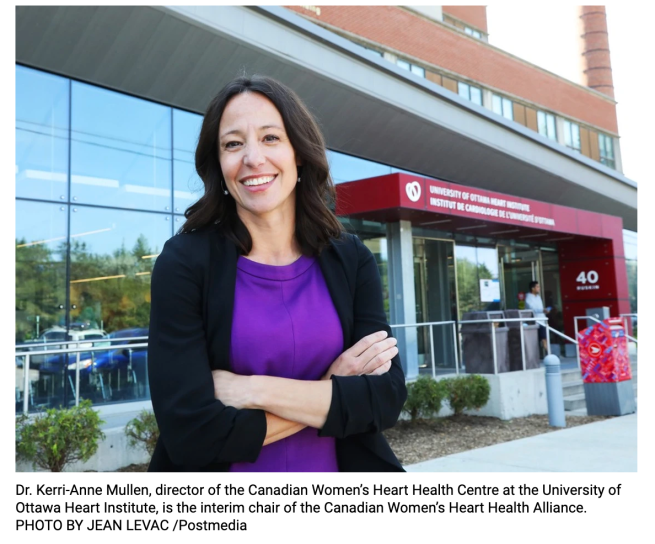
EP: “We hear the story far too often about women who have been turned away from the Emergency Department, about doubt by the woman herself about her symptoms, and sometimes doubt among healthcare providers,” says Dr. Kerri-Anne Mullen, director of the Canadian Women’s Heart Health Centre at the University of Ottawa Heart Institute.”
♥ NOTE FROM CAROLYN: Dr. Mullen is, sadly, correct. But in my case, a man with the letters M.D. after his name told me quite confidently that my cardiac symptoms were NOT cardiac symptoms. And the reason I believed him was that he conveyed absolutely zero doubt about his (wrong) medical opinion. I was so embarrassed for making a fuss over nothing, however, that I couldn’t get out of that Emergency Department fast enough, and it took two weeks of dangerously worsening symptoms before I could force myself to return.
♥ NOTE FROM CAROLYN: $840,000 (or $210,000 per year) is a healthy chunk of change for cardiac research. How does this grant compare with multi-million dollar women’s cardiac health research grants and, more importantly, with any practical results obtained from spending those funds? See also: Implementation Science: Should Research Actually DO SOMETHING?
EP: “In general, women present later than men with cardiovascular disease, but one-third of cardiovascular events in women occur before the age of 65 and these tend to be under-recognized, causing delays in diagnosis and poorer prognoses than in men. We have heard far too many stories of delayed diagnoses and women feeling that they are being treated differently than men.”
♥ NOTE FROM CAROLYN: My misdiagnosed heart attack also happened when I was in my 50s, which in the wonderful world of cardiology made me a “young” heart attack survivor. Speaking of women feeling they’re being treated differently than men during their heart attacks, one of my readers shared an overheard Emergency Department comment from an Emerg doctor to his (male) patient that exemplifies the difference: “All of your cardiac tests results came back normal, but we’re going to admit you for observation just to make sure it isn’t your heart.” Thus yet another man in the Emergency Department with symptoms but “normal” cardiac tests is admitted to the hospital – while I and countless other women with symptoms but “normal” cardiac tests are dismissed and sent home. That’s called treating women differently than men. How will this new grant affect the systemic bias that has allowed these differences to survive unchecked despite many previous cardiac studies that basically conclude: “Sucks to be female – better luck next life” ?
EP: “One of the Alliance’s first initiatives will be to get an algorithm that has been developed to improve recognition of heart attacks in women into more Emergency Departments across Canada.”
♥ NOTE FROM CAROLYN: I love the idea of improving the ability of all physicians to correctly diagnose women’s heart attacks, but whenever I hear healthcare professionals use words like “algorithms” to explain how something new will change healthcare as we know it, I get nervous. The medical profession, for example, already has best-practice published treatment guidelines in place for diagnosis and treatment of all cardiac events. And as cardiologist Dr. Sharonne Hayes (founder of the Mayo Women’s Heart Clinic) once warned a staff audience at WomenHeart: The National Coalition for Women with Heart Disease: “Right now, guidelines help women get the care that has been shown to improve survival and long term outcomes in large groups of patients. But the problem is that the guidelines are less likely to be applied to women compared to men. We know that when hospitals have systems in place to ensure they provide care according to the guidelines, women’s outcomes improve, even more than men’s.” But will the clinicians who are not applying existing guidelines be any more likely to embrace a shiny new algorithm instead?
EP: “Chest pain is the most common heart attack symptom in both men and women, Mullen says. But, while men often describe a ‘crushing’ pain, women tend to describe it as a dull ache or nagging pain and describe other symptoms, such as jaw pain, back pain, fatigue or excessive sweating. That can be confusing for women and for healthcare providers.”
♥ NOTE FROM CAROLYN: “Confused healthcare providers” are the reason I now advise the women in my ‘Heart-Smart Women’ presentation audiences to say loudly and firmly to their doctors: “I have chest pain. I think I’m having a heart attack!” – and then shut up. Because apparently, if I’m having chest pain PLUS nausea PLUS sweating PLUS pain down my left arm, it’s too confusing for doctors. And for more on how female heart patients tend to talk to doctors in the Emergency Department, read about the fascinating research of Harvard linguist Dr. Catherine Kreatsoulas. who reminds physicians that not all women use the words “chest pain” to describe their most common cardiac symptom. She’s witnessed women, for example, who both minimize their symptoms and even argue with Emergency docs: “Well, it’s not really chest PAIN. It’s really more like pressure. . .” But removing the words “chest pain” from a woman’s medical chart essentially means she can kiss a cardiac diagnosis goodbye.
EP: “The initiative comes at a time when there is an alarming trend in women’s heart health — an increase in deaths due to heart attacks in young women — which makes increased research, education and training more urgent than ever. A key to the Alliance is the involvement of women with lived experience. Ottawa’s Risa Mallory is among them. Mallory was conscious of her own heart health throughout much of her adult life because her mother died at age 59 from cardiac complications. But, when she suffered a Spontaneous Coronary Artery Dissection (SCAD), she suspected it was angina and it took her a few days to get to a hospital. While being treated at a hospital in Phoenix, Arizona, Mallory had a massive heart attack and went into cardiac arrest. She spent eight days in the hospital there, and 12 more at the Heart Institute in Ottawa after returning home. She still deals with shortness of breath and fatigue, and is on a ‘cocktail’ of medications. Ninety per cent of spontaneous coronary artery dissections happen to women. Mallory says her own experience underscores the continuing need for education and research around heart health for women. She adds: ‘Typically, women do not respond quickly (to suspected cardiovascular problems). They often underestimate the risk, they don’t want to be a burden and don’t want to be seen as hysterical.’ She now advises: ‘If you think you are having a heart attack, just act!’ ”
♥ NOTE FROM CAROLYN: Great advice from Risa Mallory! I like to ask my audiences to imagine what they’d do if their own cardiac symptoms were happening to their daughter or Mum or sister or friend – and then make exactly that decision to take action for themselves. Meanwhile, as Risa says, educating physicians and nurses about women’s unique cardiac risk factors, symptoms – and especially diagnostic challenges – is critically important. Yet a recent report on 16 Canadian medical schools still “points to an ongoing scarcity of women’s health content in medical school curricula.”(1) For some encouraging updates, read about these nine innovative educational modules for med students from the new Canadian Women’s Heart Health Education Course.
EP: “But Mallory, who is part of the Women’s Heart Health Alliance, acknowledges that women tend to delay seeking urgent help during a heart attack. Early heart attack signs are missed in about 78 per cent of women, according to Heart & Stroke. She says it is an exciting opportunity to shift the trend in women’s heart health by increasing research, education and practice. Meanwhile, two-thirds of clinical research on heart disease continue to be done on white middle-aged men.
“It is changing, but there is still a bias against women and a gender gap.”
© 2023 Ottawa Citizen ♥ Image of Dr. Mullen: © Postmedia
1. Anderson N.N., Gagliardi A.R. “Medical student exposure to women’s health concepts and practices: a content analysis of curriculum at Canadian medical schools.” BMC Medical Education. 2021; 21: 435
♥
Thank you to veteran Globe & Mail health journalist André Picard for telling me about this Ottawa article.
.
Q: What would be on your priority list if you were the one deciding how to spend this $840,000 grant?
.
♥ LAST NOTE FROM CAROLYN: I wrote much more on what researchers tell us about how women’s cardiac care differs from men’s care in my book, A Woman’s Guide to Living with Heart Disease. You can ask for it at your local library or favourite bookshop (please support your independent neighbourhood booksellers!) or order it online (paperback, hardcover or e-book) at Amazon – or order it directly from my publisher, Johns Hopkins University Press (use their code HTWN to save 30% off the list price).


This $840k will make a cumulative effect on women’s heart health. With so many fine cardiac medical and medical research centres across our country, and many in others all collaborating through on-line capabilities more than ever, it will matter.
Personally, having experienced cancer, diabetes and heart disease — now heart failure — I think women still freeze more in fear over the concept of breast cancer than even being curious about heart disease.
Women need to be vigilant about all of these health threats and put as much awareness and understanding effort into the slight and subtle cues of heart disease as much as they do with mammograms and breast cancer check ups.
LikeLike
Hi Dawn – I believe you’re absolutely right: women ARE afraid of breast cancer (not that this isn’t a dreadful and scary diagnosis) but still tend to consider our actual biggest health threat as just a “man’s problem”. The trouble is, as many cardiac researchers continue to warn, some of their physicians still believe that to be true as well. Raising awareness about women’s heart disease has been a noble idea, but in reality less successful than hoped – as reported in the latest American Heart Association’s National Survey of Women’s Heart Disease Awareness which (amazingly!) found that women are now significantly LESS aware than they had been a decade earlier!!!
For example, barely 50% of women surveyed recently were aware that chest pain is a cardiac symptom! How is that even possible? The AHA committee responsible for the survey described their own results asL “a decade of lost ground”! In other words, we’re going backwards. Whatever they – or patient advocates like me – have been doing isn’t working. We have to face that disappointing reality, based on results. And those disappointing results have happened despite the same decade of hugely expensive and far-reaching official awareness-raising campaigns like Go Red For Women in the U.S. or Wear Red Canada here.
Yet the only official response to those shocking survey results has been to offer more info, more data, more facts, more statistics (which ironically is the understandable typical kneejerk response from all awareness campaign organizers). I felt absolutely horrible reading those dismal survey results (so much so that I even took an entire summer off from writing about women’s heart disease last year – until I reminded myself that I generally don’t write for the general public, but for women living with heart disease who remain the majority of my readers and commenters).
In my own case, heart disease did NOT matter to me until it HAPPENED to me. Until then, I never gave one moment’s thought to heart disease – any more than I would have given to lupus or epilepsy or any other diagnosis that had never touched me or somebody I care about. I was just like those women (and physicians) who consider heart disease to be a man’s problem.
That’s the likely reality for the women who responded to the AHA national survey. Yet if we continue to do what we’ve always done (more info, more data, more facts, more statistics) we will surely continue to get the poor results we’ve recently witnessed.
Right now, I’m increasingly keen on medical education, which may just be our last best hope. We need to reach the physicians and nurses of the future – and make women’s cardiac care a priority staple of medical and nursing school class content.
I hope your optimism pays off with this Ottawa grants! Take care, Dawn . . .♥
LikeLike
Not number one, but I would like to see some of that money go towards finding out more about cardiac microvascular disease in women and how to diagnose and treat it.
Part of the problem (which you have experienced and described very well), is the diagnosis of “non-cardiac chest pain” women get branded with. If a major coronary artery is not majorly blocked on cardiac Cath, then it is either our stomach or our head that is causing the chest pain.
Some cardiologists even view microvascular disease as not even a “real” diagnosis. I am so tired of physicians telling me I can’t differentiate between heart pain and acid reflux.
I guess Medical school and physician education should probably be number one.
Blessings Carolyn, thanks for keeping up the Good Fight!
LikeLike
Hello Jill – I’d like to put in a good word about the amazing clinicians (and patient partners) who organize the “Meeting of Minds” cardiac conferences in London, England. The videos of the expert speakers and their presentations about coronary microvascular disease are fabulous! You may have seen these already, but just in case, here’s a link to the last conference videos.
Speaking of medical school education, these videos need to be presented at every medical school and every nursing school! How is it that some clinicians are so informed and so open to sharing their unique knowledge with their colleagues – while others still (unbelievably!!) wonder if this is “real” diagnosis!!
ARRRRRGH!
Take care. . . ♥
LikeLike