
by Carolyn Thomas ♥ @HeartSisters
It turns out that gardening is associated with better cardiovascular health among older adults compared to older adults who do NOT garden, according to researchers at Penn State University.(1)
Gardening, they explain, is considered “a multi-component physical activity that encompasses balance, muscle-strengthening, and aerobic exercise obtained through a range of activities and intensities.”
For example, most physical activity health guidelines recommend that adults “engage in at least 2  1/2 hours of moderate intensity physical activity per week” – at a level called a Metabolic Equivalent (or MET) of 3 or higher. (A MET is a number that indicates the relative rate at which you burn calories during a physical activity).
If you’re sitting down while reading this article, for example, that’s barely one MET. Reading won’t make much of a dent in your physical activity goals – unless you’re like my reader Helen Robert, a survivor of a SCAD heart attack who sent in this photo of my book propped up on her treadmill in Ottawa with the note: “This book has been getting me through my daily treadmill this week!”) Thank you, Helen! ♥
The Penn State researchers found that the older adult gardeners they studied “spend 15–33 hours/week gardening during the active growing season (May-July) – and the activities in which they engage average 3.8 METs.”(2) .
Researchers list other MET numbers for common gardening tasks which include:
- watering: 1.5 METs
- weeding or cultivating: 3.5-4.5 METs
- planting: 4.3 METs
- shoveling/digging: 5-7.8 METs
That’s a lot of daily METs out in the garden!
When U.K. researchers asked participants why they gardened, the most frequently reported reason was “pleasure and enjoyment”.(3) And as the researchers observed, any activity that brings us pleasure and enjoyment is one we’re likely to continue doing.
By comparison, when the timer finally ‘dings’ at the end of a workout on a piece of gym equipment, I tend to leap off that machine as if it’s on fire. But my family has always known that if I was out in the garden, they’d need to repeatedly call me inside for dinner – because I just don’t want to stop. And I have never ever felt that way about gym equipment.
The Penn State study, published last year in the Journal of the Academy of Nutrition and Dietetics, reported:
“Among adults aged 65+, the relationship between gardening and better health status was stronger for women than for men, particularly with better cardiovascular health status, lower odds of diabetes, better mental and physical health status, greater fruit and vegetable intake, and lower risk of 10-year mortality.”
Over 140,000 people over age 65 were included in this study, and appropriately grouped as either gardeners, exercisers, or non-exercisers. Both male and female gardeners had significantly lower odds of diabetes – even when compared with exercisers. And the Penn State authors also suggest what all active gardeners already intuitively suspect: that gardening and its associated exposure to nature, sunshine, birds singing, soil and fresh air “may have anti-inflammatory benefits and improve immune function. Many studies have used gardening, horticultural therapy, and exposure to nature as an intervention to improve health outcomes.”
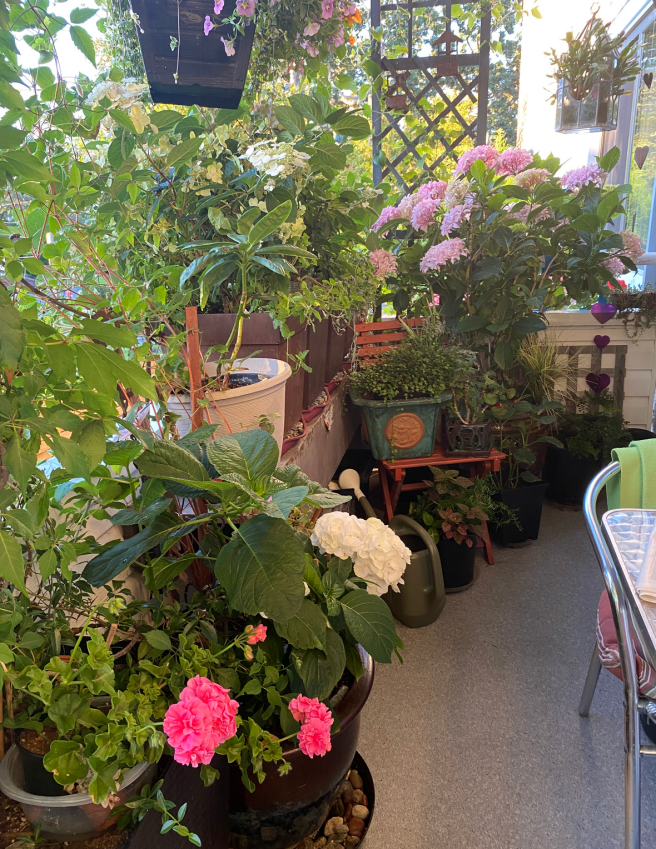
 As a lifelong gardener, I’m not surprised. My former homes have included a national award-winning “impossible” garden I planted in just six inches of soil on the roof of an underground parkade, a classic English cottage garden on 1/3 of an acre, and of course my current tiny balcony jungle (pictured left and above), home to my gorgeous 6-foot pink Piilu clematis (left). And I can tell you, based on two recent marathon gardening mornings spent working alongside my favourite son, Ben in his own garden, that after several hours of digging, shoveling, planting and lugging heavy pots around, we both felt muscles we didn’t know we had. We were sore, tired and filthy – and we also felt very good!
I am not a gardener because I thought it might improve my health. Instead, I think what I most love about working in a garden (big or small) is that gardening is such a hopeful activity.
Every time I plant a seed or a tulip bulb or a new clematis vine (I’m up to seven of those so far!), I can clearly imagine what I hope they will become years from now. It’s the anticipation that has me hooked. To me, gardens represent both instant gratification (like those irresistible 6-packs of colourful annuals every May) and delayed gratification (like the classic clematis-grower’s rule: “The first year they peep, the second year they creep, and the third year they LEAP!”)
Each of my gardens has been a work in progress. Every winter, I find myself making new gardening plans for next summer. A couple years ago, for example, while plunged into utter despair over the shocking results of the American Heart Association’s national survey on women’s awareness of heart disease (basically, the survey showed women were LESS aware of cardiac risk factors and symptoms than they’d been TEN YEARS EARLIER!), I decided to take an entire summer off from writing about women’s heart disease here. I needed to start writing about something that filled me with joy, not despair.
 So I wrote about my new adventure: learning to grow roses in my balcony pots for The Novice Rose Gardener (FYI, links to all 17 of my 2022 rose-growing essays start here). And then the following year (after the rose experiment stumbled badly), I became obsessed with hydrangeas, so I dug up all my roses and donated them to Ben’s garden (where I have visiting privileges!) This year on my little balcony, I now have six beautiful hydrangeas which will bloom right through to the first frost – which is our sign here in Canada’s temperate west coast climate to plant winter pansies while we dream about spring seed catalogues.
I’m no longer the nimble gardener I’ve been all my life (thank you, osteoarthritis!) My wonky knees can no longer easily kneel or squat, but I’ve somehow found ways to adapt and modify what needs doing. Adapting and modifying are common practices among many older gardeners, whether you have an estate garden or a tiny balcony like mine.
And as the Arthritis Society physiotherapists tell me: “MOTION IS LOTION”. My sore gnarled fingers actually feel better after a pleasant hour of outdoor dead-heading (which is also the perfect activity if you long for stunning before-and-after impact).
Adults who don’t regularly do resistance training like lifting weights, as Harvard Health reminds us, can lose 4 to 6 pounds of muscle per decade. They add: “Over time, loss of muscle strength can put everyday activities out of reach – such as walking, cleaning, shopping and even dressing. Loss of muscle mass can also lead to dangerous falls.” Avid gardeners rarely need to buy specialized weights to help retain muscle mass because we already have full watering cans, loaded wheelbarrows, big bags of soil or compost, and heavy pots to lug around. And the reason I’m still able to lift a large full watering can is because I so often carry it back and forth to the balcony. If I stop lifting it, I’ll soon stop being able to lift it.
The Penn State study’s conclusions, published last year in the Journal of the Academy of Nutrition and Dietetics read like this:
“Among adults aged 65+, gardening is associated with better cardiovascular health status, lower odds of diabetes, better mental and physical health status, higher fruit and vegetable intake, and lower risk of 10-year mortality. Our research also suggests that while gardening may be considered a physical activity by public health professionals, for gardeners it’s motivated primarily by non-physical activity-related reasons.”
Although I have truly loved my time gardening for decades, all those gardening benefits did not evidently prevent my “widow-maker“ heart attack after all – but they likely helped me to survive what many do not. But gardening certainly brought me endless joy and happiness and lovely distractions both before and since cardiac diagnoses. I know that many people who live with chronic illness may, like me, no longer have the physical capacity to maintain the same level of gardening they used to, but even a lone African violet on a bright window sill can make one’s heart sing watching those perfect new blooms miraculously unfurl.
And finally, these wise words from the famous British garden designer and author, Gertrude Jekyll (1843–1932) – who wrote:
“The lesson I have thoroughly learned, and wish to pass on to others, is to know the enduring happiness that the love of a garden gives.”
♥
1. Veldheer S et al. “Gardening Is Associated With Better Cardiovascular Health Status Among Older Adults in the United States: Analysis of the 2019 Behavioral Risk Factor Surveillance System Survey.” J Acad Nutr Diet. 2023 May;123(5):761-769.e3.
2. Park SA et al. “Can Older Gardeners Meet the Physical Activity Recommendation Through Gardening?” Hort Technology. 2008;18(4):639–643.
3. Chalmin-Pui LS et al. “Why Garden? – Attitudes and the Perceived Health Benefits of Home Gardening.” Cities. 2021;112.
4. Teixeira PJ et al. “Exercise, Physical Activity, and Self-Determination Theory: a Systematic Review.” Int J Behavioral Nutr Phys Act. 2012;9:78.
Nordic Track image: Helen Robert
Q: If you too love gardening, what’s your favourite part of your own garden – past or present?
.
NOTE FROM CAROLYN: I wrote more about cardiac risk factors and how to address them in my book, “A Woman’s Guide to Living with Heart Disease”. You can ask for it at your local library or favourite bookshop, or order it online (paperback, hardcover or e-book) at Amazon, or order it directly from my publisher Johns Hopkins University Press (and use their code HTWN to save 30% off the list price when you order).
 Heart Sisters
One thought on “Can gardening ward off heart attacks?”