
by Carolyn Thomas ❤️ Heart Sisters (on Blue Sky)
Asking for – and accepting – help from other people can be a challenge for those of us who generally see ourselves as the helper, not the helpee. I come from a long line of Ukrainian women who are born helpers. My late mother’s reflexive response to neighbourhood news of a new baby or a broken leg, for example, was to turn on the oven and start baking for the occasion. .
But because “I’m fine!” seems to be my genetic default response to almost any inquiry about my own health, I’ve turned down countless offers of help over the years from others who truly seemed willing to help.
I could be the poster child for feeling fiercely reluctant to ask for that help (notably while recuperating from a widow-maker heart attack in 2008, and more recently after finding a breast lump while showering – which turned out to be a malignant tumor). Ironically, I have often been surprised since launching Heart Sisters in 2009 by how many breast cancer patients follow this site, or buy my book, or leave comments in response to my articles here – even though I rarely if ever write about breast cancer.
What I have written about at length since Day One, however, is the profoundly surreal and predictable experience of becoming a patient – no matter our diagnosis.
Most patients report that they can recall, in exquisite detail, the exact words a doctor used to deliver their diagnosis – even decades later. See also: The 5 stages of “What the hell just happened to me?”
Stanford University researcher Xuan Zhao studies the known reluctance to ask for help, as she described in a recent interview:
“When people are in need of help, they may not fully recognize the motivations of those around them who are ready to help. This can introduce a persistent difference between how help-seekers and potential helpers consider the same helping event.
“Our research team consistently observed that help-seekers underestimated how willing strangers – and even friends – would be to help them, and how positive the helpers would feel afterward. They also overestimated how inconvenienced helpers would feel.”
Our society, she added, tends to value independence, so asking others to go out of their way to do something for us may seem wrong or selfish – even when it’s a perfectly reasonable request and when helpers are in fact very willing to help.
Last week, for example, I knew I’d need a ride to my first appointment with my cardio-oncologist (that’s an emerging medical specialty, by the way, focused on minimizing both the acute and chronic cardiac side effects of powerful cancer treatments). See also: When cancer treatments damage your heart
As this appointment loomed closer, I studied my list of people who had told me: “Just let me know if there’s anything I can do to help!” And exactly as Dr. Xuan Zhao’s research confirmed, I began to second-guess the likely response of each potential helper (e.g. “Hmmm…can’t ask Jenni – she’s always so busy!”)
But because I really needed that ride, I did ask my friend Jenni (I think my rambling request included lots of explanatory disclaimers like “only if you’re available, of course….”
Her immediate response: “Yes! I can do that for sure! ”
Dr. Xuan Zhao explains a perspective that turns out to be common among our potential helpers:
“The truth is, most of us are deeply pro-social and want to make a positive difference in others’ lives. Empathizing with and helping others in need seems to be an intuitive response, and dozens of studies, including my own, have found that people often feel happier after conducting acts of kindness.
“Earlier Stanford research also suggests that people tend to overestimate how likely their direct request for help would be rejected by others.”
Remember too that the people closest to you might even feel annoyed if you don’t reach out for help.
Dr. Gregg Levoy tells a compelling story about that reaction in his Psychology Today column. While he was housebound with torn ligaments suffered after a freak accident, a friend of his dropped in unannounced one day – and became upset when he learned more about that accident. Dr. Levoy explains:
“When I told him what had happened, he was genuinely angry with me, for being too stubborn to call him or anyone for help. I hadn’t told anyone of my accident, hadn’t called anyone to come cook me a meal or do a load of laundry or go food-shopping for me.'”
“What the hell are friends for?’ he scolded as he began picking up pizza boxes and dirty clothes. ‘What were you thinking?’ “
Dr. Levoy suggests that you tell others directly what would help you: “If you just tell people that you ‘need help’, they’re likely to try to diagnose what sort of help you seem to need.”
I knew I’d need a very specific kind of help when I started chemotherapy on June 2nd and learned that, in our Cancer Agency, patients are prescribed pre-loaded syringes of certain meds to inject ourselves at home for seven evenings in a row following each round of chemotherapy. Yes, INJECT OURSELVES! Because I have an enthusiastic vaso-vagal syncope response (I faint at the sight of blood, or even the bony crunch sound of Hilary Swank getting her nose broken in the movie Million Dollar Baby) – seriously! – I knew I’d need somebody to help me with these self-injections.
And when I say “help with” – I mean “give me the shot!”
Most of my family members had to put their heads between their knees and fan their faces to recuperate from simply being asked to do these injections.
So I took a big deep breath and crossed the street one day to have a chat with my longtime neighbour Sue, whom I’ve known since the 1970s. And best of all, Sue is a retired nurse. She said YES right away when I asked if she could do my injections. I could hardly believe she was so casually agreeable about what to me was such a huge favour. When my grown children offered to pay Sue for her time, her answer was a firm “ABSOLUTELY NOT!” I’m just being neighbourly!” And when she had previous plans for one of those 7 p.m. injections, it became a team effort when my lovely daughter-in-law Paula (also experienced with sub-cutaneous injections herself) stepped in with a big smile. Seven successful injections – and no fainting.
Sometimes what patients really want or need the most isn’t so much help with practical tasks like meals or laundry or grocery shopping (or seven days of injections) – but help with emotional support.
My longtime reader Deborah shared her own example of needing to ask directly for this kind of support in her response to an article here called “Choose Your Listeners Carefully“:
“When I was diagnosed with my thoracic aortic aneurysm, I had enough time before surgery to consider who, in my family, would be most physically and emotionally supportive during my post-operative recovery.
“I’d already done lots of ruminating and, while I didn’t like this fact, I knew my husband would likely need to pull back his emotional support at some point and I didn’t want that when I needed it most. (He did withdraw at one point, but he was back in supportive mode after about a 24-hour ‘rest’).
“So to be on the safe side, I asked a sister and sister-in-law to be here for me. They were, and they were wonderful.”
Speaking of asking directly, another neighbour Pam brought over a bowl of her insanely delicious homemade lemon mousse one evening last week. Because everything I eat these days tastes either bland or metallic due to chemotherapy, my poor little taste buds were blown away by every lemony spoonful. It was quite simply the best food I’d ever eaten.
And later, when I was returning her empty bowl, she said: “Just let me know if there’s anything else I can do.”
So I pointed to the empty bowl and asked:
“More of this after my next Chemo Week, please!?”
♥
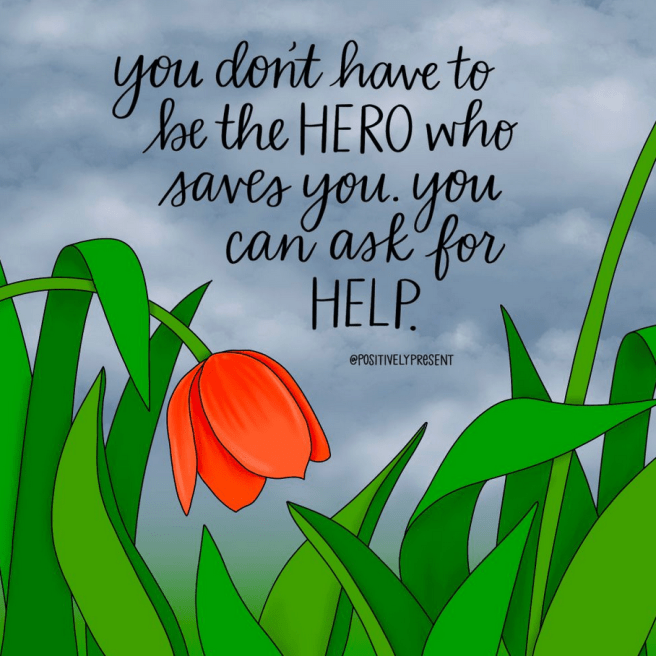
Image: PositivelyPresent
Q: Do you tend to resist asking others for help?
.
NOTE FROM CAROLYN: I wrote much more becoming a patient (and about accepting help!) in my book, “A Woman’s Guide to Living with Heart Disease” (Johns Hopkins University Press). You can ask for it at your local library or bookshop. Please support your favourite independent neighbourhood booksellers, or order it online (paperback, hardcover or e-book) at Amazon – or order it directly from my publisher, Johns Hopkins University Press (use their code HTWN to save 30% off the list price).
 Heart Sisters
Carolyn,
It’s been almost a year since I had a surprise trip to the hospital and had my gallbladder removed. There was concern that everything still was not right. I was told that an MRI was needed. The surgeon who performed the surgery didn’t understand why I would need an Ativan tablet. I then asked to speak to the hospital social worker to discuss my negative experience of my first MRI. The second was better with one Ativan. The social worker was supportive, listened, and asked for me to be prescribed two Ativan tablets.
I am so glad I asked for help. I now know what I need should I need another MRI in the future.
Marty L.
LikeLike
Hi Marty – it was a good thing you had the presence of mind to ask to speak to the hospital social worker! The surgeon’s lack of compassion could have made a stressful procedure a dreadful experience. This lack of compassion makes me insane. The Washington Post published an article years ago on claustrophobia during an MRI scan – researchers found that almost 15% of patients report a panic attack during an MRI – and the relief provided by even one sedative can really make a difference. How is it possible that the surgeon did NOT understand that?
If you do ever need another MRI, you’ll know for sure to get a prescription in advance, fill that prescription, and bring the meds with you to your MRI appointment.
I hope you recovered uneventfully and are enjoying good health a year later!
take care. . . ❤️
LikeLike
I think I may have a world record in the number of times I have said, “No,that’s okay, I’m fine.” in response to offers of help.
I attribute this to several things. Such as a general attitude ( based on real experience) that I can do the task better myself.
Or the offer of help in general and not being able to come up with a specific task for the person offering.
Or in the case of my grown children, both of whom have complex issues of their own, a lack of confidence in their abilities and the fear that their help will end up causing me more distress than relief.
I do have one friend, another retired nurse, that I know I can call for almost anything.
Also, recently when I fractured my humerus I was pleasantly surprised when my 40yr old autistic son was able to call the ambulance, stick with me in the hospital, call relatives and pick me up after 2 weeks in rehab and get me settled at home.
LikeLike
Hello Jill – I think I’ve been competing for that same world record in saying “No, that’s okay, I’m fine!”
It’s all part of that “I don’t want to be a bother…” knee jerk attitude I’ve legitimately inherited since childhood! But lately I’ve been so delighted when I do ask (or accept) help – and this almost always results in a deeper connection with the helper! Bonus!
And isn’t it a lovely heartwarming thing to observe a family member go well beyond our expectations to help out their Mum?!
Take care. . . ❤️
LikeLike
My daughter has a saying, “Just because you can, doesn’t mean you should”
So many times in life I have pushed myself way beyond what I “should have” rather than ACCEPT help!!
I think that aging offers us more and more opportunities to let go of our proud egoistical “I can do it myself” attitudes. The passage of “Let go and Let God” includes accepting the godly giving nature of human beings that surround us and letting them help us.
As a work in process, your posts always provide a wonderful point of contemplation for me and open up our opportunities to learn from each other.
A shared service for all.
Thank You
LikeLike
Dear Carolyn,
I am so sorry for your cancer diagnosis. I hope everything will go perfect.
I did not even need to ask for help 42 years ago before my triple by-pass operation. Several mothers of my son’s friends offered to care for my 13 year old son during the three weeks in the hospital. They were great. I myself would not have asked for help.
Last December I thought I had a heart attack and tried to get rid of the pain in the back for two hours. I took more nitro than usual. Then I woke up my husband and he called the ambulance. In the hospital, I suddenly lost my speech, thinking why are my lips numb, am I at the dentist? My right arm became numb, too. If I had waited at home two hours more I would have died. It was a blocked basilar artery.
They took it away with catheter without narcose. I had the feeling my whole head is burning. After this experience at home, I was so afraid to get it again that I asked my twin sister to fly to us in order to help me to find my contenance.
All the Best for you Carolyn.
LikeLike
Hello Eira – I love your story of all those mothers pitching in to help take care of your son while you were in the hospital – and without even being asked! I hope your health has improved since last December – what a frightening experience that must have been!
Take care…❤️
LikeLike
I’ve so often seen (and felt) that instinct to minimise, to apologise, to say “I’m fine” even when clearly not.
Thank you for naming the emotional weight so many of us carry around help-seeking, and for offering a more compassionate way forward.
Marie Ennis-O’Connor
LikeLike
Hello dear Marie – thanks for including this post in your Weekly blog Roundup!
I loved discovering the Stanford University research that found “a persistent difference between how help-seekers and potential helpers consider the same helping event!” While we help-seekers tend to fret about being a bother, the potential helper feels happier being able to help! Amazing. . . ❤️
LikeLike