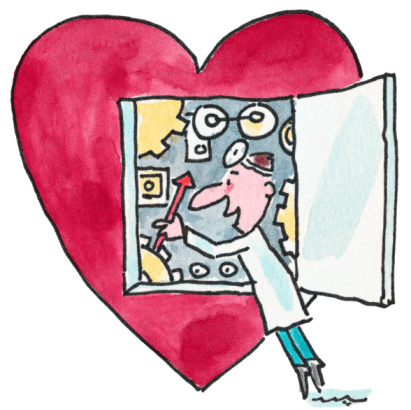
Fighting, battling, and beating: combat metaphors in medicine are just wrong

by Carolyn Thomas    @HeartSisters

Are you “battling” heart disease”? Have you “beaten” cancer? Are you “fighting” a chronic illness? These wartime references are metaphors as described by Dr. Jack Coulehan, a physician, an award-winning poet, and editor of the 5th edition of The Medical Interview: Mastering Skills for Clinical Practice, a best-selling textbook on the doctor-patient relationship.(1)  Dr. C explains that there are several basic metaphors used in medicine that to a large extent generate the vocabulary of doctor-patient communication – but can also unintentionally objectify and dehumanize the patient.

Here are three of the most prominent metaphors you’re likely to encounter in health care:  Continue reading “Fighting, battling, and beating: combat metaphors in medicine are just wrong”

How Minimally Disruptive Medicine is happily disrupting health care

by Carolyn Thomas      @HeartSisters

I went on an adventure to a magical, faraway place. It was my second visit to the world-famous Mayo Clinic in beautiful downtown Rochester, Minnesota. My first trip there was back in 2008, five months after surviving a misdiagnosed widow-maker heart attack.

I was there that first time because I had applied (and was accepted) to attend the annual WomenHeart Science and Leadership Symposium for Women With Heart Disease at Mayo Clinic – the first Canadian ever invited to attend. This is a training program that arms its graduates with the knowledge, skills and (most of all!) Mayo’s international street cred to help us become community educators for other women when we go back to our hometowns.

Thus, a circle that began with me sitting in that 2008 training audience of 45 women (ages 31-71, all of us heart patients) was completed on my second trip as I became one of the presenters onstage – this time in front of an audience of cardiologists! – at a Mayo Clinic medical conference on Heart Disease in Women (Thank you Drs. Hayes, Mulvagh and Gulati for your persistent invitations!)  But long before I took the stage that weekend, I’d been invited to come to Rochester a day earlier to meet with some pretty amazing Mayo staff. Continue reading “How Minimally Disruptive Medicine is happily disrupting health care”

Which patients does the “patient voice” represent?

by Carolyn Thomas  ♥  @HeartSisters

There are patients. And then there are patients.  Let’s consider, for example, two friends of about the same age, same height, same size, same socioeconomic demographic – each one (in an amazingly freakish coincidence) a survivor of a similarly severe heart attack, admitted to the same hospital on the same day. Let’s call these two made-up examples Betty (Patient A) and Boop (Patient B).

Betty is diagnosed promptly in mid-heart attack, treated appropriately, recovers well, suffers very little if any lasting heart muscle damage, completes a program of supervised cardiac rehabilitation, is surrounded by supportive family and friends, and is happily back at work and hosting Sunday dinners after just a few short weeks of recuperation.

Boop, on the other hand, experiences complications during her hospitalization, recuperation takes far longer than expected, her physician fails to refer her to cardiac rehabilitation, she has little support at home from family, her cardiac symptoms worsen, repeat procedures are required, she suffers longterm debilitating consequences, and is never able to return to work.

Yet despite these profound differences, physicians would still describe both of these women with the same all-inclusive descriptor, “myocardial infarction” (heart attack).  Continue reading “Which patients does the “patient voice” represent?”

Kindness in health care: missing in action?

by Carolyn Thomas    @HeartSisters 

I don’t remember much of what happened during that fateful visit to the Emergency Department.  I remember the on-call cardiologist saying something to me about my “significant heart disease”. After hearing those words, I felt so stunned that – although I could see his lips moving and could hear sounds coming out of his mouth – he may as well have been speaking Swahili.  (Doctors, please remember this in the future when delivering life-altering diagnoses to your patients!)

What I do vividly remember, however, is a small but profound act of kindness later that day when I was brought to my bed in the CCU (the cardiac intensive care unit). Continue reading “Kindness in health care: missing in action?”