
Erin Gilmer: “Us” vs “them”: the under-served patient speaks up

by Carolyn Thomas  ♥  @HeartSisters

 I’m very sad to report that Erin Gilmer died on July 8, 2021. Rest in peace, Erin.

.

I asked permission to republish this letter written by patient advocate and health policy attorney Erin Gilmer, who has lived in poverty brought about by debilitating chronic illnesses.

Erin offers a unique patient perspective in this letter to the organizers of the annual Medicine X conference at Stanford University.  After writing her letter, she was subsequently invited to speak at Medicine X 2014.  Although not well enough to travel to California in person after recovering from spinal surgery, she was thrilled when Medicine X organizers offered to put together an edited recording of her presentation to be shown to both live and online audiences on September 5th, 2014.  (Sadly, her video presentation is no longer available on the Stanford site, but this is a copy she sent me of the  letter to Medicine X organizers):

“Dear Medicine X Conference organizers,

“Your upcoming healthcare conference forum on under-served populations brings up a concern for me that I hope you will consider in the next few months.  The best way I can explain my concern is through this example:   Continue reading “Erin Gilmer: “Us” vs “them”: the under-served patient speaks up”
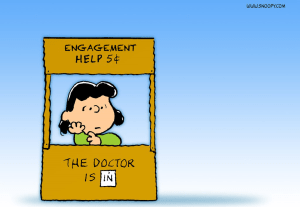
Patient engagement (as described by 31 non-patients)

by Carolyn Thomas  @HeartSisters

I was one of the four patients interviewed for the Center for Advancing Health report called Here to Stay: What Health Care Leaders Say About Patient Engagement.  It’s an interesting, illuminating and frustrating document to read.

The late Dr. Jessie Gruman, president and founder of the CFAH, wrote in her forward to this report:

”  What are people talking about when they say ‘patient engagement’ anyway?  That phrase encompasses so many concepts and ideas that it’s become meaningless.”

As I wrote here, my own concern (as a person who’s pretty darned engaged in my own health care) is not that the phrase is meaningless. It’s more that non-patients, business and industry have co-opted the concept of patient engagement for their own purposes.

And consider once again that, even in this impressive 170-page CFAH document that is all about patient engagement, there were only four patients interviewed – compared to 31 clinicians,  employers/purchaser representatives, health plan administrators, vendors, community health leaders, government organizations,  health care contractors and consultants.
Continue reading “Patient engagement (as described by 31 non-patients)”

Who will take care of you at home if you’re seriously ill?

by Carolyn Thomas     @HeartSisters

It turns out that the hilarious British spoof on the horrors of the Man-Cold might be more true than we ever imagined. The joke reality here is that when a husband gets sick, his wife is naturally expected to become his doting caregiver, but when a wife gets sick, she may feel distinctly on her own.

A study presented at the annual meeting of the Population Association of America reported that the risk of divorce among married couples is more likely to rise when the wife – but not the husband — becomes a heart patient.

Study author Dr. Amelia Karraker, a researcher at the University of Michigan Institute for Social Research, examined how the onset of four serious illnesses – cancer, heart disease, lung disease and stroke – affected the marriages of couples over a 20-year period. Dr. Karraker explained:

”    We found that women are doubly vulnerable to marital dissolution in the face of heart disease.

“They are more likely to be widowed, and if they are the ones who become ill, they are more likely to get divorced.”

Why is this?    Continue reading “Who will take care of you at home if you’re seriously ill?”

Why you should hug your cardiologist today

by Carolyn Thomas     @HeartSisters

hugI like to tell my women’s heart health presentation audiences that, if you’re going to have a heart attack, you should really try to have one here in Victoria, British Columbia – or in any other city that boasts a healthy ratio of cardiologists-per-square-city-block.

My theory on this is that cardiologists, just like the rest of us, want to raise their families in a charming historic town with good schools, good restaurants, good shopping, fun night life, live theatre, sports teams, 200 km of cycling trails, a symphony orchestra, picture-postcard ocean/forest/mountain scenery, and a near-perfect coastal climate allowing them to garden or play golf 12 months a year. If this town also has a major university and a good-sized teaching hospital that attracts both students and cardiac researchers, that’s also going to go a long way in appealing to cardiologists.  You’re welcome, Tourism Victoria . . . Continue reading “Why you should hug your cardiologist today”