Signs & symptoms: are they the same thing?

by Carolyn Thomas   ❤️   Heart Sisters (on Blue Sky)

Women showing up at the Emergency Department seeking help due to their frightening cardiac symptoms can often feel “stopped at the gate” .This means they’re denied critical assessment and management of both acute heart disease signs and symptoms.

But signs and symptoms have different meanings.  Your body’s physical symptoms are essentially something that feels out-of-the-ordinary, which may indicate a disease or medical condition.  Symptoms are reported by the person who is experiencing them. And signs are what your health care professional can see or measure. These two words are often used interchangeably, but they’re not the same.   . Continue reading “Signs & symptoms: are they the same thing?”

When “Look on the bright side!” feels wrong

by Carolyn Thomas   ❤️   Heart Sisters (on Blue Sky)

“If you have to get cancer, yours is a good kind to get!”  That’s what someone recently said out loud to me. It’s the kind of thing you might say out loud if you were truly trying to cheer me up but weren’t quite sure what on earth to say to a heart patient with a newly diagnosed malignant breast tumor the size of a small grapefruit. Yale University professor of psychology Dr. Laurie Santos calls this cheerfully minimizing response to a cancer patient as “the kind that decides ‘bad’ negative emotions could be fixed if only we had a more ‘look on the bright side!’ attitude.”

Nobody wants to say the wrong thing to any newly-diagnosed patient, but that perky “good kind of cancer” comment landed with a hollow thud. It’s also an example of something that only a patient might say one day – when this is behind her.
Continue reading “When “Look on the bright side!” feels wrong”

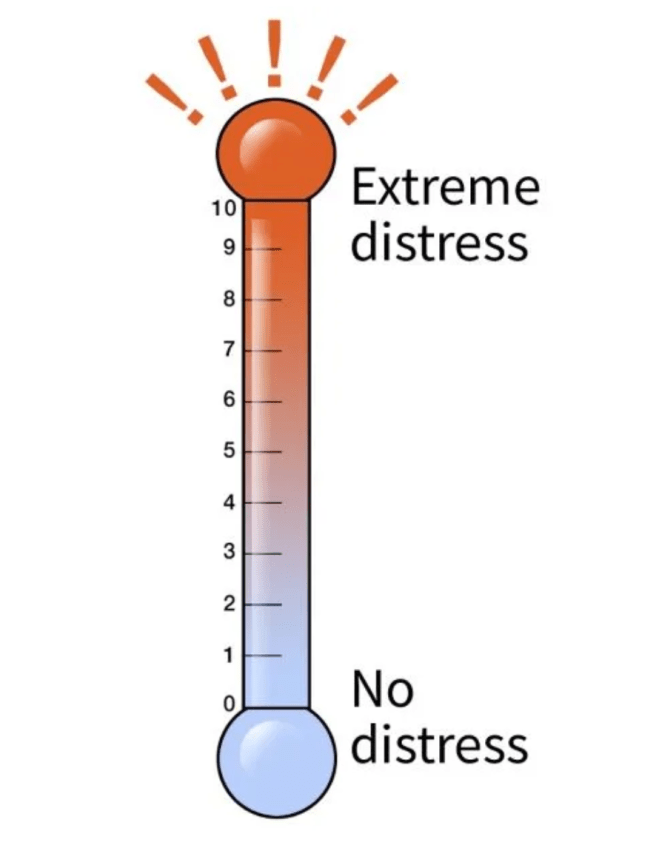
Where are you on the Distress Thermometer?

by Carolyn Thomas   ❤️   Heart Sisters (on Blue Sky)

I’ve been sleeping poorly lately. I think I have an ice pick headache coming on. I can’t seem to concentrate. I feel utterly overwhelmed. I cried off and on for an entire day last week. I am clearly distressed. 

I recognize this distress because I’ve experienced a similar response in the past – like surviving a misdiagnosed “widow maker” heart attack back in 2008, for example. That was pretty darned distressing.  The National Institutes of Health describe distress as “emotional, social, spiritual, or physical pain, or suffering that may cause a person to feel that they are not able to manage or cope with overwhelming changes caused by normal life activities or a serious medical diagnosis.”  Those are almost exactly the words I said to a friend just this past week when I was wailing into the phone about my new breast cancer diagnosis: “I just don’t think I am able to get through this!”   (You can read more about my breast cancer experiences in these posts).

Enter the Distress Thermometer:
Continue reading “Where are you on the Distress Thermometer?”

Connection instead of isolation: my waiting room experiment

by Carolyn Thomas   ❤️   Heart Sisters (on Blue Sky)

When was the last time you struck up a casual conversation with somebody you don’t know?  Psychologist Dr. Gillian Sandstrom, who teaches at the University of Essex in the U.K., studies this phenomenon, and now describes herself as a “talker-to-strangers”, adding:

“The benefit shown in my research is that chatting with strangers is good for your mood.”    .
Continue reading “Connection instead of isolation: my waiting room experiment”