
I’m not past my prime – or did I miss the memo?

by Carolyn Thomas  ♥   @HeartSisters

According to the Cambridge dictionary,  being in one’s prime is described as  being in the best, most successful, most productive stage, e.g. “The horse retired from racing although still in his prime.”  By comparison, being past one’s prime means that the horse has been put out to pasture.

I’ve been thinking a lot about that metaphor this past week – not so much about horses, but about being “past my prime” – especially when we talk about women, especially women living with heart disease or other life-altering diagnoses. Yet this past week, I feel like I’ve had a crash course reminding me of what I used to be able to accomplish both physically and mentally when I was “in my prime”. But where did my prime go? And did I notice it leaving?  Continue reading “I’m not past my prime – or did I miss the memo?”
“What? So what? Now what?” Self-reflection for the new heart patient

by Carolyn Thomas  ♥  @HeartSisters  

For weeks following hospital discharge after my “widow maker” heart attack, I kept forcing a “Fine, just fine!” smile when around others each day, desperately trying to make sense out of a cardiac diagnosis so shocking that it made no sense to me. What I later learned was that sense-making turns out to be a remarkably common early response to a serious medical crisis.     Continue reading ““What? So what? Now what?” Self-reflection for the new heart patient”

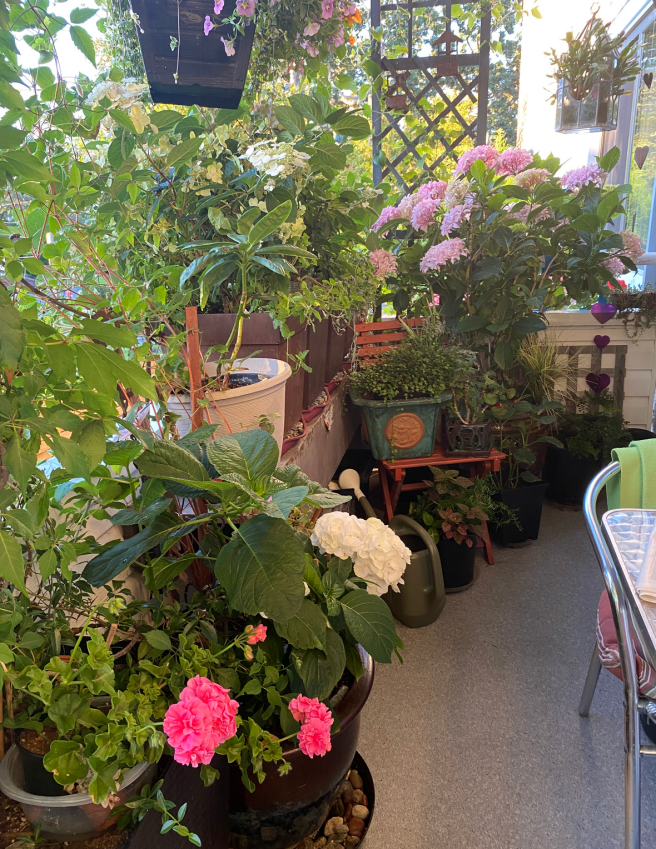
Can gardening ward off heart attacks?

by Carolyn Thomas   ♥  @HeartSisters

It turns out that gardening is associated with better cardiovascular health among older adults compared to older adults who do NOT garden, according to researchers at Penn State University.(1) 

Gardening, they explain, is considered “a multi-component physical activity that encompasses balance, muscle-strengthening, and aerobic exercise obtained through a range of activities and intensities.”

For example, most physical activity health guidelines recommend that adults “engage in at least 2 1/2 hours of moderate intensity physical activity per week” – at a level called a Metabolic Equivalent (or MET) of 3 or higher. (A MET is a number that indicates the relative rate at which you burn calories during a physical activity).

If you’re sitting down while reading this article, for example, that’s barely one MET. Reading won’t make much of a dent in your physical activity goals – unless you’re like my reader Helen Robert, a survivor of a SCAD heart attack who sent in this photo of my book propped up on her treadmill in Ottawa with the note: This book has been getting me through my daily treadmill this week!”)  Thank you, Helen!  ♥

The Penn State researchers found that the older adult gardeners they studied “spend 15–33 hours/week gardening during the active growing season (May-July) – and the activities in which they engage average 3.8 METs.”(2)      .   
Continue reading “Can gardening ward off heart attacks?”

Chronic complaining: don’t be such a “Greiner Zanner”

by Carolyn Thomas   ♥  @HeartSisters

I called my favorite flower shop last week to complain.  Earlier that morning, I had picked up a bouquet of mini-gerbera flowers for our condo lobby, as I like to do each week.  The gerberas (pictured above) were advertised as seven stems for $5.99. But when I got home and unwrapped the bouquet, I counted only five. My first thought: (a) maybe miscounted by a busy florist?  My second thought: (b) maybe ALL of the displayed bouquets had only five stems, too – despite the “seven stems” advertised in this week’s flyer?  The nice lady on the phone offered me two free gerbera stems if I wanted to come back to the shop to pick them up.

“These aren’t ‘FREE’ “,  I snapped at her. “I’ve already paid you for SEVEN!”  And I did not go back.  Instead, I stewed over that interaction.     .     Continue reading “Chronic complaining: don’t be such a “Greiner Zanner””