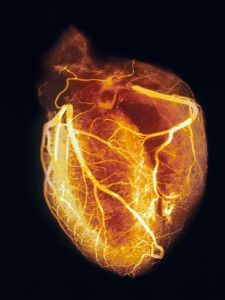
Here’s how your heart looks during a coronary angiography procedure. The white/yellow blood vessels are bringing oxygenated blood to the working muscles of the heart. (See link below to the whole slide show).
Coronary angiography (also called cardiac catheterization) is sometimes referred to as the ‘gold standard’ of diagnostics for heart patients. The procedure involves threading a tiny catheter through an artery in the wrist or groin and pushing it up, up, up right into the beating heart. It’s considered to be an invasive procedure, but not surgical. Patients are sedated, but usually awake throughout.
The catheter is guided through the artery with the aid of a special x-ray machine. Contrast material (dye) is injected through the catheter and x-ray movies are created as the contrast material moves through the heart’s chambers, valves and major vessels.
The interventional cardiologists in the ‘cath lab’ then watch your beating heart up on the monitor, where they can spot any coronary arteries that are blocked or narrowed, and evaluate your heart function. If significant blockages are seen, further procedures like balloon angioplasty, stent implants or coronary artery bypass graft (CABG) – commonly known as bypass surgery – may be attempted to restore blood flow to the threatened heart muscle.
I’ve undergone two of these invasive cardiac procedures – the first an emergency catheterization and stent implant when I was hospitalized for a heart attack, the second 15 months later to investigate ongoing cardiac symptoms. And I can tell you that it is freakishly fascinating to lie on the cath lab table, sedated yet very awake, and watch your own beating heart on the overhead monitor. Continue reading “Inside your heart – as captured by National Geographic” →
Like this? Share it with others!



 Heart Sisters