The most frightening cardiac symptom

by Carolyn Thomas    ♥    @HeartSisters

The chest pain. The shortness of breath. The freakish pressure radiating up to the jaw or down the arm. All of these can be signs of a heart attack or other cardiac events..  But for Martie, a 46-year old heart patient diagnosed with Spontaneous Coronary Artery Dissection (SCAD), her worst symptom was described like this:

“The most prominent symptom I had, which kept getting stronger and would not go away, was the little voice in my head telling me this was NOT normal. It is my one piece of advice to all my friends. Listen to that voice in your head!”              . Continue reading “The most frightening cardiac symptom”
Diagnostic uncertainty: when we just don’t know

by Carolyn Thomas      @HeartSisters

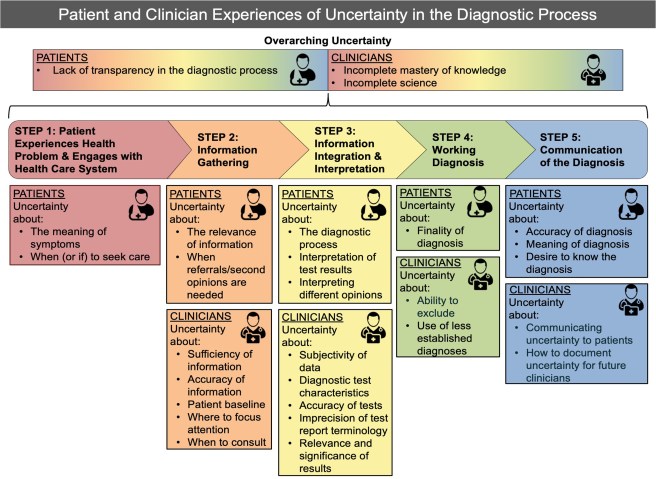
The image above is all about uncertainty. It’s like a 5-step roadmap that you’d use when traveling an unfamiliar road to a new destination you know nothing about and do not want to visit.(1)  For people experiencing scary symptoms they fear might be heart-related, for example, uncertainty about what’s happening now and what will happen next is pervasive. But a new study published in the journal Patient Education and Counseling reminds us that patients aren’t the only ones facing uncertainty around a medical diagnosis: “Both patients and clinicians experience diagnostic uncertainty, but in different ways.”(2)        .        .   Continue reading “Diagnostic uncertainty: when we just don’t know”

“Be alert to both the absence of normal as well as the presence of abnormal”

by Carolyn Thomas      @HeartSisters

It isn’t often that I’m wide awake at 1 a.m. But sometimes, a dream or a fire truck siren or whatever jolts me so wide awake in the middle of the night that sleep seems suddenly impossible. When this does happen, I’ve learned that I can sometimes lull myself back to sleep by turning on my bedside radio. (Radios! Remember those?)  My old clock radio is tuned permanently to CBC, our national Canadian broadcaster. And 1 a.m. is when CBC runs the Public Radio International program called “The World” . I love that show.

It isn’t often that I hear something on The World so perfectly applicable to women’s heart attacks that I’m moved to sit up in bed, grab a Sharpie and the little stack of post-it notes beside said radio, and quickly scribble down the words before I forget what’s just been said. But this was one of those times.         .    .    Continue reading ““Be alert to both the absence of normal as well as the presence of abnormal””

Dear Carolyn: “I couldn’t tell if my pain was ‘normal’.”

by Carolyn Thomas     @HeartSisters

I happen to have a pain specialist in my family:  my darling 6-year old granddaughter Everly Rose, who studies her assorted owies very seriously. She updates me at each visit on how every scratch, scar or scab is coming along, rating the pain that each injury caused her on the playground, at summer day camp, or while playing with Homie, her cat. 

I, on the other hand, am apparently keen on NOT making a fuss, no matter what – yes, even the chest and left arm pain that continued during my own misdiagnosed heart attack.

One of my Toronto readers told me recently about the time that she too could not bring herself to describe her pain as pain.  As part of my occasional “Dear Carolyn” series of reader narratives, I’m sharing her story here. Notice how many times she avoids revealing her true pain:       .          .   Continue reading “Dear Carolyn: “I couldn’t tell if my pain was ‘normal’.””