
Weird facts about women and heart disease

by Carolyn Thomas   ♥   @HeartSisters

Every February is Heart Month – when facts and stats about heart disease flood our screens. But Heart Month facts and stats are so pre-COVID – when we also learned the truly discouraging results of the latest American Heart Association (AHA)’s national survey.  This survey found that women’s awareness of heart disease actually DECLINED over the previous decade – despite all the inspiring Red Dress fashion shows/awareness-raising/Go-Red-for-Women campaign efforts out there. So instead of repeating more scary statistics as if I hadn’t read that survey’s results, this time I’m simply offering some weird stuff I’ve learned over the years about women and heart disease:    .             Continue reading “Weird facts about women and heart disease”

Let’s pretend that atypical heart attack symptoms don’t exist

by Carolyn Thomas    @HeartSisters  

Two cardiology reports landed in my inbox on the same day this past week, in the  same issue of the same cardiology journal. The first was a Yale University study on how women, particularly women younger than age 55, fare worse after surviving a heart attack compared to male counterparts, partly because of a tendency to present with vague or atypical symptoms that can delay accurate diagnoses.(1) The second was about the future of the American Heart Association’s Go Red For Women® campaign.(2)*   Both papers were published in the journal, Circulation.

The trouble was this: each report seemed to contradict the other. Continue reading “Let’s pretend that atypical heart attack symptoms don’t exist”

Women, controversial statin guidelines, and common sense

by Carolyn Thomas  @HeartSisters

101109expIf you’re a heart patient, I’m betting that you’re already taking one of the cholesterol-lowering drugs called statins. That’s because these drugs – with brand names like Lipitor, Crestor, Zocor or any of their generic forms – are routinely prescribed to those diagnosed with cardiovascular disease. Many studies (largely funded by the drug companies that make statins) suggest that, for heart attack survivors, these drugs may help to significantly lower our risk of having another cardiac event. It’s what doctors call “secondary prevention”.
Some studies further suggest that statins are also useful for those who’ve never had heart disease, but who do have high LDL (or “bad”) cholesterol – what’s called “primary prevention”. But recently, statins hit the front page of The New York Times with a big fat *splat* when new clinical practice guidelines for treating/preventing heart disease were released by the American Heart Association and the American College of Cardiology (both heart organizations that are coincidentally largely funded by drug companies, too). The guidelines essentially said: from now on, forget about your LDL numbers. It’s all about your risk factors now. 

The likely result of this change, as I observed here and here, is the recommendation that, as long as you have a detectable pulse, you need to take statins. 

Continue reading “Women, controversial statin guidelines, and common sense”

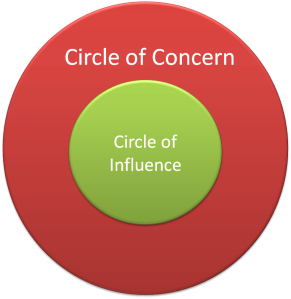
A “crazy-making vicious cycle of stress and discontent”

circle of concern

by Carolyn Thomas @HeartSisters

The best business management lesson that Jen Thorson ever learned may well be a lesson worth learning for all of us – particularly those of us living with heart disease (or any other chronic and progressive diagnosis).

Early in her business career, Jen (now a 30-something mom, distance runner, heart attack survivor and blogger), took a management course called “Dealing with Difficult People Without Losing Your Cool” (and who among us has not signed up for such a course at work, usually with a verrrry specific person in mind?)  Continue reading “A “crazy-making vicious cycle of stress and discontent””