
Melissa Mia Hall, who couldn’t afford health insurance, dies of heart attack

by Carolyn Thomas    @HeartSisters

Melissa Mia Hall, 1954-2011

Melissa Mia Hall’s book-reviewing dog, Daisy

Texas author, artist and book industry journalist Melissa Mia Hall once wrote: “When I need help writing book reviews, my dog Daisy is always eager to lend a paw.” After trying to lift Daisy recently, Melissa felt an odd pain in her chest. She told her editor at Publishers Weekly that she had pulled a muscle. She later emailed a friend:

“Right now really hurting. Hurt my chest/back last night lifting Daisy wrong.  She’s too heavy and I pulled a muscle, I guess. I thought at first I was having a heart attack it was so awful. Tonight I’m really hurting still. Ibuprofen’s not helping much. Using heating pad. It’s been a long painful day and hard to concentrate on much. Why now?  Sigh… xoxo” Continue reading “Melissa Mia Hall, who couldn’t afford health insurance, dies of heart attack”
When your artery tears – Spontaneous Coronary Artery Dissection

by Carolyn Thomas  @HeartSisters

.

Laura, a 40-year old American heart attack survivor, told me this story of her own cardiac event:

“I was asleep and my symptoms woke me up. I had several simultaneous symptoms, but the first one seemed to be chest pain in the centre-left, somewhat under my left breast area. I’d never felt anything like it, so sometimes it’s hard to describe – it wasn’t sharp or crushing or burning, more like a dull pressure. I also had pain down the inside of my left arm that radiated up into the left side of my jaw and my left ear.

“I was very overheated, and I felt like I was going to throw up. The nausea and overheating faded, but the pain – chest, arm, jaw – stayed. In hospital, I was diagnosed with a heart attack caused by SCAD – spontaneous coronary artery dissection, treated with six stents.”

It used to be seen as a deadly condition that was only correctly diagnosed post-mortem.  In fact, the condition was first identified during an autopsy in 1931 after a woman in her 40s had died during a SCAD heart attack. Continue reading “When your artery tears – Spontaneous Coronary Artery Dissection”

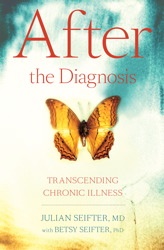
“After The Diagnosis”: two books, same title, one hope

by Carolyn Thomas    ♥  @HeartSisters

A never-married Catholic priest offers marriage counselling to couples. A childless shrink spouts advice on how to raise toddlers. Oprah Winfrey talks about money problems. “You have no clue!” – I want to scream at them. As a heart attack survivor, I now tend to gravitate towards those who are able to practice what they preach based on actual personal experience – not what they have learned at arm’s length. Clinical psychologist Dr. Elvira Aletta, for example, has been diagnosed with not one but two chronic diseases. Dr. Stephen Parker is a cardiac psychologist who is also a heart attack survivor.

And recently, I’ve come across two authors of books on coping with chronic illness that, ironically, share the same main title, After The Diagnosis:

  • Kidney specialist and Harvard prof Dr. Julian Seifter was diagnosed with Type 1 diabetes when he was a young medical intern.
  • Dr. JoAnn Le Maistre received her PhD in clinical psychology, delivered a baby daughter, and learned she had multiple sclerosis  – all within a few months.

What these authors have to share with heart attack survivors and others diagnosed with a chronic illness is quite profound. Here’s why: Continue reading ““After The Diagnosis”: two books, same title, one hope”

Disregard that internet chain letter about “Cough CPR”

by Carolyn Thomas @HeartSisters

Since my heart attack, my friends and family like to forward me every heart-related email going around, usually with the subject line: “Have you seen this one yet?!?!” A particularly persistent one that just won’t go away is entitled “How to Survive a Heart Attack when Alone.” Have you seen this one yet? It recommends that people who think they are having a heart attack should start coughing, long, deeply and frequently. The email claims that coughing will improve blood circulation to the heart, keeping you alive until emergency services arrive. 

Does this work?  

In a word: NO!  Here’s why:

Continue reading “Disregard that internet chain letter about “Cough CPR””