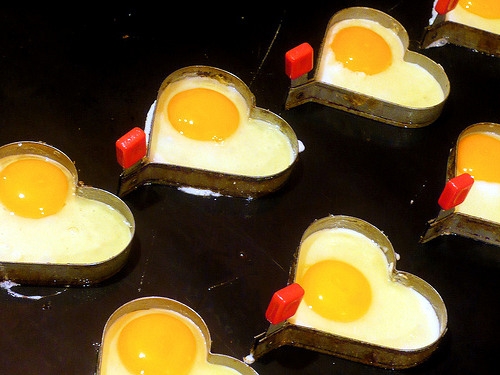
Eggs: good or bad for your heart?

by Carolyn Thomas     @HeartSisters

“I cannot lay an egg, but I am a good judge of omelettes.”

George Bernard Shaw

Eggs were once vilified for their high cholesterol content and were thought to be a major contributor to heart disease.

According to Harvard University’s Harvard Heart Letter, however, it is not the cholesterol in eggs or other food that’s a major culprit. It’s saturated and trans fats (which our bodies may convert to artery-clogging cholesterol). Here’s how Harvard cardiologists unscramble the dietary facts and myths about the egg.

Fact: Eggs are a good source of nutrients. One egg contains six grams of protein and some healthful unsaturated fats. Eggs are also a good source of choline, which has been linked with preserving memory, and lutein and zeaxanthin, which may protect against vision loss.

Myth: Eating eggs is bad for your heart. The only large study to look at the impact on heart disease of eating up to six eggs per week (reported in the April 2008 issue of the American Journal of Clinical Nutrition) found no connection between the two. In people with diabetes, though, egg-a-day eaters were slightly more likely to have developed heart disease than diabetics who rarely ate eggs.  (Ed. note: Quelle surprise . . . this study was done on men only). UPDATE January 2015: A new study (Katz et al) on egg consumption in heart patients also found no significant link between eating eggs and heart disease; Quelle surprise . . . study was funded by the American Egg Board (a minor improvement: this study included six women!) Continue reading “Eggs: good or bad for your heart?”
Do you suffer from ‘kitchen illiteracy’?

by Carolyn Thomas  @HeartSisters

Two of our biggest heart disease risks are diabetes and obesity, and they happen to be two serious health crises in North America.  But according to Civil Eats, the roots of both diet-induced diseases may lie in a rarely publicized but even more pernicious epidemic: kitchen illiteracy.    Continue reading “Do you suffer from ‘kitchen illiteracy’?”

The fall of home cooking and the rise of heart disease

by Carolyn Thomas 

Chef and food activist Dan Barber, writing in The Nation recently, had a goofy, radical, off-the-wall idea:  we need to learn how to cook.  “A lack of technique behind the stove is as complicit in harming human health and the environment as the confinement pig or the corn-fed steer,” he boldly claimed. And author Michael Pollan (In Defense of Food), writing in the New York Times, notes the irony of our fascination with wildly popular celebrity chefs and TV cooking shows (even an entire food cable network!):

“How is it that we are so eager to watch other people browning beef cubes on screen but so much less eager to brown them ourselves? For the rise of Julia Child as a figure of cultural consequence — along with Alice Waters and Mario Batali and Martha Stewart and Emeril Lagasse and whoever is crowned the next Food Network star — has, paradoxically, coincided with the rise of fast food, home-meal replacements and the decline and fall of everyday home cooking. 

Continue reading “The fall of home cooking and the rise of heart disease”

De-junk your kitchen to start heart-smart eating

by Carolyn Thomas  @HeartSisters

Here’s a quick way to start eating in a more heart-healthy way literally overnight: do a pantry makeover.  Start by getting rid of every food item in your kitchen that has either of these two characteristics:  too little nutritional value (fibre, vitamins, minerals, protein) or  too much fat, sodium or sugar.  This includes all junk food of course, but also almost all processed foods in your pantry.  

When I first got home from hospital after my heart attack, for example, I became an obsessive grocery label reader.  I couldn’t believe the sodium content in a can of refried beans!  That stuff will kill you.

If you put unhealthy food in your grocery cart, you’ll eat it.  If you don’t, you won’t. Very simple.

When you go shopping, bring a list.  Don’t shop on an empty stomach. Choose most foods from around the perimeter of the grocery store, where the healthiest food tends to be located. And most important – read those labels.  But meanwhile, if you’re feeling ruthless, start tossing out anything in your pantry right now that fits those two criteria  – and then let’s look at re-stocking basic heart-healthy pantry must-haves:

Continue reading “De-junk your kitchen to start heart-smart eating”