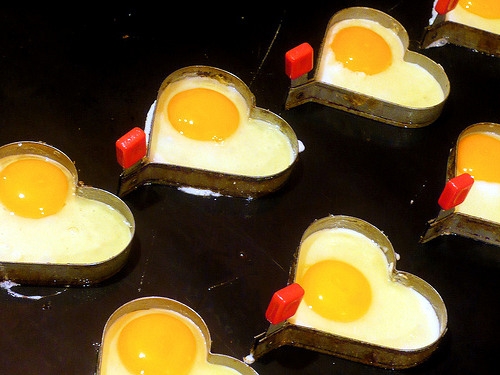
Eggs: good or bad for your heart?

by Carolyn Thomas     @HeartSisters

“I cannot lay an egg, but I am a good judge of omelettes.”

George Bernard Shaw

Eggs were once vilified for their high cholesterol content and were thought to be a major contributor to heart disease.

According to Harvard University’s Harvard Heart Letter, however, it is not the cholesterol in eggs or other food that’s a major culprit. It’s saturated and trans fats (which our bodies may convert to artery-clogging cholesterol). Here’s how Harvard cardiologists unscramble the dietary facts and myths about the egg.

Fact: Eggs are a good source of nutrients. One egg contains six grams of protein and some healthful unsaturated fats. Eggs are also a good source of choline, which has been linked with preserving memory, and lutein and zeaxanthin, which may protect against vision loss.

Myth: Eating eggs is bad for your heart. The only large study to look at the impact on heart disease of eating up to six eggs per week (reported in the April 2008 issue of the American Journal of Clinical Nutrition) found no connection between the two. In people with diabetes, though, egg-a-day eaters were slightly more likely to have developed heart disease than diabetics who rarely ate eggs.  (Ed. note: Quelle surprise . . . this study was done on men only). UPDATE January 2015: A new study (Katz et al) on egg consumption in heart patients also found no significant link between eating eggs and heart disease; Quelle surprise . . . study was funded by the American Egg Board (a minor improvement: this study included six women!) Continue reading “Eggs: good or bad for your heart?”
Your health care decisions: don’t worry your pretty little head over them

by Carolyn Thomas     @HeartSisters

My mother, like many women of her generation, would never dream of telling her doctor that she wants a second medical opinion, even if she suspected that her doctor’s treatment or advice was lacking. This means that, if he were negligent or incompetent or even downright dangerous – which he’s not, by the way –  my mother would rather die than get a second opinion. To ask for one would be rude and insulting to her physician, and that just would never happen.  Whatever her doctor says  goes unquestioned. He is the boss of her health care.

She’s not alone. Many patients choose to simply defer to their physicians, even when that physician is not providing comprehensive information about diagnosis or treatment options. As orthopedic surgeon Dr. Howard Luks described some of his colleagues:

“Time is short for doctors, they often have biases, and many assume patients don’t want the burden of overwhelming information.”

Before my own heart attack, I could have been one of those patients, too. When my doctor ordered lab tests for me, for example, I figured that if the results were bad, I would be phoned.  When I was prescribed drugs or procedures, I figured these were necessary – or my all-knowing physician wouldn’t have mentioned them to me. Otherwise, I was much too busy to think much about my medical decisions.

And now when I ask the women in my heart health audiences to raise their hands if they know their blood pressure numbers, it’s common to see at least 1/3 of the group who have absolutely no clue.  And when I ask them if they know their cholesterol numbers, the awareness level is even worse.

A survey of women over 40 done by The Federation of Medical Women of Canada (called the LIPSTICK Survey) reported that women spend more time thinking about their weight than they do about their hearts. Only 10 per cent of women surveyed, for example, knew their personal cardiac risk factors, versus 64 per cent who know how much they weighed in high school. Continue reading “Your health care decisions: don’t worry your pretty little head over them”

The ‘Merry Christmas Coronary’ and the ‘Happy New Year Heart Attack’

by Carolyn Thomas   @HeartSisters

Did you know that December 26th (celebrated as our Boxing Day holiday in the UK, Australia, Germany, Greenland, New Zealand, Hong Kong, and here in Canada) is historically one of the most dangerous days of the year for people vulnerable to cardiac problems?

And many of these Merry Christmas Coronaries will hit people who didn’t even realize they were at risk when they unwrapped their gifts the day before.

Dr. Samin Sharma, director of interventional cardiology at Mount Sinai Medical Center in New York, says:

“This time of year is notorious for heart attacks, heart failures and arrhythmias.”

It’s widely accepted that the holiday season tends to see increased numbers of cardiac events. One study by researchers at the University of California, San Diego and Tufts University found that heart-related deaths increase by 5% during these holidays. Another study found that daily visits to hospitals for heart failure increased by 33% during the four days after Christmas.

Anecdotally, cardiologists often report that their hospital Emergency Departments stay relatively quiet on Christmas Day itself. Then, come December 26th, they see a surge of cardiac traffic. Continue reading “The ‘Merry Christmas Coronary’ and the ‘Happy New Year Heart Attack’”

Help your heart by de-stressing for the holiday season

by Carolyn Thomas     @HeartSisters

Ah, Christmas. . .  Joy to the world, peace on earth, blahblahblah. For some, the Hallmark card fantasy of the perfect family Christmas is nigh impossible to achieve without the accompanying requisite levels of artery-damaging stress and anxiety by the time the New Year arrives.  As Michele Meyer wrote in Heart Healthy Living:

“Whether your family resembles the Waltons or the Sopranos, few family gatherings are without potential for unspoken tensions.”

And psychologist Dr. Susan Heitler reminds us in the the same article:

“Both unresolved resentment and anxious anticipation of conflict during the holidays can harm your heart by spiking anger or depression. The higher the level of emotional arousal, the more stress on your heart.”

If you’re sometimes tempted to just skip Christmas and go straight to Mother’s Day, consider some of these stress-busting tips this year from Toronto author Susan Stern (in Awakening Your Life Skills) who says that we should all start a plan in advance for de-stressing the holiday season as much as possible.   For example:  Continue reading “Help your heart by de-stressing for the holiday season”