“We are all patients.” No, you’re not.

by Carolyn Thomas  @HeartSisters

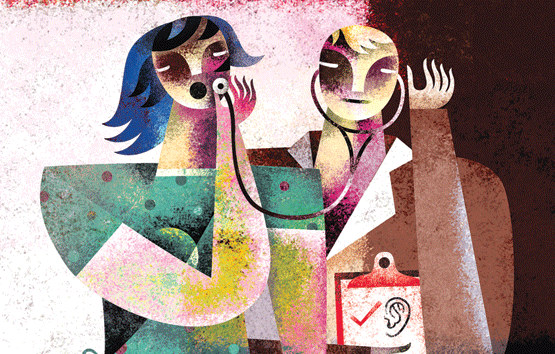
patientI read recently about a conference on breast reconstructive surgery following mastectomy, to which not one single Real Live Patient who had actually undergone breast reconstructive surgery following mastectomy was invited to participate. This is, sadly, yet another example of “Patients Excluded” health care conferences – in stark contrast to the growing number of notable conferences that have garnered the “Patients Included” designation.*

The result of attending a “Patients Excluded” conference is just as you might imagine: hundreds of people working in healthcare getting together to talk at each other about caring for people who aren’t even at the table. Or, as one physician arguing for  “Patients Excluded” conferences protested:

“I already hear patients’ stories all day long in our practice. Why should I have to listen to patients at my medical conferences?”

Continue reading ““We are all patients.” No, you’re not.”

Women, controversial statin guidelines, and common sense

by Carolyn Thomas  @HeartSisters

101109expIf you’re a heart patient, I’m betting that you’re already taking one of the cholesterol-lowering drugs called statins. That’s because these drugs – with brand names like Lipitor, Crestor, Zocor or any of their generic forms – are routinely prescribed to those diagnosed with cardiovascular disease. Many studies (largely funded by the drug companies that make statins) suggest that, for heart attack survivors, these drugs may help to significantly lower our risk of having another cardiac event. It’s what doctors call “secondary prevention”.

Some studies further suggest that statins are also useful for those who’ve never had heart disease, but who do have high LDL (or “bad”) cholesterol – what’s called “primary prevention”. But recently, statins hit the front page of The New York Times with a big fat *splat* when new clinical practice guidelines for treating/preventing heart disease were released by the American Heart Association and the American College of Cardiology (both heart organizations that are coincidentally largely funded by drug companies, too). The guidelines essentially said: from now on, forget about your LDL numbers. It’s all about your risk factors now. 

The likely result of this change, as I observed here and here, is the recommendation that, as long as you have a detectable pulse, you need to take statins. 

Continue reading “Women, controversial statin guidelines, and common sense”

When patients are seen as “The Enemy”

by Carolyn Thomas  @HeartSisters

My daughter loves her career as a probation officer. She is very good at what she does, and finds the work both challenging and rewarding. Yet her client case load includes some of the most unsavoury of individuals, found guilty by the courts of child abuse, domestic violence, sexual assault or worse, many of them  living with added complexities like addictions or mental health issues. She’s been insulted and screamed at by distraught clients. Police are sometimes dispatched to her workplace to intervene in potentially dangerous crises. Few of us could even imagine working in her office every day.

Yet whenever I ask my daughter what kind of day she’s had today, I marvel at her continuing ability to truly care about the work she does, despite the many challenges of working within the criminal justice system, dealing with an often-desperate clientele, and an almost overwhelming legal bureaucracy.

Contrast that perspective with the collective unrest among physicians who seem to hate their jobs.  Continue reading “When patients are seen as “The Enemy””

The weirdness of Post-Heart Attack Stun

by Carolyn Thomas  @HeartSisters

Jodi JacksonI‘m laughing right out loud as I type this post, although I am the last person you’d think would ever laugh at another person’s heart attack story.  Usually. . .  But I love Jodi Jackson’s concept of “Post-Heart Attack Stun” – and I just had to laugh at her delicious examples of this concept at work, both during and after her heart attack at age 42.

Although I didn’t realize until I read about Jodi that there was even an official name for this cardiology concept, I sure knew what she was talking about.   

Post-Heart Attack Stun is what Jodi calls the period following a heart attack where everything seems so surreal that you really don’t absorb what has just happened.    Continue reading “The weirdness of Post-Heart Attack Stun”