 by Carolyn Thomas ♥ @HeartSisters
Do you have a book in your life that you keep opening just for the pure delight of reading it again? I am that obsessed with the book called The Exquisite Machine: The New Science of the Heart, published by MIT Press. In fact, I keep this book beside my favourite red chair so it’s always handy for re-reading random chapters. I’ve been doing this ever since veteran cardiac researcher Dr. Sian Harding wrote the book in 2022, and I can also say I haven’t felt this way about other books I love. So I can’t resist sharing with you some fun facts about our hearts and the research I’ve learned about from Dr. Harding’s work: .
First, let me quickly assure you that, unlike most books about cardiology I’ve read, this book is a patient-friendly reading experience from start to finish. And even though I’ve already read the entire book, I somehow feel like I’m always discovering something new with each fresh read.
 Because her entire 40-year career was spent in academic research, Dr. Harding says she likes to compare notes with what she calls “vast and sensitive data resources in science.” Sensitive data just means surprising facts to the rest of us.
So sensitive, in fact, that she reminds us that researchers can now report the following:
♥ The performance of a cardiac surgeon on the day after their birthday is measurably worse than on any other day of the year (Kato et al, 2020, BMJ)
♥ A male cardiologist who has worked with female colleagues will have a markedly better survival rate among his female patients (Greenwood et al, 2018, Proceedings of the National Academy of Sciences)
♥ In both healthy research volunteers and those living with heart disease, a 2-hour walk along busy downtown streets creates clear damage to the heart, while the same walk in a nearby leafy park increases lung capacity and improves your heart health (Sinharay et al, 2018, The Lancet)
♥ Also in that study, researchers found that cardiac harm from the environment is much wider than air pollution alone. The rate of premature deaths worldwide due to pollution are estimated to be higher than war, murders, malnutrition or vehicle accidents. And noise levels, for example, significantly affected the health of blood vessels in both healthy people and those in the heart disease group. Airplane noise is now known to increase blood pressure if you live directly under a busy flight path. (Sinharay et al, 2018, The Lancet)
♥ You might believe that ultra-fit endurance athletes like competitive cyclists are healthier than the rest of us – which is partly true. They do live about 17 per cent longer than the general population. But a 2020 study found that a significant number (in fact, over half) of endurance cyclists studied developed heart abnormalities and rhythm problems – like atrial fibrillation. As Dr. Harding concludes: “Extreme exercise saves lives in an emergency, but is risky as a modern lifestyle choice!” (Wundersitz et al, 2020. Progress in Cardiovascular Diseases 63) * Scroll to the end for much more on this topic in the excellent book The Haywire Heart.
♥ The last time Germany hosted the World Cup, the incidence of cardiac emergencies in football fans watching was three times higher than the average rate – regardless of the final score. The effect was the same whether the favoured team won or lost, a result attributed to the “tension of the game.” (Lampen et al, 2008, New England Journal of Medicine)
♥ The famous Framingham Heart Study began in 1948, motivated by the massive stroke that had killed four-time U.S. President Franklin D. Roosevelt (Dr. Harding notes that his blood pressure was reported to be an astonishing 300/195). But back then, both doctors and patients alike were profoundly ignorant about the causes of cardiovascular disease. Death from heart disease was accepted as a natural consequence of aging. So cardiac researchers enrolled 2/3 of the adult population of the town of Framingham, Massachusetts town (more than 5,200 men and women, ages 30-62 years, mostly middle-class, urban and white). So far, three generations related to that original research group have also been studied. Framingham researchers introduced the new concept of cardiovascular risk factors into the medical vocabulary in a landmark paper in 1961. But ironically, Framingham’s actual accuracy in predicting future cardiac problems – especially in low-income/high risk populations – has been controversial. (Gray et al. 2009, British Journal of Cardiology)
After decades of authoring scientific papers for medical journals, Dr. Harding hung up her lab coat for the last time in 2022 – coincidentally, the year her book was published. In a later interview with Hospital Healthcare Europe, she explained the difference between writing journal articles and writing The Exquisite Machine:
“As a scientist, you must write in a very specific controlled way. You can’t use vivid language, and I wanted to learn how to write differently.”
Not surprisingly, she still has a keen interest in All Things Cardiac, as you can immediately tell a few pages into her book. She even wrote two sections titled The Invisible Woman and The Hysterical Woman (and if you’ve ever had cardiac symptoms misdiagnosed or dismissed as I have, you can probably guess what kind of not-fun facts you’ll find there!)
“As well as being misdiagnosed, women are less likely to be treated quickly, less likely to get the best surgical treatment, and less likely to be discharged with the optimum set of heart drugs. None of this is excusable.”
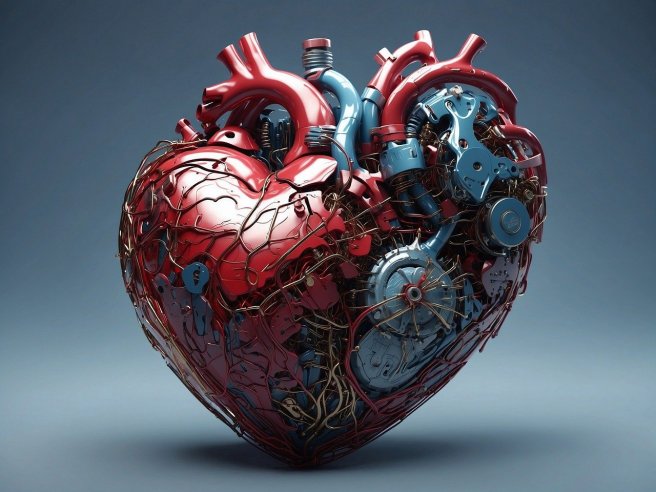
Heart image: The Digital Artist, Pixabay
♥
Q: Have you ever had the experience of reading and re-reading something you’ve kept around since the first read?
.
NOTE FROM CAROLYN: I wrote more about cardiac research in A Woman’s Guide to Living with Heart Disease (published by Johns Hopkins University Press). You can ask for this book at your local library or favourite bookstores (please support your local independent booksellers!) or order it online (paperback, hardcover or e-book) at Amazon – or order it directly from Johns Hopkins University Press (use their code HTWN to save 30% off the list price when you order).
See also:
♥ Heart Sisters posts that include Dr. Sian Harding’s research
♥ The Haywire Heart: * (an interesting book about the link between endurance sports and heart disease by cardiologist/athlete/AFib patient Dr. John Mandrola with journalist Chris Case and cyclist Leonard Zinn)
May
 Heart Sisters
Fascinating fun facts! And I love the heart image at the top!
LikeLiked by 1 person
Thank you Cheryl! Hope you are feeling better and enjoying February (Heart Month!) ❤️
LikeLike
Hoping to provide insight to patients and healthcare providers, my story of very delayed diagnosis of A-Fib/Flutter in an endurance athlete is contained in Chapter 5 of The Haywire Heart!
LikeLike
Genevieve! There you are on page 152! I just looked you up in my copy of The Haywire Heart! Your dramatic story of a misdiagnosed competitive cyclist deserves to be widely read, so for those readers who have not yet read this book, I’d like to quote this brief excerpt:
“At the age of 41, she noticed some weakness when she rode. She thought she wasn’t training enough. But when she started waking up with severe palpitations, in a sweat, she knew something serious was upon her. It would take 10 years for doctors to find the correct diagnosis. She was first told she had an anxiety disorder and was prescribed anti-depressants…”
And also:
“Why did it take so long for Halvorsen to be correctly diagnosed? In her mind, being female played a significant role. As one of her young female primary care physicians wrote in her chart: ‘Has magical and mythical thinking about her heart. Has a generalized anxiety disorder.’ Halvorsen discovered this stupefying diagnosis after asking for her medical charts as she transitioned from one doctor to another in her quest…”
I’m so glad your narrative is quoted so clearly in this important book (although of course NOT glad at all that you had to go through this to be featured!)
Thank you for letting all of us know!
Take care. . .❤️
LikeLike
Who knew? I should have asked my heart surgeon when his birthday was!!!
I keep a select library of what I refer to as Esoteric Science and Philosophy. Authors such as Alice Bailey, Madam Blavatsky, Rudolph Steiner and many more. Most of these were written in the late 1800s and early 1900s. I started reading this type of literature about 35 years ago.
Each time I go back and re-read a chapter I read years ago, I see it with new eyes. . . Life experiences having changed me and hopefully made me wiser, I see and understand more clearly the ideas being presented. Often things I did not understand the first time I read them become crystal clear on the 2nd 3rd or 4th reading.
And so we grow!
Blessings and warm reading adventures!
LikeLike
Hello Jill – I’m guessing that very few of us have asked our cardiac surgeons about their birthdays!
I love your list of “Esoteric Science and Philosophy” books – and so interesting that your favourites date back to the 1800s and early 1900s.
Yet so many people seem to believe that only the modern current “self-help experts” (or worse, the “influencers”!) of today are worth reading or quoting.
February blessings back at you! ❤️
LikeLike
I must admit, the first book that opened up my mind to a Spiritual journey was Wayne Dyer’s “Pulling Your Own Strings” before that book my head was filled with thoughts. . .most of them given to me by “others”.
It was reading that book that gave me the perspective of “thinking about my own thinking” and realizing there was a higher “me” that I could allow to direct my life.
I’ve been working on holding that perspective ever since! So the modern self-help literature is a place to start. But, only to wake up the Truth that is in our own Hearts!❤️
LikeLike
Hi again Jill – I was at a conference in Chicago several years ago where Wayne Dyer was the keynote speaker. He had also brought his whole family to the conference (they sat in the front row of the audience listening – six little kids!) I remember wondering if my own children could ever be that well-behaved during a one-hour presentation! This was in the late 70s (around the time his book “Your Erroneous Zones” had just come out). He was my favourite kind of speaker: a really remarkable communicator plus interesting and useful content that really had an impact on me.
Thanks for that reminder! ❤️
LikeLike