
 by Carolyn Thomas ♥ @HeartSisters
If you’re a heart patient who has had one or more coronary stents implanted, I think you’ll like this history lesson about how such a small device ended up inside your beating heart – with thanks to the Journal of Clinical Medicine and the British Medical Bulletin for much of this lesson.1
First, if you suffered a blocked coronary artery before the 1980s, balloon angioplasty procedures to help unblock that artery were done without stents –> a technique that is now inelegantly referred to (yes, seriously) as plain old balloon angioplasty (POBA). Essentially, this means that a long, thin guidewire (catheter) is threaded up into a blood vessel and then guided to the blocked artery (what doctors call the “culprit vessel”). The catheter has a tiny balloon at its tip. Once the catheter’s in place, the balloon is inflated where the artery is narrowed. This presses the soft plaque or blood clot blocking blood flow up against the sides of the artery, allowing room for adequate blood flow to the heart muscle.
Back then, as the BMB explained, “POBA undoubtedly revolutionized the treatment of coronary artery disease.” But there were sometimes problems in those early days of POBA. One big problem: “Outcomes were compromised by the re-narrowing of coronary arteries due to acute closure of the artery” due to tearing or what’s called elastic recoil.2
Elastic recoil typically occurred in 5–10 per cent of POBA patients immediately after the angioplasty procedure (within hours or even minutes). This scary scenario could lead to a rebound blockage of that artery, which – not surprisingly – often meant severe complications, including acute myocardial infarction (heart attack) – or the need for emergency coronary artery bypass grafting (open heart surgery).
Enter the arrival of coronary stents in 1986. Picture these tiny bare metal mesh tubes. The mesh design allowed cells to grow through and around the stent, securing it permanently in place. These were developed to overcome the dangerous outcomes of Plain Old Balloon Angioplasty.
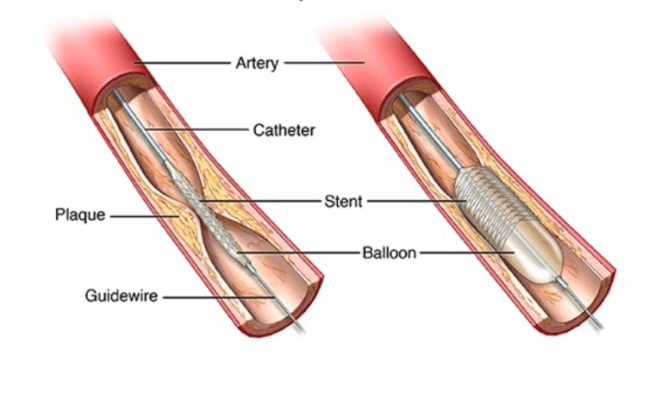 The metal coronary stent was considered the second revolution in the treatment of coronary artery disease. It would take another five years for the first coronary stenting to treat a patient while in mid-heart attack. And it wasn’t until 1994 that the FDA in the U.S. approved use of stents to treat acute and threatened blood vessel closures after those failed balloon angioplasties.
Some heart patients (like me) have a stent implanted because they are in mid-heart attack and need immediate life-saving emergency care. Other patients are at high risk of having a heart attack in the very near future.
In 1999, the third revolution in interventional cardiology was the first drug-coated stent (also known as a drug-eluting stent, or DES) implanted into a human coronary artery. Stents are made of material that’s not native to the human body, which then wants to increase cell growth inside that foreign object. The drug coating was initially an immuno-suppressant medication (originally approved for use in kidney transplant recipients to help prevent organ rejection) by safely reducing this cell growth inside stents – an effect that worked for about a month. This slowly-released drug coating meant a marked improvement in rates of re-stenosis in those early weeks, but emerging studies soon revealed a disturbing problem: late (over 30 days) and very late (over 12 months) stent thrombosis (blockage) inside these drug-eluting stents. This was, as you can imagine, a “dreadful complication”, as described in the Journal of Clinical Medicine.1
It turned out that re-stenosis due to cell growth inside a metal stent is a slow process, but “stent thrombosis (ST) can occur suddenly with acute life-threatening symptoms“. ST is an uncommon but serious complication that almost always presents as “death or a large non-fatal heart attack”.
♥ HEART PATIENTS! PAY ATTENTION TO THIS NEXT PART! ↓
To help prevent death or a large non-fatal heart attack, it is EXTREMELY IMPORTANT to continue taking your daily anti-platelet medications exactly as prescribed for you – until your doctor tells you that it’s safe to stop taking them.
The American Heart Association describes medications called Dual Anti-Platelet Therapy (DAPT):
“One anti-platelet agent is aspirin. Almost everyone with coronary artery disease, including those who have had a heart attack, stent, or coronary bypass surgery are treated with aspirin for the rest of their lives. A second type of anti-platelet agent, called a P2Y12 inhibitor, is usually prescribed for months or even years in addition to the aspirin therapy.”
Common types of recommended anti-platelet drugs include:
- Clopidogrel (Plavix)
- Dipyridamole (Persantine)
- Prasugrel (Effient)
- Ticagrelor (Brilinta)
HOW LONG DO STENT PATIENTS TAKE ANTI-PLATELET DRUGS?
Trick question! Post-stent heart patients are often given a range of DAPT recommendations to help prevent another blockage, commonly from 6-12 months. Last year, the Canadian Association of Interventional Cardiology (the docs who implant stents for a living) issued new guidelines for the use of post-stent anti-platelet drug therapy. Their most current recommendation: a minimum of 3-6 months was recommended (depending on your bleeding risk). Importantly, guideline authors stressed a shared decision-making approach for each individual patient, weighing their known risk of bleeding (a common side effect of anti-platelet drugs) vs. their risk of future cardiac events. They also note that “stent thrombosis after discontinuing anti-platelet therapy seems to be mostly confined to the first six months after a DES is implanted.”
The key messaging here is: discuss and listen carefully to your doctor’s opinions on this issue. Do NOT stop or start any new treatments without consulting your doctor.
In my own case, I had a bare metal stent implanted in my left anterior descending coronary artery during my widow-maker heart attack in 2008. While recovering in the the CCU (the Intensive Care unit for heart patients), I asked one of the cardiologists this question:
Me: “What’s the difference between my bare metal stent and a drug-eluting stent?”
Cardiologist: ” About $2,000.”
What I learned much later is that re-stenosis (e.g. if a stented coronary artery once again becomes blocked) develops in about 30 per cent of patients who have a bare metal stent implanted – although stent thrombosis rates appear to be lower with bare metal stents than with DES.3
As cardiologists learned more about the common and potentially dangerous side effect of re-stenosis, they began choosing drug-eluting stents over bare metal stents to help reduce those re-stenosis rates – along with several generations of different drug coatings.
The potential fourth revolution in the treatment of coronary artery disease was announced in 2011 with the official approval in Europe of what’s known as the Absorb BVS (Bioresorbable Vascular Scaffold). This coronary stent was made of polylactide, a material often used in dissolvable sutures, to replace those permanent metal tubes of DES. Within 2-3 years, this type of stent is fully dissolved. Here in Canada, our government approved the Absorb heart stent in 2016. But in 2023, when cardiologist Dr. Gregg Stone and his research team published their five-year follow up study in the Journal of the American College of Cardiology, he concluded that “despite the improved implantation technique, the absolute 5-year rate of target lesion failure was 3% greater after Absorb BVS compared with non-dissolving drug-eluting stents.” 4
Finally, remember that coronary stents do not cure the underlying condition that caused that blockage in your coronary artery in the first place. A stent impacts only the coronary artery it lives within – not the initial reason for the stent. That’s why your cardiologist is so keen on your own contribution to the cause. For example:
- taking all of your cardiac meds as prescribed
- being physically active
- lowering high blood pressure and cholesterol numbers
- choosing heart-healthy meals
- maintaining a healthy weight
- good sleep and stress management
These and other lifestyle improvements – unlike your implanted stent – will improve every cell in your body.
♥
-
Javaid Iqbal et al: “Coronary stents: historical development, current status and future directions”. British Medical Bulletin, Volume 106, Issue 1, June 2013, Pages 193–211 and also: Brami P et al: “Evolution of Coronary Stent Platforms: A Brief Overview of Currently Used Drug-Eluting Stents.” Journal of Clinical Medicine. 2023; 12(21):6711.
-
Hoffmann R. et al. “Patterns and mechanisms of in-stent restenosis. A serial intravascular ultrasound study.” Circulation. 1996 Sep 15;94(6):1247-54.
-
Canadian Cardiovascular Society/Canadian Association of Interventional Cardiology 2023: “Focused Update of the Guidelines for the Use of Anti-platelet Therapy.” Bainey, KR et al. October 23, 2023.
-
Stone GW et al. “ABSORB IV Investigators. 5-Year Outcomes After Bioresorbable Coronary Scaffolds Implanted With Improved Technique.” J Am Coll Cardiol. 2023 Jul 18;82(3):183-195.
.
NOTE FROM CAROLYN: I wrote more about coronary artery disease in my book “A Woman’s Guide to Living with Heart Disease“. You can ask for it at bookstores (please support your local independent bookseller!) or order it online (paperback, hardcover or e-book) at Amazon – or order it directly from my publisher Johns Hopkins University Press (use their code HTWN to save 30% off the list price).
♥
Floral heart image: smdesigns; Stent image: Johns Hopkins University
See also:
–10 things I didn’t know about angioplasty until I read this book
–other Heart Sisters posts about stents
 Heart Sisters
Sort of a side question – I thought you’ve said daily baby aspirin treatment was based on a typo in an article years ago and there’s no research showing it’s actually effective?
I was on Plavix for 6 months after 6 stents in 2015 (4 in the LAD, 2 in Ramus Intermedius, all drug-eluting stents) but I bled so much that they discontinued it as soon as they felt it was safe, about 6 months after the second batch of stents. I stayed on aspirin for a while, but still bled abnormally, so discontinued it after a couple years.
I had an eye stroke in 2022, was lectured about the need for aspirin, and resumed taking it; then had a vitreous hemorrhage in the other eye in 2023, so I discontinued the aspirin again.
I’ve since gone back on it after numerous lectures from various doctors. So far, knock on wood, bleeding hasn’t been bad, and I don’t mind continuing it if small dings don’t make me wonder if I’ll bleed to death (only slight exaggeration). But I would certainly prefer to not take it, given my vitreous hemorrhage, and would like to be able to discuss it with my cardiologist and other doctors with references to hand.
Thank you for your continued amazing work!
Holly
LikeLike
Hi Holly – you’re right! I did write about that 2002 typo in the British Medical Journal (BMJ) that basically convinced the world we all need to take low-dose aspirin every day to prevent a heart attack. Here’s the link to the post I wrote when the study author, Oxford University Professor Colin Baigent was interviewed a few years after that typo incident. Turns out that the final sentence of his published aspirin study paper said that daily aspirin for low-risk patients was “appropriate” – when the word should have been “INappropriate”!
But back to your situation: it’s important to know that Dr. Baigent’s research was about “primary prevention” for low-risk people with no history of cardiovascular disease, not “secondary prevention” of another cardiac event in people like you and me – who already live with cardiovascular disease.
Most cardiac research does support aspirin for patients like us, BUT aspirin is not a benign drug for those with a high bleeding risk. My go-to resource for this dilemma is this Mayo Clinic opinion on Daily Aspirin Therapy: Understanding Benefits & Risks.
I hope this helps a bit. There’s a fine line between helping and hurting when it comes to aspirin and other anti-platelet drugs when you have a history of high bleeding risk! Good luck to you. . . ❤️
LikeLike
Happy Mother’s Day, Carolyn!
Thank you for all the time and effort you take to research and compose your wise and heartfelt news for us, your “Heart Sisters.” I’m blessed to be included in receiving your fun and educational newsletters.
Please remember that you are appreciated and loved.
Jan
LikeLike
Hi Jan – lovely to hear from you! Thanks so much for your very kind words.
And Happy Mother’s Day to you as well! ❤️
LikeLike
Hi Carolyn,
This report has truly made me feel like a freak as I somehow seem to always fall outside the normal rim of things. I suffered my AMI/STEMI widowmaker in 2010 and I have a DES. I’ve never had any plaque build-up but a rare form of Coronary Artery Disease in which my arteries go into spasms and collapse. At that time I was given the second smallest stent made – 2.5mm -due to a microvascular disorder. It is in my main coronary artery just outside my aorta, my last cath was a little over 4 years ago and it was still clear.
I had an A-ICD implanted in 2018 because of what they call ‘episodes’. I suffer with a number of severe allergies and dissolving stitches is one. Because I can be taken off of the Plavix and aspirin I was frozen. I’m allergic to adhesive tape-silicones, iodine, sulfur, and latex, natural rubber. They glued me back together, inside and out and two days later I was in my electrophysiologist office for severe chemical burns from the surgical dressing. New allergy.
The thing is I keep falling outside of the norm and everyone wants to place me in a group. For one of my problems I have a rare blood type and hypercoagulability making my blood super thick. I take both aspirin and Plavix and have for 13 1/2 years. I am 5’4″ tall and at the time weighed 108.2 pounds, placing me underweight.
I am 100% compliant in medications, diet, and exercise as I’m a listed transplant candidate. The diet for cardiac patients has my weight down to 105.3 lbs. I’ve been on a salt-free diet for 41 years because of high BP and medications. My old INS doctor said mine was caused by a bad temper and I had to be medicated to prevent a stroke. I had a heart that didn’t grow to normal size.
Fast forward – my major cardiac condition is a full sentence “Coronary artery disease involving native coronary artery of native heart without angina pectoris.”
Saw my cardiologist Thursday and they did a 12 lead ECG and I’m heading back to the cath lab once as it appears that I’ve suffered a rare anteroseptal infarct. My have been enlarged for sometime now and now my right atrial is enlarged.
Like I said they are still generalizing all heart patients. Cardiologists fail to see women as individuals but treat us like small men.
LikeLike
Hello Robin – Yikes! “Severe chemical burns from the surgical dressing!? That sounds just awful!
And yes, once again you seem to be baffling to the medical profession, but that does not make you a freak at all. It might seem nicer (for docs) if all women DID fit into some kind of box that was always predictable and identical – but of course none of us is identical to any other heart patient.
We all have major differences in symptoms, test results, condition severity, family history, treatment decisions, outcomes etc. – as evidenced here in the variety of ways that cardiologists make decisions about the stents mentioned in this post – bare metal stents, for example, were considered a “miraculous” improvement for heart patients compared to POBA – until some surprising exceptions started popping up with drug-eluting stents – as in Jill’s comment (below) where her bleeding risk meant her own bare metal stent was actually recommended by current treatment guidelines.
Knowing about this difference may be more challenging for doctors, but it is actually a hallmark of good medicine – that way, all patients are considered as unique individuals.
Good luck to you – take care. . . ♥
LikeLike
Clear, concise and on point. Thank you, Carolyn.
LikeLike
Thank you Dr. Anne – and Happy Mother’s Day to you! ❤️
LikeLike
Carolyn,
Thanks for sharing this important information. It’s interesting to learn about the evolution of the stent. I’ll keep this info handy when I see my cardiologist.
LikeLike
Hi Emmi – I agree – it’s so interesting seeing the evolution of stents (see Jill’s response below, as an ICU nurse when early angioplasty and stents were seen as “miraculous”!)
Happy Mother’s Day! ❤️
LikeLike
Hi Carolyn,
I worked in an Open Heart Surgical ICU during the years that POBA and stenting appeared on the medical frontier. It was so miraculous and non-invasive, we wondered if Coronary By-Pass surgery would become obsolete!
Of course it hasn’t become obsolete, but is now reserved for the worst case scenarios where stenting cannot do the job.
I too have a bare metal stent. Circa 2017. When I asked why a bare metal stent instead of a DES – If I remember correctly, the answer I got was because I was on Blood Thinners, specifically Warfarin, for the rest of my life due to my high risk of Atrial Fibrillation, that a drug eluting stent was unnecessary.
Did you run across that anywhere in your reading?
Happy Mothers Day!
LikeLike
Hello Jill – I’m not a physician etc etc etc (rest of disclaimer!) 🙂 – but in my travels, I did find a 2013 study from Brigham & Women’s Hospital in Boston. I’m guessing that, in your case, there may have been a concern about bleeding.
Here’s what this study concluded: “5-7 % of patients undergoing stenting are on oral anticoagulation for atrial fibrillation, a prosthetic valve, a recent left ventricular thrombus or recent pulmonary embolus. In those with the highest bleeding risk, use of a bare metal stent is strongly advised. In addition to bare metal stent use, the use of proton pump inhibitors, tight control of the international normalized ratio (INR) and only one month of dual anti-platelet therapy can reduce the bleeding risk without an increase in stroke or stent thrombosis.”
So it seems there is still a place for bare metal stents (or maybe these dissolving stents of the future, although they’re not used in every heart hospital yet).
The good news: you and I both had bare metal stents implanted – and we’re still here!!! And neither of us have suffered a stent thrombosis! Yay, us!!
Happy Mother’s Day to you, too! ❤️
LikeLike
Thanks for that study! and yes I only took Plavix for 1 month after the stent just as was recommended. But I remain on baby aspirin.
I never really investigated since I wasn’t really given a choice of what stent I would prefer LOL.
But it feels good to know that there was a scientific basis for the choice that was made for me in the Cath lab.
My last cardiac cath a few years ago showed the stent wide open. Yeah!!
LikeLike
Hi again Jill – yes, heart patients are rarely invited to share their opinions on what kind of stent they’d prefer to have implanted! Go figure. . .
I think of that when I see these shocking “Ask Your Doctor!” pharmaceutical company ads for CANCER DRUGS! What kind of oncologist would make a decision on the most appropriate cancer treatment drug because the patient has heard about this drug on a TV ad? Arrrgh. But I do feel pretty confident that the cardiologist who answered my question to him about the difference between bare metal and DES was telling me that, in his opinion. the most important factor was MONEY!
It’s very reassuring that your last trip to the cath lab showed a wide open stent! I’ve had that experience too. Since most research suggests that problems with any implanted stent becoming blocked are far more likely to occur in the earlier days/weeks/months post-implant, it feels like those of us who got our stents years ago can rest a bit easier, right?
I sure hope so anyway! ❤️
LikeLike