
The freshly-diagnosed patient has plenty of opportunity to start thinking thoughts that are bizarre and often frightening. Any new life-altering medical condition (like the misdiagnosed widow-maker heart attack I survived back in 2008) can throw us off-balance, both physically and emotionally.
And hearing yet another new diagnosis will likely feel worse than any others. We rarely if ever see it coming. I’ve been learning this first-hand ever since April 1st when I was diagnosed (surprise!) with a malignant tumor in my right breast.
Learning about that new diagnosis (invasive ductal carcinoma) felt utterly surreal at first – mostly because cancer is so different from other diagnoses in two important ways:
1. Despite my newly confirmed cancer diagnosis, I felt perfectly fine, living my normal life in every way – and with no symptoms. Compare that to my heart attack, when I was critically ill with life-threatening symptoms – until I was treated.
2. But many of us cancer patients start feeling ill when our treatments begin. Cancer treatment basically stops short of killing the patient by trying to kill off the cancer cells first.
Cancer treatments can often feel like a race to see who wins. The Illinois Science Council, for example, describes chemotherapy for cancer patients like this:
“Most cancer patients, at some point, will likely receive chemotherapy as part of their treatment plans. This anti-cancer therapy is not one drug, but a category of drugs – all of them work by entering cells and stopping them from quickly dividing into new cells, with the hope that they will stop tumors from growing, too.”
A Canadian government report found that over one-third of seniors now live with two or more chronic diseases. That’s a lot of scary new diagnoses nobody wants. Four of those chronic diseases (cardiovascular disease, diabetes, chronic respiratory disease and – yes, cancer) account for over 60% of all deaths here in Canada.
My own 12-month treatment plan features three different chemo drugs – scheduled for every third Monday at our local Cancer Clinic.
I liked this description of a typical Cancer Clinic Chemotherapy Room at Boston’s Beth Israel Deaconess Medical Center – because it’s so remarkably similar to how I’d describe our own Cancer Clinic, too:
“All cancer treatment facilities have a designated area for chemotherapy infusions. For virtually all new patients, the first step into the infusion room (typically called the Chemo Room) is scary. You have no idea what to expect and envision something quite grim.”
“Perhaps you imagine a large space full of very ill-appearing people, most of whom might be either sleeping or vomiting. Mostly, you are thinking about yourself and what lies ahead. Will it hurt? Who will be my chemo nurse and will I like her/him? How sick will I be? And, above all else, is this going to work and stop the cancer?
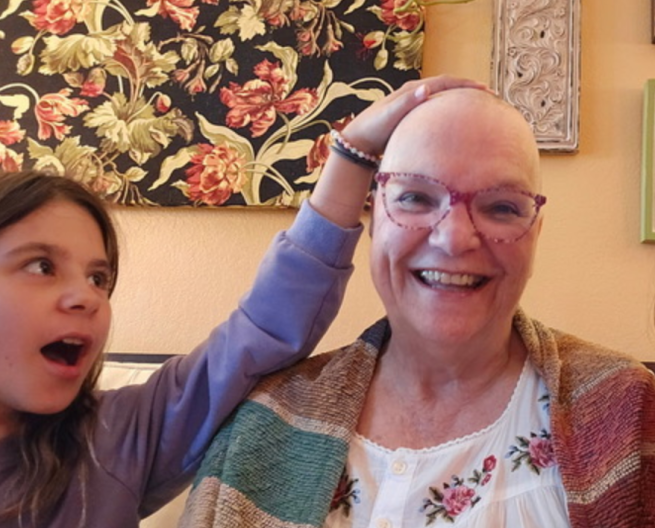
As a new cancer patient, I had the same questions.. I knew that chemotherapy drugs can cause considerable damage, especially to fast-growing healthy cells (e.g. hair follicles) and other cells that are quickly dividing in the body – which explains why all my hair fell out. . Compared to other chemo side effects, by the way, hair loss has been a non-issue for me. Turns out I love a bald head!
Two of my worst chemo side effects so far were triggered early on by a chemotherapy drug called docetaxel. First came truly distressing side effects of the disgustingly metallic taste of almost everything I tried to eat or drink. I basically lived on ginger ale, protein shakes and frozen fruit popsicles. See also: Remember When Food Tasted like Food?
The same chemotherapy drug was the likely culprit behind another brutal side effect called Hand-Foot Syndrome – during which painful blisters on the soles of both feet start peeling off in alarming chunks. I’m now in month #2 of using a walker so I can get around with less discomfort.
Consider that scenario for a moment: within one short week, I could neither eat nor walk. It was a quality-of-life crisis.
What I didn’t realize at the time, however, was that I could request a break from my treatment plan. All I knew was that I just could not bear to go back to the same Chemo Room three Mondays later – where I knew the same toxic drugs would slowly drip into every cell of my body once again. It was one of the chemo nurses, in fact, who suggested I ask my oncologist this question:
“What other treatment options are available to me?”
My oncologist’s response was not what I’d expected. He immediately agreed that yes, we could safely delay chemotherapy for a week or more to give my body a rest, and we could also try reducing the dosage of the chemotherapy drugs by 20 per cent on future Chemo Days.
Those two changes seem to be working. Shortly afterwards, I could taste some foods – and by now my foot blisters have slowly begun to heal, too.
So far, my body’s response to killing off those cancer cells has been spectacular by all accounts. My tumor (originally the size of a small grapefruit) has shrunken dramatically. My oncologist actually called it “imperceptible”! Yet despite this terrific news, I have a surgical consult booked later this month to discuss a mastectomy.
But even a spectacular response still comes with the reality of cancer treatments and their side effects. Chemotherapy affects my body’s ability to maintain healthy white blood cells, for example. This is dangerous for cancer patients because those precious white blood cells are what protect us every day from deadly infections.
I now carry a letter from the Cancer Clinic, for example, that I must bring with me to the Emergency Department if I develop a fever (often a sign of infection). And on the third day following each chemotherapy appointment, I start the first of seven days of injections at home. These injections are meant to help my bone marrow produce new white blood cells. Severe bone pain is its most common side effect.
It’s only much later that I can reflect on how overwhelming this way of existence has become. Life with cancer is SIMPLY NOT NORMAL! We try to make sense of what makes no sense to us. This is what behavioural scientists call cognitive distortion.
One of the experts who teaches and researches this subject at Stanford University is psychiatrist Dr. David Burns (author of The Feeling Good Handbook. Here’s Dr. Burns’ list of some of the most common examples of what he calls “twisted thinking” so often experienced in patient responses like these:
1. All-or-nothing thinking (no grey areas): We look at our life now in absolute, black-and-white categories. “This is really bad and it’s getting worse!”
2. Over-generalization (using words like “always” or “never”): We may view recuperation setbacks as signs of permanent defeat.
3. Mental filter: We pick out even the smallest of negative events and ruminate on them over and over.
4. Discounting the positives: (“Yeah, but . . . “): We minimize our early progress by pointing out what we still aren’t able to do well yet.
5. Magnification or minimization: We may exaggerate the significance of each symptom, or minimize progress by shrinking its importance.
6. Emotional reasoning: (If X, then Y. . . ): We believe every feeling to be a valid emotion: “I feel angry, so this proves I’m being treated unfairly!”
7. “Should” statements: (if directed at ourselves, can lead to guilt or shame; if directed at others, can lead to resentment): Some of us try to motivate ourselves (and others) with shoulds and shouldn’ts.
8. Personalization and blame (“It’s all my fault” vs. “It’s all YOUR fault!”): We can hold ourselves personally responsible for an event that’s not under our control, or we blame other people or their circumstances.
♥
So what can you do if you recognize one or more of these twisted thinking patterns in your own life? Here are some of Dr. Burns’ suggestions:
♥ Identify the cognitive distortion: Write down your negative thoughts so you can track which of these cognitive distortions have become your favourites.
♥ The Double Standard Method: Instead of self-talk that’s harsh or condemning, talk to yourself in the same kind and compassionate way you would talk to your Mum or sister or friend in a similar situation.
♥ Think in shades of grey: Instead of thinking about your problems in either black or white, try thinking of things that don’t work out exactly as you’d hoped as a partial success, not a complete failure.
♥ The Survey Method: Ask other patients (in person or via online patient support groups) if they have experienced similar situations.
♥
Q: Which examples of twisted thinking seem most familiar to you?
..
NOTE FROM CAROLYN: I wrote more about becoming a patient in my book, “A Woman’s Guide to Living with Heart Disease”. You can ask for it at your local library or favourite bookshop (please support your neighbourhood independent booksellers!) or order it online (paperback, hardcover or e-book) at Amazon – or order it directly from my publisher, Johns Hopkins University Press (use their code HTWN to save 30% off the list price).
 Heart Sisters
Carolyn,
Thanks for this article and all of the articles you post. Years ago Karend H. said something to me that I have found helpful over the years “Don’t should on yourself.” It makes me smile and reminds me to ease up.
Marty
LikeLike
Hello Marty and thanks so much for sharing Karen’s wise advice!
Take care. . . ❤️
LikeLike
Hello Marty and thanks so much for sharing Karen’s wise advice!
Take care. . . ❤️
LikeLike
Hello Marty and thanks so much for sharing Karen’s wise advice!
Take care. . . ❤️
LikeLike
This was very interesting to me because, after focusing on my heart issues for so long, I was just diagnosed with stage 3B colon cancer.
I had breast cancer 12 years ago but for me, it was a walk in the park ( only needed radiation), but now I am 78 with a completely different set of decisions.
Given my age and Afib (which can complicate at least the chemo I would have to do), I’m inclined to forego chemo – – I’ve had surgery to remove the tumor but a couple lymph node showed cancer cells. What you’re going through actually is reinforcing my feeling — I don’t have a couple years to be miserable in hope I’ll gain a couple years or more at the back end.
I want to live whatever life I have as well and as long as I can while I can. If I were your age, I might be more up for the task. But even in my situation, your blog was very helpful to me in making a decision, and I thank you.
LikeLike
Hello Kathleen – you’re so right. We face different decisions at different ages and stages of life. Every cancer patient is different, every diagnosis is
different. For five years, I watched a close friend go through her cancer treatments, a young fit woman diagnosed on her 50th birthday. She and her oncology team
threw everything they had at “the cure”. Every year, as the cancer continued to spread to different areas (lungs, brain, bone), she underwent more surgery,
more chemo, more radiation. Her family encouraged her to try more powerful treatments in an effort to “beat” the cancer. Those decisions were understandable for a
a 50 year old dynamo, but may be less understandable had she been two decades older on diagnosis. There’s no right or wrong path – these big decisions must resonate
with the PATIENT first and foremost.
I believe that we make the best decisions based on what we know at the time. I’m wishing you good luck Kathleen as you weigh your own decision-making.
Take care ❤️
LikeLike