“It’s 2 a.m. and I think I’m having a heart attack”

by Carolyn Thomas    @HeartSisters

“It’s 2 a.m. and I think I might be having a heart attack. Right now I have a tight chest and pain in my left arm and in my elbow that comes and goes; early this week, I was having pain in my left and right legs. What should I do?”

“I’m sitting in bed and have been up for hours. For four days, I have been having upper right back pain up to the neck. I cannot turn my head left. Tonight I have pain in my elbow and a tingling all the way down my right arm and to my fingers. I’m only 29 and a healthy weight. I need some answers. Do I need to go to the ER?”

“I have most of these symptoms.  My mom thinks I’m fine. I really think she doesn’t understand. I can be heading to a heart attack any day soon. And I’m only 14, almost 15 in a couple of days.”

These represent just a tiny sampling of the symptom questions that my blog readers often send me. My response to each of these is virtually always some variation of this statement:   Continue reading ““It’s 2 a.m. and I think I’m having a heart attack””
Finally. An official scientific statement on heart attacks in women.

“Sucks to be female. Better luck next life!”

You’re unlikely to spot this succinct summary within the pages of the new official scientific statement on women’s heart attacks from the American Heart Association, but that’s basically the message.(1)  That pithy summary, by the way, was originally quoted here from Laura Haywood-Cory, who at age 40 survived a heart attack caused by Spontaneous Coronary Artery Dissection.  (See also: Cardiac Gender Bias: We Need Less TALK and More WALK.
 .
The AHA statement, published in the journal Circulation to a flutter of media interest, basically confirms what I’ve been writing and speaking about for the past eight years: if you’re a woman having a heart attack, you’re more likely to be underdiagnosed – and then undertreated even when appropriately diagnosed – compared to our male counterparts.
.
So my question this week (as a woman who was sent home from the ER in mid-heart attack with a misdiagnosis of acid reflux) is this:  if Laura and I and countless other women who’ve survived a heart attack have long ago reported on this “news”, why has it taken 92 years for the American Heart Association to produce its first ever scientific statement on myocardial infarction in female patients?  But don’t get me wrong – I’m always relieved to see any attempt from any major heart organization that helps to spread the word, so I’m running the full AHA news release for you here:  

Continue reading “Finally. An official scientific statement on heart attacks in women.”

Depressed? Who, me? Myths and facts about depression after a heart attack

fake-smile

by Carolyn Thomas    @HeartSisters

I have a friend who has a friend who’s been depressed, off and on, for years. During that time, my friend and I have done our fair share of eye-rolling whenever the subject of this person’s depression came up. We wondered why she just couldn’t pull up her socks and quit all this self-absorbed moping around.

Neither my friend nor I had ever had one nanosecond of actually experiencing clinical depression ourselves – which, of course, didn’t stop us from passing judgement.  Continue reading “Depressed? Who, me? Myths and facts about depression after a heart attack”

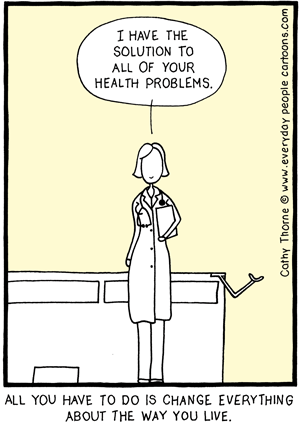
Why don’t we listen to doctors’ heart-healthy advice?

change lifestyle cartoon cathy thorne

by Carolyn Thomas  @HeartSisters

Imagine that your daughter is preparing for a ski race. It’s five minutes before the start of the race. You want to give her some meaningful advice. Which one of these two messages are you going to use?

1. “Honey, remember to do XYZ – it will help you avoid falling!”
2. “Honey, remember to do XYZ – it will make you faster and you’ll have more fun!”

Austrian physician Dr. Franz Wiesbauer, writing to his fellow doctors in a Medcrunch article called Why Your Health Message Does Not Work, has asked this question many times. His conclusions?  Continue reading “Why don’t we listen to doctors’ heart-healthy advice?”