The lost art of common courtesy in medicine

by Carolyn Thomas  @HeartSisters

So I showed up for a scheduled medical test at the hospital the other day. It was one of those particularly distasteful tests that involve a full day’s prep at home choking down a range of hideous chemical cocktails, consumption of which is designed to induce explosive liquid diarrhea that requires staying very, very close to a toilet all day long. The procedure itself  on the following morning was right up there on the Creepy Disgusting Embarrassing Cringe Scale of medical experiences.

Hospital procedures like this feel invasive, uncomfortable, distressing, and revoltingly undignified for most patients. All the more reason that medical staff who administer such procedures need to start treating us like we’re more than just the nameless, faceless 10 o’clock patient in Bed 8, what I’ve previously described here as “the obstacle between them and their next coffee break, just a piece of meat on a slab – but worse, an invisible piece of meat.”

Call me crazy, but I might even go so far as to insist that patients deserve to be treated with common courtesy, and let’s start with the simple basics of saying something like:

Hello. My name is _____ and I’ll be doing your ______  today.” Continue reading “The lost art of common courtesy in medicine”

Why are hospital staff wearing uniforms, scrubs and white coats in public?

by Carolyn Thomas

One of our big hospitals is around the corner from my local grocery store. This location is handy for hospital staff, who can pop in for groceries on their way home from a long shift. And it also makes it über-creepy for those of us who watch them leaning over the produce bins while still wearing the same bacteria-laden scrubs, white coats or uniforms they’ve been wearing at work.

Here’s why I get the heebie-jeebies at this sight.  John Gever, Senior Editor at MedPage Today, has reported recently on a study* suggesting that more than 60% of physicians’ coats and nurses’ uniforms sampled tested positive for disease-causing bacteria, including antibiotic-resistant Staphylococcus aureusContinue reading “Why are hospital staff wearing uniforms, scrubs and white coats in public?”

When a pet dies: another definition of broken heart

by Carolyn Thomas  @HeartSisters

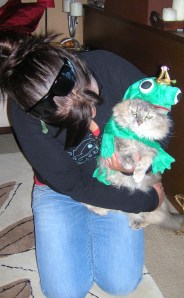
My cat Lily died in my arms last Monday evening. We were sitting around watching the hockey playoffs on TV, Lily curled up in her little wicker bed on the floor beside me. Suddenly, I heard an unusual, low-pitched “meeeooow” like I’d never heard before, a small cough, two deep sighs, and then nothing. The vet believes that “her heart just gave out” due to hypertrophic cardiomyopathy, the most common form of heart disease in cats. Sometimes there are no signs and sudden death is the first, and last, hint of any problem. That trip to the vet was a blur. My daughter Larissa (that’s her on the left showing off Lily’s frog costume last Halloween) and my son-in-law Randy were right there with me.

Later, after a weepy final visit with my Lily in the vet’s office, we were back at home over rhubarb crisp and tea. They quietly removed Lily’s toys, food  and assorted cat stuff so I wouldn’t have to deal with them the next morning.

Let me tell you a little about my Lily. After my heart attack, I found out that owning a pet happens to be very good for heart patients.  In fact, being a cat owner could actually reduce your risk of another heart attack by nearly one-third, according to a 10-year study by researchers at the University of Minnesota’s Stroke Institute. And even having a purring cat on your lap can lower your blood pressure.

So off we headed to the local animal shelter, where we adopted the world’s cutest cat.  Continue reading “When a pet dies: another definition of broken heart”

Apply now for the WomenHeart Symposium at Mayo Clinic

by Carolyn Thomas  @HeartSisters

Are you, or do you know, a woman living with heart disease who is interested in making a real difference to women’s heart health as a WomenHeart community educator?

Are you also at least six months past your last hospitalization for cardiac treatment, have your doctor’s written permission to travel, are very comfortable speaking in public, and want to start a WomenHeart Support Network in your home community?

If so, consider applying to attend a life-altering training event called the WomenHeart Science & Leadership Symposium at the world-famous Mayo Clinic, October 7-10 in Rochester, Minnesota.  Continue reading “Apply now for the WomenHeart Symposium at Mayo Clinic”