Self-tracking device? Got it. Tried it. Ditched it.

smartwatch-2301284_1280

by Carolyn Thomas    @HeartSisters

It took a while to improve upon the humble pedometer. This wearable device, typically attached on or near one’s waist, has been tracking how many steps and how much distance we travel each day ever since its invention by Abraham-Louis Perrelet back in 1780.

But with the explosion of wearable digital activity trackers on the market, I’m now waiting for the randomized control trial that compares those fancy-schmancy new devices head to head with that simple old-fashioned pedometer. In other words:

Q:  Just because you make it digital, does it make it better? 
Continue reading “Self-tracking device? Got it. Tried it. Ditched it.”

Two ways to portray heart failure. One of them works.

Screen Shot 2016-02-10 at 4.25.29 PM
  EXAMPLE #1: Sisters and heart failure patients Shaun Rivers (left) and Kimberly Ketter

by Carolyn Thomas     @HeartSisters

If you were suddenly diagnosed with heart failure, you would first of all be utterly horrified by hearing those words “heart failure” – which brings me to the eternal question: when are cardiologists going to come up with a better name for this common condition in which a person’s heart has trouble pumping blood as well as it should? (See also: “When Doctors Use Words That Hurt“)

I hope that the second thing that happens after you hear those dreadful words is that somebody will immediately show you this beautiful photo (above) of twin sisters Shaun Rivers and Kim Ketter, both nurses from Richmond, Virginia.  They were each diagnosed with heart failure during the same week in 2009 when the twins were just 40 years of age.  

Now compare the twins’ photo (and its accompanying text from the American Heart Association) with something that I hope you will never, ever see upon hearing that frightening diagnosis:
Continue reading “Two ways to portray heart failure. One of them works.”

Marilyn Gardner’s “Stupid Phrases for People in Crisis”

crisis

Note from Carolyn:  This guest post is republished here with the kind permission of its original author Marilyn Gardner, who writes on Communicating Without Boundaries about cross-cultural communication, with an emphasis on faith and third culture kids. Marilyn grew up in Pakistan, lived and worked in Pakistan and Egypt as an adult, and moved to the United States where she is learning to live away from curry, Urdu, Arabic and the Pyramids.  She lives in Cambridge, Massachusetts, 15 minutes from the international terminal where she flies to the Middle East and Pakistan as often as possible. 

Despite the pervasive popularity of the following cliché reassurances, Marilyn asks that you please leave the following well-meaning but unhelpful platitudes at home whenever you’re trying to comfort a person who is suffering during any kind of personal crisis – including a cardiac emergency:

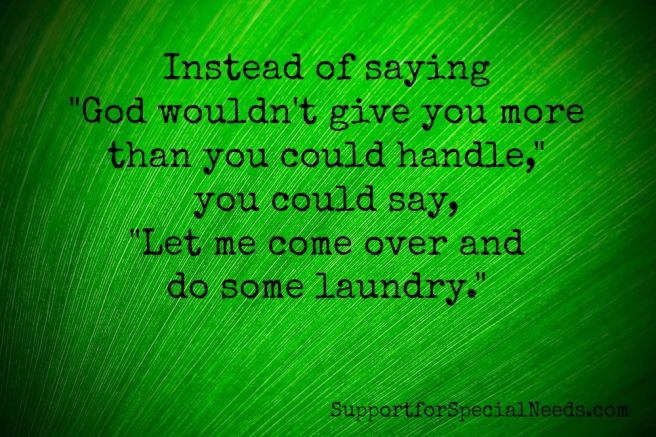
  • God will never give you more than you can handle.  While some may believe it is theologically correct, depending on your definitions, it is singularly unhelpful to the person who is neck-deep in a crisis, trying to swim against a Tsunami. A wonderful phrase recently came from Support for Special Needs. They suggest changing this from “God will never give you more than you can handle” to “Let me come over and help you do some laundry.” This strikes me as even more theologically correct.

Why don’t we listen to doctors’ heart-healthy advice?

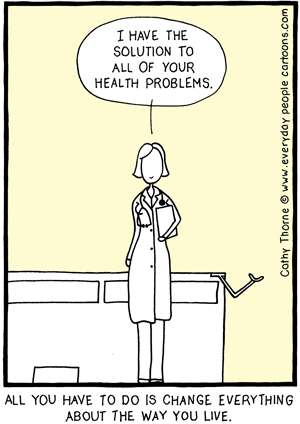
change lifestyle cartoon cathy thorne

by Carolyn Thomas  @HeartSisters

Imagine that your daughter is preparing for a ski race. It’s five minutes before the start of the race. You want to give her some meaningful advice. Which one of these two messages are you going to use?

1. “Honey, remember to do XYZ – it will help you avoid falling!”
2. “Honey, remember to do XYZ – it will make you faster and you’ll have more fun!”

Austrian physician Dr. Franz Wiesbauer, writing to his fellow doctors in a Medcrunch article called Why Your Health Message Does Not Work, has asked this question many times. His conclusions?  Continue reading “Why don’t we listen to doctors’ heart-healthy advice?”