Premenopausal women and cardiac symptoms

by Carolyn Thomas      @HeartSisters

Most of you throughout your adolescent and adult lives have no doubt observed that hormone fluctuations during a menstrual cycle can affect certain body parts on certain days of that cycle. These fluctuations cause symptoms ranging from bloating to cramps, vivid dreams, fatigue, acne breakouts, food cravings, or irritability. (That word ‘irritability’ is doctor-speak to describe the act of threatening spouses with strangulation if they leave that freakin’ toilet seat up one more time…)

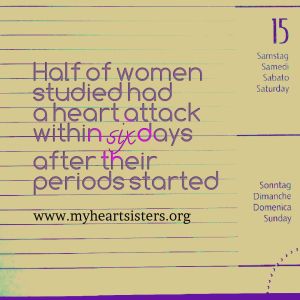
For decades, scientists have also observed that women’s risk of heart attack increases after menopause. One theory for this age-related delay (compared to male heart patients, who generally tend to have their heart attacks a decade or so before we do) was the drop in female hormones at menopause, particularly estrogen. That timing seemed to intuitively make sense. Estrogen levels go down, heart attack rates go up. It’s why physicians believed for a long time that hormone replacement therapy in postmenopausal women could actually prevent heart attacks. (PLEASE NOTE: it doesn’t.*) Continue reading “Premenopausal women and cardiac symptoms”

Excuse me while I bang my head against this wall…

by Carolyn Thomas      @HeartSisters
.

Last week, the disturbing results of a study on women and heart disease were released, attracting media headlines like Women and Heart Disease: New Data Reaffirms Lack of Awareness By Women and Physicians. I had to go have a wee lie-down after I read this paper in the Journal of the American College of Cardiology.(1)

The study’s lead author, cardiologist Dr. Noel Bairey Merz, of Cedars Sinai Heart Institute in Los Angeles, announced that “increasing awareness of cardiovascular disease in women has stalled with no major progress in almost 10 years”, and (far more intensely disturbing, in my opinion): “Little progress has been made in the last decade in increasing physician awareness or use of evidence-based guidelines to care for female heart patients.”

No wonder I had to lie down. But taking to one’s bed in response to yet another discouraging study about cardiology’s gender gap is no longer enough. Perhaps it’s time for female heart patients like me to simply throw our collective hands in the air while banging our heads against the nearest wall. Continue reading “Excuse me while I bang my head against this wall…”

Six lessons Emmi learned from her Hollywood Heart Attack

by Carolyn Thomas  ♥  @HeartSisters

Emmi S. Herman is the mother of three millennials and grandmother of two perfect grandchildren. As a doting grandmother myself, I can relate. I can especially relate to her because, like Emmi, I too survived what doctors call the widow maker” heart attack (a misnomer that really needs fixing given how many women I know who have survived it. Physicians don’t, for example, call this serious cardiac event the “widower” maker, do they?)  Emmi is a children’s book author with expertise in early literacy skills. When not writing copy at her day job or at work on a memoir about her sister, she is in her car somewhere between New York and New Jersey.

Here’s how she describes the six important lessons she learned about having a heart attack.  Continue reading “Six lessons Emmi learned from her Hollywood Heart Attack”

European women face the same cardiac gender gap we do

by Carolyn Thomas    @HeartSisters

I’m interested in women’s heart health, and because my Heart Sisters blog readers come from all parts of the world (in 190 countries at last count), that interest isn’t aimed only at women’s shared experiences here in North America where I live. As the World Heart Federation tells us, heart disease is the #1 global health threat to women everywhere on the planet.

Researchers know that the cardiac gender gap we worry about here is distressingly similar to what women around the world face, too. Here’s how one European cardiologist describes how she views this gap for the women where she lives:  Continue reading “European women face the same cardiac gender gap we do”