
Mayo Clinic’s ‘WomenHeart Science and Leadership Symposium’ featured in Time magazine

by Carolyn Thomas  @HeartSisters

Two organizations very dear to my heart – literally – were featured last month in Time magazine’s Women and Health series. Both the world-famous Mayo Clinic and the not-for-profit organization called WomenHeart: The National Coalition For Women With Heart Disease were singled out because of a unique and life-altering program they host for women heart disease survivors. As a 2008 graduate of the annual WomenHeart Science & Leadership Symposium at the Mayo Women’s Heart Clinic in Rochester, Minnesota, I was thrilled to see these two pioneering advocates for women’s heart health acknowledged by Time.

Each year, Mayo’s leading heart specialists welcome 50 heart disease survivors attending this 4-5-day Symposium.  I like to describe it as part world class cardiology training, and part community activism bootcamp.   Time magazine describes it like this:

“The idea is to educate women and empower them to spread their newfound knowledge about women and heart disease in their home communities. That’s the point, says the Symposium’s leader, Dr. Sharonne Hayes, director of the Mayo Women’s Heart Clinic.

“When she and three heart disease patients came up with the original idea for the Symposium back in 2002, they had one goal: to awaken patients and doctors to the impact heart disease has on the 42 million North American women currently living with it — and the families of the millions more who did not survive.   Continue reading “Mayo Clinic’s ‘WomenHeart Science and Leadership Symposium’ featured in Time magazine”

The simple tool that predicts how well you’ll do after discharge from hospital

by Carolyn Thomas  @HeartSisters

After I was discharged from the Coronary Care Unit following my heart attack, I felt overwhelmed because, other than some reading material about heart-healthy eating and wound control, I was pretty well booted out the door with virtually no follow-up care plan once I got home.

So when my friend Viv’s daughter Kate phoned me a few days later (Kate happens to be a  cardiac nurse), I had an endless list of panicky questions for her about my surprisingly distressing ongoing chest pains along with dozens of other issues.  I was convinced that another heart attack was imminent – an extremely terrifying prospect for a freshly diagnosed heart patient. She was able to answer my questions (“Sounds like what we call post-stent stretching pain – very common!”) and reassured me that I just might live through another day.

Canadian researchers in Ottawa have developed a simple tool for hospital staff to predict the probability that patients like me, discharged directly from hospital back to the community, will be readmitted – or die – within 30 days.

The study, published in the Canadian Medical Association Journal, could help identify patients who may benefit from closer monitoring and care so that serious health problems can be prevented. Continue reading “The simple tool that predicts how well you’ll do after discharge from hospital”

How women can have heart attacks without having any blocked arteries

by Carolyn Thomas  ♥  @HeartSisters
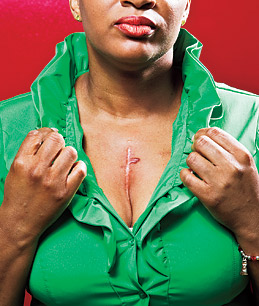
Turns out that the kind of heart attack that I had (caused by a 95% blockage in the big left anterior descending coronary artery) – the so-called widowmaker heart attackmay actually be relatively uncommon  in women. You might guess that fact by its nickname.  It’s not, after all, called the “widower-maker”.

While cardiologists warn that heart disease can’t be divided into male and female forms, there are some surprising differences. Cardiologist Dr. Amir Lerman at the world famous Mayo Clinic in Rochester, Minnesota, told the Los Angeles Times recently:

“When it comes to acute heart attacks and sudden death from cardiac arrest, women have these kinds of events much more often without any obstructions in their coronary arteries.”

Instead, it appears that a significant portion of women suffer from another form of heart disease altogether. It affects not the superhighway coronary arteries but rather the smaller arteries, called microvessels. These tiny arteries deliver blood directly to the heart muscle.

Ironically, I can now boast two diagnoses for the price of one – first, the widowmaker heart attack caused by a fully occluded coronary artery back in 2008, and then, after several months of puzzling, ongoing cardiac symptoms – like chest pain, shortness of breath, and crushing fatigue – a second diagnosis of inoperable coronary microvascular disease. Continue reading “How women can have heart attacks without having any blocked arteries”

Gender differences in heart attack treatment contribute to women’s higher death rates

The alarming results of a study undertaken in France highlighted serious gender differences in cardiac treatment of men and women.  These shocking differences contribute to a higher death rate among women suffering a heart attack.

The French study(1) investigated more than 3,000 patients, 32% women, who had been treated for heart attacks over a two-year period.

Lead author Dr. Francois Schiele, Cardiology Chief at the University Hospital in Besancon, France, presented the results of the research at the American College of Cardiology’s 59th Annual Scientific Session in Atlanta last month. Dr. Schiele’s team found that, on average, the women studied: