Do Emergency physicians diagnose? Or not?

by Carolyn Thomas  ♥  @HeartSisters 

Australian researcher Dr. Mary Dahm and I were emailing back and forth about her recently published study on diagnostic uncertainty in medicine (one of my favourite subjects, I might add – especially when it involves female heart patients).  I mentioned to her that the Emergency physician who had misdiagnosed my heart attack as acid reflux seemed remarkably confident at the time – despite being remarkably wrong. That misplaced confidence is what researchers who study diagnostic error call unwarranted certainty – a contributing risk factor for misdiagnosis.  But Dr. Dahm raised the issue of whether diagnosing is what Emergency physicians actually do:

“The question about whether or not Emergency Department doctors diagnose is highly contested within the specialty. Regardless, they do exclude life-and limb-threatening conditions.”          .
Continue reading “Do Emergency physicians diagnose? Or not?”

When doctors won’t say “I don’t know”

by Carolyn Thomas    ♥  @HeartSisters

I’ve often wondered – long before my own cardiac misdiagnosis – how our physicians can possibly correctly diagnose the countless medical mysteries presented to them day after day. The reality, of course, is that no doctor – even the most experienced and skilled – can be 100 per cent certain of the precise cause of every medical problem out there. And if the cause can’t be identified, the mystery won’t likely be appropriately solved.

But when doctors don’t know,  how do they communicate that uncertainty to their patients?       .     Continue reading “When doctors won’t say “I don’t know””

Diagnostic Uncertainty vs. Unwarranted Certainty: which is worse for patients?

by Carolyn Thomas     ♥    @HeartSisters 

The Emergency physician who misdiagnosed my heart attack displayed not even a whiff of uncertainty while delivering that misdiagnosis.  “YOU” – he declared confidently – “are in the right demographic for acid reflux!”  (without any gastrointestinal diagnostic tests). He sent me home that day with instructions to ask my family doctor to prescribe antacid drugs for my symptoms (central chest pain, nausea, sweating and pain down my left arm).  I now suspect that, if only that confident doc would have bothered to Google my symptoms, both he and Dr. Google would have landed on the same search result:  myocardial infarction (heart attack).

But in fact, he seemed remarkably certain despite being remarkably wrong.   . Continue reading “Diagnostic Uncertainty vs. Unwarranted Certainty: which is worse for patients?”

Diagnostic uncertainty: when we just don’t know

by Carolyn Thomas      @HeartSisters

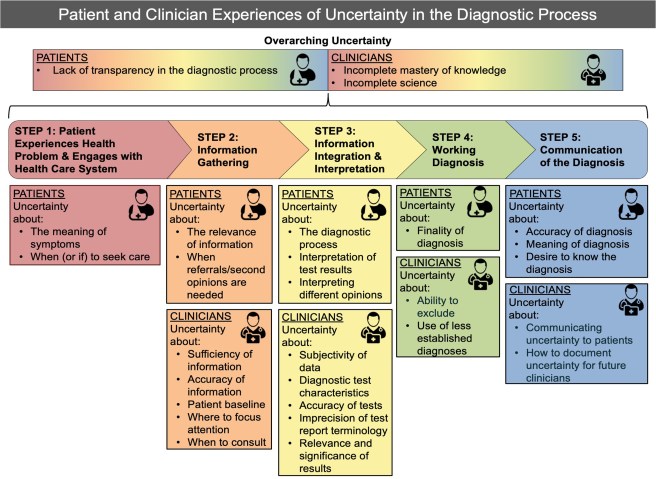
The image above is all about uncertainty. It’s like a 5-step roadmap that you’d use when traveling an unfamiliar road to a new destination you know nothing about and do not want to visit.(1)  For people experiencing scary symptoms they fear might be heart-related, for example, uncertainty about what’s happening now and what will happen next is pervasive. But a new study published in the journal Patient Education and Counseling reminds us that patients aren’t the only ones facing uncertainty around a medical diagnosis: “Both patients and clinicians experience diagnostic uncertainty, but in different ways.”(2)        .        .   Continue reading “Diagnostic uncertainty: when we just don’t know”