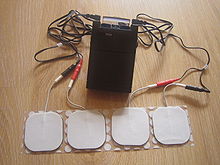
My love-hate relationship with my little black box

by Carolyn Thomas    @HeartSisters

Every morning, I clip it onto my belt, or tuck it into a hip pocket.  I very carefully attach its sticky little electrode pads onto the skin just over my heart, tucking their long black wires under my clothing. Lately, I also have to hold the electrodes in place on my skin with surgical tape because they’re starting to lose their stickiness after so much daily wear. I turn on the black box at my waist, and adjust its two knobs to the correct power levels. I feel a prickly little buzz pulsating across my chest.

It’s called Transcutaneous Electrical Nerve Stimulation (TENS), and it involves electrical impulses called neuromodulation to treat the chest pain (angina) of Inoperable Coronary Microvascular Disease (MVD) – a disorder of the smallest of the coronary arteries (too small to stent, too small to bypass).

My portable TENS unit is about the size of an average cell phone. You may know the much larger version of this machine if you’ve ever had physiotherapy treatments following a muscle injury.  The only wounded muscle it’s working on for me now, however, are those in my heart. Emerging cardiac research is showing that, just as the TENS machine works on improving blood flow, reducing inflammation and speeding up healing for an injured shoulder or knee, it may bring the same benefits to heart patients with MVD like mine.

But I do have a love-hate relationship with my little black box.  Continue reading “My love-hate relationship with my little black box”

Having a heart attack? Call 911 – and pack your Tetris game

by Carolyn Thomas

I confess that there was a time when I was ever so slightly addicted to playing the computer puzzle game Tetris.  Like many parents, I discovered it through my children during their early teen years.  Back then, I was known to occasionally “borrow” their little Gameboy and then stay up until 2 a.m. playing “just one more game” while trying to beat my previous best score. But U.K. researchers tell us that time-wasters like Tetris or other so-called “distractor tasks” might very well help to minimize the psychological effects of Post Traumatic Stress Disorder (PTSD).

We know that heart attack survivors have a disturbingly high incidence of undiagnosed PTSD.  Research reported in the British Journal of Health Psychology suggests, for example, that as many as 16% of cardiac survivors actually meet clinical criteria for acute PTSD, and a further 18% report moderate to severe PTSD symptoms.

So if distractor tasks such as playing an obsessively distracting computer puzzle game like Tetris can successfully help to treat PTSD in those affected by combat exposure, could playing Tetris also help heart attack survivors?   Continue reading “Having a heart attack? Call 911 – and pack your Tetris game”

When the ‘wrong’ family member gets heart disease

by Carolyn Thomas   ♥  @HeartSisters

I’ve come to learn that a common reaction to a heart attack is others’ utter shock that this could happen to “YOU, OF ALL PEOPLE!”  Women in particular report reactions like this because, generally speaking, we’re used to being the ones who take care of others, and to being the strong glue that holds our family life and relationships together.

How dare we get sick?

Dr. Wayne Sotile, in his very useful book Heart Illness and Intimacy: How Caring Relationships Aid Recovery, talks about the “family scramble” that can happen when somebody in that family is diagnosed with heart disease.  And few things can heighten the family scramble, he claims, like the “wrong” family member getting sick.  Continue reading “When the ‘wrong’ family member gets heart disease”

14 reasons to be glad you’re a man when you’re having a heart attack

by Carolyn Thomas  ♥  @HeartSisters  ♥ Updated May 1, 2022

I just finished reading a truly weird rant on another website, written by a man decrying the “sexism” of society because all of our male doctors are now focused only on women’s heart disease – while apparently ignoring men completely.  It turns out he’s not alone in his misinformation: see also Women’s Heart Health: Why it’s NOT a Zero Sum Game.

It would surely be the fantasy dream of every female heart attack survivor if this man were actually correct about all that attention women’s heart disease is allegedly attracting.  The frightening reality instead is that since 1984, the differences between men and women’s cardiac diagnoses, treatments and outcomes has continued to grow.

In the interests of enlightening the unconscious among us about All Things Cardiac, I am happy to point out an assortment of gender differences if you find yourself having a heart attack:  Continue reading “14 reasons to be glad you’re a man when you’re having a heart attack”