

by Carolyn Thomas ♥ @HeartSisters
I’ve noticed that a specific conversation topic keeps popping up when my girlfriends of a certain age get together – particularly when we start comparing what we used to be able to do with what we’re able to do now. .
Here’s just one simple example: I used to be able to sit down on the floor and then casually stand up again without any help. Now, with a wonky left knee encased in a big skookum brace, plus two painful wrists (one sporting its own brace), I know those days are gone. (Thank you, osteoarthritis!) Yes, I might still be able to painfully get myself down onto the floor, but there’d better be two strong adults around to pull me back up by both arms. .
Meanwhile, Brazil’s Dr. Claudio Gill Araújo and his team had been studying this simple motor function called the Sitting-Rising Test. Over 6,000+ heart patients who had gone through his cardiac rehabilitation clinic (Programa de Exercício Supervisionado) in Rio de Janeiro were studied.(1) Dr. Araújo told me that if you’re a person aged 50-80 (the age range of his cardiac rehab patients) and you can carefully lower yourself onto the floor from a standing position and then back up again without using your hands, forearms, knees or the sides of your legs to help you – Congratulations! It turns out that you’re not just mastering a show-off party trick, but you may actually be more likely to live longer compared to the rest of us who are still down there trying to struggle up off the floor.
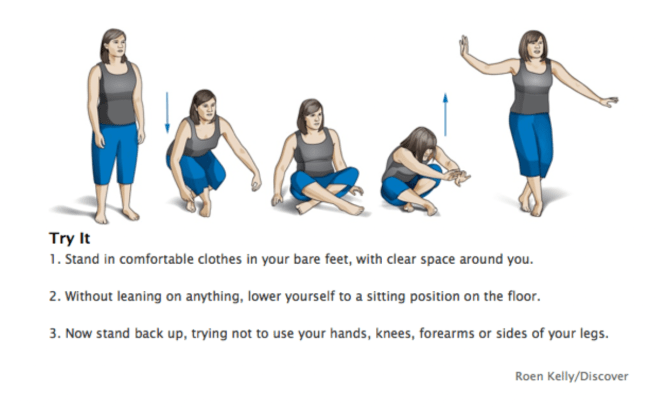
♥ IMPORTANT NOTE: You know your own body! Do not attempt the Sitting-Rising Test when you’re alone if you have reason to suspect you might keel over and bonk your head on something dangerous while doing it!
We know that life expectancy across the world has been rising since the mid-20th century, and the resulting increases in these older populations have been celebrated as major success stories. But as the Director-General of the World Health Organization once warned: “Adding more years to life can be a mixed blessing if it is not accompanied by adding more life to years.”
In other words, I do not want to live longer simply for the sake of having more birthdays (although the promise of our traditional birthday mocha cake from the Dutch Bakery might just entice me to hang on). And to my astonishment, I’ve learned that my recent osteoarthritis diagnosis has impacted my day-to-day quality of life far more than heart disease now does. I did not see this coming. I’m relieved that, although there are motor functions I can no longer manage, long daily walks (with my brace) are not only still possible but surprisingly helpful in so many ways.
Published studies that have measured motor function in older adults (for example, walking speed, grip strength, and timed chair rises) have found that – like that ability to do the Sitting-Rising Test – these physical skills are associated with longer life.(2) But as I’ve written in a number of Heart Sisters posts previously, avoiding death should never be the sole goal.
Approach goals, for example, (“I’m going for a long walk because I always feel good when I’m near the ocean”) are significantly more effective than avoidance goals (“I’m going for a long walk so I don’t die of another heart attack”)
It’s about balance and moderation, I think. Aging is not measured by timed chair rises or grip strength, but I know I’ll be happier one day if I can safely get up off my chair or open a pickle jar. I don’t need to sit down on the floor to play with my darling grandson Zachary, but I like to do my daily 30-Minute Full Body Pain Relief Workout from Essentrix so I can balance my arthritis pain with our toddler play times (thank you Heart Sisters readers for introducing me to this free online program that adds life to my years!) Speaking of grandbabies, I highly recommend them!
This week, the British Medical Journal (BMJ) published an interesting essay written by Dr. Helen Salisbury. As well as seeing patients in her Family Practice office in Oxford, she leads the Communication Skills Course for medical students at the University of Oxford. And although her essay this week is about her experiences with patients living in England, her message feels truly universal.
She covers an issue that those girlfriends of a certain age and I have been increasingly wondering about lately:
“Is there something wrong with me, or am I just getting old?'”
First, Dr. Salisbury describes her own family practice as serving a mixed community:
“They include sprightly octogenarian park runners, as well as people not yet 60 who have five longterm conditions and take multiple medications. When they do ask that question about age, it’s my job to take a careful history and look for treatable causes.
“What can they no longer do that they once could? Has there been a recent change?
“Only when I’ve satisfied myself and the patient that there’s nothing my medicine can fix, can we attribute the decline to age. And it’s never simply age, of course, but a combination of factors that include genetics, weight, alcohol use, smoking—as well as fortune, good or bad.”
Dr. Salisbury writes that she believes her job is to help her patients to age well, and also to notice any sudden or unexpected downturn:
“But as ever, continuity of care is the magic ingredient of general practice that enables us to work out when investigations and referrals are likely to be helpful—and when they’re not.”
She also believes that whether her patients seek her advice on aging at all will depend on their expectations:
“These expectations are driven by the experiences of their family, and of the people around them. And such experiences vary hugely across the wealth divide, so women living in the least deprived areas can expect nearly 20 years more of healthy life than those in the most deprived.(3) She cites the much-quoted British poverty/social justice researcher David Gordon who quipped that the Number One tip for better health is: “Don’t be poor. If you are poor, try not to be poor for too long.” (4)
And Dr. Salisbury closes her essay with a scenario that will seem familiar to you if you’re one of those women of a certain age:
“I wish I could raise the expectations of some of my patients and persuade them that better health and fitness isn’t beyond their grasp even in late middle age, although the reality of their lives may make this hard to achieve.
“Interestingly, it’s also necessary to adjust the expectations of younger doctors, who often develop a skewed and pessimistic view of life at 80 as a result of their time spent on hospital wards.
“So I try to introduce these jaded trainees to others among my patients – the ones in their late 80s who are unhappy that they can no longer manage the two-mile walk into town and back without a rest – and who are disappointed that I don’t have a cure!”
Can we have both? Can we grow old having fun like those “sprightly octogenarian park runners” that Dr. Salisbury sees in her practice, and can we also grow old having fun even if our arthritis or other conditions make park running impossible anymore? The very best exercise, it is said, is the one you like doing so that you’ll keep doing it.
And no matter whether you’re immersed in Sitting-Rising Tests, or in baking peanut butter cookies with your grandkids, do so in the spirit of the immortal words of the late tennis great Arthur Ashe:
“Start where you are. Use what you have. Do what you can.”
♥
Image of lock: Shon Ejai, Pixabay
1. Araújo CGS et al. “Sitting–Rising Test: Sex- and age-reference scores derived from 6,141 adults.” European Journal of Preventive Cardiology. 2020;27(8):888-890.
2. “Monitoring changes in motor function in the years before death”,
3.U.K. Office for National Statistics: “Health state life expectancies by national deprivation deciles, England: 2018 to 2020.” April 25, 2022.
4. Townsend Centre for International Poverty Research. “Health Inequalities“, University of Bristol, England.
.
Q: Have you noticed a declining ability or function you’ve chalked up to ‘just getting old’?
♥
NOTE FROM CAROLYN: I wrote much more about changes in function among heart patients in my book, A Woman’s Guide to Living with Heart Disease. You can ask for it at your local bookshop (please support your favourite independent booksellers!) or order it online (paperback, hardcover or e-book) at Amazon, or order it directly from my publisher, Johns Hopkins University Press (use their code HTWN to save 30% off the list price).
 Heart Sisters
Hi beauty, my name is Marilyn from Oregon. I’m a 26 year old woman. I just started reading your book because I was diagnosed with moderate tricuspid valve regurgitation, months ago.
One day I felt really really bad – chest pain, middle back pain, my throat, my jaw, trouble breathing, everything hurts. They said I was having pleurisy and anxiety, and sent me home to make an appointment with my PCP. She said, maybe pleurisy and heartburn, too. I’m Mexican and eat spicy foods, and anxiety because I’m a young mom of 2 kids (6 & 2). She referred me to a therapist, and ordered an echocardiogram ( I don’t know why if the EKG in the ER was within the normal limits).
The echocardiogram showed that I have what I mentioned early, but that everything was perfect fine. They told me that the chest pain and other symptoms are more related to anxiety.
I have to repeat the echo every 2 years, or if I have a heart attack, go to the ER.
During my last pregnancy I presented with preeclampsia (my symptoms started at 33 weeks (nobody knows). I was induced at 38 weeks).
I’m still persisting with the symptoms, they come and go but are still there.
I don’t know what else to do, I continue reading and learning more about women’s heart related diseases.
Thank you for the book!!
LikeLike
Hello Marilyn – I’m sorry to hear you’ve been experiencing these distressing symptoms, especially at such a young age.
You’ve probably already read about the link between preeclampsia and later heart disease, so it’s very good that yours doctor took your symptoms seriously and ordered tests. We know that women who have a history of pregnancy complications like preeclampsia are at future risk of a cardiac diagnosis. This means you’ll have to be more careful than most people about lowering your own cardiac risks (e.g. keeping blood pressure and cholesterol numbers in normal limits, getting exercise, eating heart- healthy meals, etc. Here’s a good resource for heart-healthy meals for the whole family that I really like: 30-Minute Heart Healthy Cookbook by Cheryl Strachan
I’m not a physician so cannot comment specifically on your situation, but I can tell you generally that your echocardiogram and your ECG are two different tests, looking for different issues. An electrocardiogram measures the pattern of electric pulses generated by the heart’s rhythm, while an echocardiogram uses ultrasound waves to check the structure and function of your heart (how the valves for example are working, and if your heart is pumping effectively).
You are doing the right thing by reading and learning all you can about women’s heart health. No wonder you were feeling anxious – you were suddenly told you had a heart condition! That’s very frightening. Try to do some stress-reducing exercises or meditations every day – many examples can be found free online which you can do around your children’s schedules. It’s often hard for young mothers to put their own needs first, but putting yourself first is an important skill for you to practice now.
Good luck to you! ❤️
LikeLike
When I had my consult with the cardiac doc who did my ablation 2 months ago, I asked him why the arrhythmia became so severe so fast. He answered, “because you are getting old and your heart is wearing out.”
Pretty direct. I actually don’t resent this assessment because the surgery was successful, the arrhythmia is gone although microvascular angina persists. I was left with the feeling that I’d come face to face with my mortality and had better use my time for what’s most important to me.
I’m happy to say I’ve increased my daily steps to 5500 or more and am doing yoga 2-3 times a week. Most of all, I’ve focused on my memoir writing with the steady thought that if not now, when?
I am old and I plan to enjoy my life as long as I have it.
LikeLike
Hello Sara – that feeling that you’d come face to face with mortality is remarkably common after a significant diagnosis. Most people tend to just go through life, less interested in examining big issues like death and dying than they are in just getting through each day, one after another. So when a life-altering diagnosis that cannot be ignored suddenly strikes, no wonder it can have that sudden effect. Looks like it prompted some introspection for you.
Take care and good luck with your steps, your yoga and your memoir! ❤️
LikeLike
Between 1996 and 2012 I traveled to India almost every year. The ashram where I usually stayed required floor sitting for hours on end. At the end of class or meditation, I would watch the sprightly Indian women, decades older than I was, rise from the floor with ease and grace.
Meanwhile, I had to literally turn over onto my hands and knees and use my good knee to push up from the floor. Not so graceful, let me tell you! What was even more embarrassing was when a couple of the tiny women would feel sorry for me and come over and grab my arms and try to pull up all 5’9” 175 lbs of me!
That was in my 50s and 60s. . . Now, at 75 I don’t sit on the floor very often, but if I end up needing to for some reason, I still get up the same way.
Currently creepy joints and sciatica are trying to have their way exacerbated by exercise intolerance of a cardiac nature.
However, you have inspired me to try that 30 min pain relief workout. I’ll let you know how it goes.
Thank you for your research and support!
LikeLike
Hi Jill – I know I wouldn’t have lasted 10 minutes on your Ashram floor!
I can just picture those sprightly older women making it look so easy, and then that not-so-graceful effort required to get you from the floor to standing – because that’s just how I’d attempt to get up, too.
A few months ago I was playing with Baby Zack in his room, and I somehow ended up on the floor reading him a book. Eventually I had to call for my son (who was in the kitchen nearby) to come and help me get back up – we gave serious thought to each limb I needed to carefully move in order to get off that floor!
I know that falling is a very real health risk, so in general, I’m trying to stay as vertical as possible!
Good luck with the 30 minute workout! Take care. . .❤️
LikeLike