Because I didn’t seem to fit the profile of a person who’d just survived a widow maker heart attack, every cardiologist and nurse I met in the CCU (the intensive care unit for heart patients) asked me the same questions:
.
“Do you have a family history of heart disease? Were you a smoker? Have you been diagnosed with diabetes?”
But not one person in the CCU asked me this question:
“Have you ever experienced complications during pregnancy?”
At that time, I didn’t even know that my preeclampsia diagnosis while pregnant with my first baby meant that, statistically, I was now 2-3 times more likely to develop heart disease compared to women who did not experience pregnancy complications like high blood pressure disorders, preeclampsia, pre-term births, gestational diabetes, etc. I did not know – and the cardiologists and nurses I met after my heart attack likely didn’t either.
. . Dr. Graeme Smith
I only learned about that link one year AFTER my heart attack, when I first read about published research by Dr. Graeme Smith, Professor and Head of the Department of Obstetrics & Gynecology at Queen’s University. His research suggested a strong link between pregnancy complications and an increased risk of cardiovascular disease.
.
As Dr. Smith explained in a 2022 interview with STAT :
“Given that about one in three women have cardiovascular disease, better screening of people with pregnancy complications could help protect them before they develop the disease in the first place.
“If somebody said to you, ‘There’s a way that we can identify which women are [likely] to develop heart disease down the road,’ wouldn’t you want to screen for it?
“Well, we already have that tool, and it’s pregnancy complications!”
In 2010, Dr. Smith established the MotHERS Program™ (Mothers’ Health, Education, Research & Screening) at Queen’s. It was the first screening clinic I’d heard of that tracks new Mums who are identified as high cardiac risk after pregnancy complications. (Last year, I was honoured to be interviewed on Dr. Smith’s MotHERS Podcast about my own pregnancy complications. (You can listen to that 28-minute interview here).
.
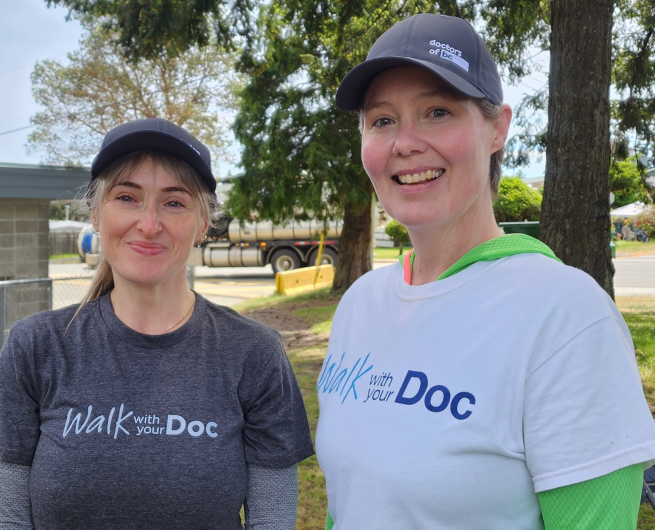
Dr. Valentyna Koval (left) and Dr. Jennifer Kask
Other doctors who are keen to spread the word to patients and their physicians about this often-overlooked cardiac risk factor include Internal Medicine specialist Dr. Valentyna Koval and family physician Dr. Jennifer Kask, both living in the beautiful coastal community of Campbell River, B.C. – about a three-hour drive north of my home here in Victoria. Last fall, Dr. Koval took time away from her local practice to travel across Canada to spend time at a clinic in Ontario.
As Dr. Kask explains:
. “We have built our small project on the scaffolding of those who are decades ahead of us in Ontario – like Dr. Graeme Smith!”
.
The BiRCH Clinic was established at the North Island Hospital Wellness Centre in Campbell River (BiRCH stands for Birth-Related Cardiovascular Health) because – as Dr. Kask says – they are “passionate about this work”. And like Dr. Smith’s MotHERS™ Clinic at Queen’s, when Campbell River maternity patients are identified as being at higher risk of a future cardiac event, their heart health can be followed up starting when their babies are about six months old.
.
I was recently invited to share my own patient perspective via Zoom with a meeting of physicians, nurses and midwives in the community of Port Alberni who wanted to learn more about the Campbell River clinic. Here’s how Dr. Kask described the importance of clinicians collaborating like this:
.
“This initiative is all about improving patient care by increasing awareness of these ‘non-traditional’ cardiac risk factors. In Campbell River, we used some funding from the Rural Obstetrical and Maternity Sustainability Program (ROAM-SP) as we were building our BiRCH Clinic referral pathway and getting really crucial feedback from our colleagues.
.
“We ran one BiRCH Clinic, learned a lot, and then we had a dinner with the maternity care providers in the community. For years here in Campbell River, we have used funding from the ROAM-SP to support multi-disciplinary engagement events on a variety of topics – usually every two months. Those funds are vital to support meeting and learning – and imagining and improving perinatal patient care.”
.
The BiRCH Clinic in the Campbell River Hospital
I’ve spoken many times on the important link between these two conditions, ranging from an OB-GYN national conference to smaller meetings over the years, and I’ve written about that link (here, for example) and also in Chapter 4 of my book “A Woman’s Guide to Living with Heart Disease” , published byJohns Hopkins University Press.
.
That Port Alberni meeting was an important educational event because both Port Alberni and Campbell River are located in relatively rural settings – hours away from a big city.
.
Campbell River is a small city of 37,000 people; Port Alberni is even smaller at about 18,000. (And if you enjoy fishing trips, by the way, both small cities claim to be the Salmon Capital of the World!)
.
But here’s why pregnant women who don’t live in big cities – and the healthcare professionals caring for these women – need so much more help than they’re able to get, according to ROAM-SP. That organization describes this grim reality:
.
“Maternity services in small rural communities are being eroded or eliminated, forcing people who require routine or even urgent maternity care to travel to distant regional facilities. This increases risks, costs and inconvenience for patients and, at the same time, increases stress and even burnout for maternity providers in regional sites with extremely large caseloads.”
.
I wrote recently about my own high anxiety when I suddenly learned that my longtime family physician here in Victoria will be retiring, leaving me and her many other patients facing a crisis: no family doctor and few – if any – family practice clinics accepting new patients anymore.
.
But just imagine how frantic we’d feel if we had no family doctor – and we were pregnant, if we were facing “travel to distant regional facilities for routine or even urgent maternity care” while we helplessly watch desperately needed maternity services being “eroded” or “eliminated”!
.
The Port Alberni meeting I spoke to was a grass roots, community-based program initiated by local clinicians. To make these evening meetings possible for clinicians (after a long hard day of taking care of their own patients), ROAM-SP funded this opportunity. Remember that funding enables clinicians in smaller communities to do what those living in big cities take for granted: to get together to educate, mentor and support each other. As ROAM-SP’s policy reads:
.
“We value your time and commitment to education and quality improvement in our community. All participants will be paid for attending.”
Such a concrete demonstration of “we value your time” has been rare in my own experience – and as the controversial topic of patient compensation has also revealed. See also: ““How a $5 Tim Hortons gift card changed my life“
That ROAM-SP funding applied to guest speakers like me, too (yes, even patient speakers!) I was pleasantly surprised to receive two generous gift cards in the mail shortly after that meeting (and thank you Rebecca Manuel for stick-handling those logistics!)
.
I’d like to also acknowledge Dr. Kask for being so thoughtful. For example:
.
inviting a patient to speak about relevant lived experience
granting my request to present at the beginning of the evening via Zoom (due to my ridiculously early bedtime)
keeping me in the loop by sharing fascinating survey feedback in the days following that presentation
.
Those participant survey results suggested the surprising after-effects on daily practice, as Dr. Kask told me later:
.
“It definitely changed the perceptions of clinicians. BEFORE the presentation, 30 per cent reported asking patients about their pregnancy complications when assessing cardiovascular risk, compared to 87.5 per cent AFTER the presentation. We certainly moved the dial from ‘I don’t know anything about this’ to recognizing the impact that the events of pregnancy have on cardiovascular risk!”
That survey confirms that the ‘I don’t know anything about this’ dial was indeed moved, and also demonstrates how daily practice change can happen within a short time. I believe it’s also a nod to the common sense wisdom of including a patient perspective in all educational initiatives for clinicians, as many academic researchers have already reported. Dr. Kask added her observations too:
.
“It was very important to start our time together with the patient perspective. We can collect a lot of data, but the most important thing is whether our work is accessible (and acceptable!) to improve the patient experience.”
.
We can’t unhear what we hear when a patient shares a story of lived experience.
.
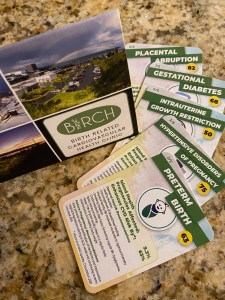
. Trading cards from Dr. Kask!
And when I said that Dr. Kask was keen on spreading the word, I meant that she even offers stickers and trading cards(“Collect All 5!”) which she passes out to her medical colleagues to remind them to ask their female patients about their pregnancy-related risk factors for heart disease.
I just love these! And if you know somebody who has ever experienced hypertensive pregnancy complications, please let them know what you’ve learned here about their increased heart disease risks.
.
Q: Are most women aware that pregnancy complications increase their risk for future heart disease?
♥
NOTE FROM CAROLYN: I wrote much more about pregnancy complications and other cardiac risk factors unique to women in my book A Woman’s Guide to Living With Heart Disease(Johns Hopkins University Press). You can ask for it at bookstores (please support your local independent bookseller!) or order it online (paperback, hardcover or e-book) at Amazon – or order it directly from my publisher Johns Hopkins University Press (use their code HTWN to save 30% off the list price).




 Heart Sisters
One thought on “Doctors who know the impact of pregnancy complications on our cardiac risk”