
Carolyn Thomas ♥ @HeartSisters

Cheryl Strachan is a Registered Dietitian, nutritionist, cardiac specialist, and author of the 30-Minute Heart Healthy Cookbook (HINT: a terrific holiday gift idea for yourself or any heart patient!) Cheryl says she loves “to banish food stress and help people with heart concerns get comfortable in the kitchen again.” Much of Cheryl’s professional career was spent working with local cardiac support groups and rehabilitation programs in Calgary. I’ve been following her patient-friendly Sweet Spot Nutrition blog for several years, and when I read her recent article about eggs and cholesterol, I immediately asked her permission to share this controversial and often misunderstood topic here for my own readers living with heart disease. Keep on reading, below. . .
♥ ♥ ♥
“What’s the deal with eggs if you have heart concerns?”
Guest post by Cheryl Strachan, originally published on Sweet Spot Nutrition 10/24/24
“If you’ve had heart concerns for longer than five minutes, you’ve probably heard conflicting news about eggs.
- March 2019, CNN, “Three or more eggs a week increase your risk of heart disease and early death”
- Feb 2020, Washington Post, “One egg a day will not increase cardiovascular disease risks…”
- July 2021, Washington Post, “Eating too many eggs can still be risky…”
- January 2024, USA Today: “Experts claim eggs can be heart-healthy.”
“It’s so frustrating! Truly, most studies (and headlines), don’t find that eggs raise risk of cardiovascular disease. However, a few do, particularly in people with diabetes, cholesterol problems, or a risk for heart failure.
“Read on to see what those findings suggest, in terms of your relationship with the mighty egg.
“Why the fuss about eggs?
“It’s the cholesterol. Historically, eggs have been viewed with suspicion because of their uniquely high cholesterol content (in the yolks, not the whites). For example, a 100 gram (3.5 ounce) serving of chicken breast has 85 mg of cholesterol. The same amount of ribeye steak: 76 mg. Two large eggs: 373 mg!
“Logically, you’d think that eating more cholesterol would increase the level of cholesterol in your blood, but for most people, the increase is small. Most of the cholesterol in the body is made by the liver, because it’s actually something we need, for important jobs like making cell walls, hormones, and bile acid. But cholesterol becomes a problem if there’s too much of it in your blood. Specifically, too much of certain “lipoproteins” – particles that ferry cholesterol around the body. Chief among the troublemakers is the “low density lipoprotein,” or LDL. Too much of that and it will push its way into the walls of your blood vessels, creating plaque and possibly leading to a heart attack, stroke, or other related problem.
“How do you end up with too much LDL cholesterol?
“Cholesterol levels are largely driven by the genes you inherit, but your eating habits can affect them as well. For example, more saturated and trans fats cause the liver, in effect, to produce more LDL cholesterol. But does eating more cholesterol cause LDL cholesterol to go up? As I said above, for most people, it doesn’t go up much. But about 25% of the population actually does see a bump in LDL cholesterol when they eat more cholesterol-rich foods. They call these people hyper-responders.
‘How do you know if you’re a hyper-responder? Unfortunately, there’s no test for it. But if your LDL cholesterol is stubbornly high, despite a committed effort to implement dietary changes, you could certainly try cutting back on cholesterol-rich foods between blood tests, and see if it makes a difference. (Hi! A dietitian could help you with this.)
‘In addition to people with cholesterol troubles, another group who might want to take it easy on the eggs…
‘People with type 2 diabetes
‘Having diabetes, a major heart disease risk factor, is another reason to potentially consider limiting eggs. Two out of three studies in people with type 2 diabetes (one in 1999 and one in 2007) found a link with egg intake and coronary heart disease (when blocked arteries cause trouble in the heart). The third study (in 2008) didn’t find that association, but reported a dose-dependent increased risk of death among people with diabetes who ate the most eggs.
‘How many eggs are we talking?
‘In the 1999 study, eating more than one egg per day, on average, for people with diabetes, was associated with about 1.5x (for women) to 2x (for men) the risk of coronary heart disease, compared to less than one egg per week. That’s a pretty big difference. In the 2007 study, again only in the people with diabetes, having more than six eggs a week was associated with twice the risk of coronary artery disease, compared with people who had less than one a week.
‘Similarly, the 2008 study found that in the participants with diabetes, eating seven or more eggs per week was associated with a twofold increased risk of dying for any reason compared with less than one egg a week.
‘Isn’t this weak evidence?
‘Keep in mind that these studies are a relatively weak form of evidence, because they’re based on observational data, where researchers ask people about their eating habits and then check in years later to see how they’re doing. This type of study can’t prove that the eggs caused the heart problems, because something else about the big egg eaters might be at work. Maybe they eat a lot of bacon and sausage with those eggs. (Although researchers do try to adjust the data for things like that as much as possible.) People may also report their dietary habits inaccurately, or change them during the course of the study.
‘A better way to answer this question would be a randomized controlled trial (RCT), where half the people are randomly assigned to eat more eggs, and half aren’t. But it’s tough to do studies like that last long enough for a significant portion of the participants to have heart attacks or die.
‘However, a 2017 systematic review of six short-term RCTs found that having 6 to 12 eggs a week didn’t affect LDL cholesterol or other heart disease risk factors, compared to eating few or no eggs. So that’s good. But as always, they concluded by saying that firm conclusions couldn’t be drawn. More research needed.
‘Meanwhile, one more group to think about:
‘Men: Could you be at risk for heart failure?
‘Strangely, this next finding only applies to men. Three studies found that having more than one egg a day, on average, was linked with a 20-30% higher risk of heart failure, but in men only. Same caveats as above though – this kind of study can’t prove cause and effect.
‘What increases your risk for heart failure? Having a heart attack or other evidence of coronary artery disease, high blood pressure, diabetes, being over 65, smoking, and several other factors.
‘The case for eggs
‘On the other hand, eggs are a nutrient-rich, relatively affordable protein source. They give you vitamins A, D and B12 and a nutrient called choline that’s involved in regulating mood and memory. They also deliver two antioxidants, lutein and zeaxanthin, which may actually help prevent atherosclerosis as well as age-related macular degeneration.
‘(If you don’t eat many eggs, you can also get lutein and zeaxanthin from dark green leafy vegetables like spinach, kale, and more.)
‘Eggs as part of a healthy diet
‘Interestingly, some evidence suggests that eating more eggs as well as more high saturated fat foods (hello bacon!) and/or little fibre (eg. white toast) might be what triggers blood cholesterol to rise in response to a higher cholesterol intake. So if you do eat more eggs, it likely helps to eat them in the context of an overall lower saturated fat, higher fibre (i.e. heart-healthy) diet.
‘What do the guidelines say?
‘Back in 2013 and 2015, the “Dietary Guidelines for Americans” and the American Heart Association’s “Guideline on Lifestyle Management to Reduce Cardiovascular Risk,” removed previous statements about limiting dietary cholesterol, citing insufficient evidence of an impact on blood cholesterol.
‘That’s what lead to the idea that eggs had been exonerated. But keep in mind these guidelines are for the general public.
‘On the other hand, the 2015 National Lipid Association Recommendations for Patient-Centered Management of Dyslipidemia,” which gives guidance for treating people with high cholesterol, still recommended limiting dietary cholesterol to less than 200 mg per day “to lower LDL cholesterol and non–high-density lipoprotein (HDL) cholesterol concentrations”. (To keep cholesterol that low, you’d have to limit eggs, meat, poultry, and/or fish.)
‘And more recently, one of the key nutrition recommendations of the 2019 American College of Cardiology / American Heart Association “Guideline on the Primary Prevention of Cardiovascular Disease” is that “A diet containing reduced amounts of cholesterol and sodium can be beneficial to decrease ASCVD risk.” (ASCVD = atherosclerotic cardiovascular disease.) So you can see that if you have heart concerns, it’s not necessarily a free-for-all with eggs.
‘It’s always your decision
‘If you have type 2 diabetes, high cholesterol, or are at risk for heart failure, do you have to cut way back on eggs? Of course not. That decision is yours, and depends in part on how conservative you want to be. Some people I’ve worked with are highly motivated to avoid another heart event and so will take whatever precautions they can, even if the evidence isn’t solid. And some want to focus on just whatever makes the biggest impact. Or what’s most doable for them.
‘It’s all good with me. I’m just here to support whatever goals you have.
‘Also, how much do you like eggs? That matters too! 😋
‘And if not eggs, what will you eat instead, assuming it’s breakfast? A bowl of corn flakes would be worse (no question that refined grains are problematic).
‘It’s a good idea to replace the protein in the eggs with something like plain Greek yogurt, peanut butter, or cottage cheese. And to get those dark green leafy vegetables often, for the lutein and zeaxanthin, among other things.”
‘So bottom line, how many eggs?
‘I like to reference the American Heart Association’s guidance:
“Healthy individuals can include up to a whole egg or equivalent daily. Vegetarians (lacto-ovo) who do not consume meat-based cholesterol-containing foods may include more dairy and eggs in their diets within the context of moderation discussed herein. Patients with dyslipidemia (a metabolic disorder in which abnormally high or low amounts of lipids or lipoproteins in the blood.particularly those with diabetes mellitus or at risk for heart failure) should be cautious in consuming foods rich in cholesterol.”
“For older patients with normal cholesterol levels, given the nutritional benefits and convenience of eggs, consumption of up to 2 eggs per day is acceptable within the context of a heart-healthy dietary pattern.”
Similarly, here’s what the the European Society of Cardiology’s “Dietary recommendations for prevention of atherosclerosis” says:
“…a moderate consumption of eggs (up to three servings of two eggs per week, or one egg per day) can be permitted.
“This may not apply to people with hyperlipidaemia or diabetes for whom more caution is appropriate. A similar caution would be suitable in populations with a western dietary pattern rich in foods with a high content of saturated fatty acids; in this case, it may be wise not to exceed a weekly consumption of three eggs.”
“So you can see, people with diabetes or high cholesterol can definitely have eggs. But maybe not a 3-egg omelette every day. And ideally in the context of overall heart-healthy eating habits.
“Most importantly…
“If you need to lower LDL cholesterol, the most important change you can make is to cut back on saturated fat, particularly from foods like processed and red meat and butter, and switch to more unsaturated fat instead (think salmon, nuts, avocado, olive oil). And don’t let the egg question distract you from the food habit that has the best evidence for overall heart health: A Mediterranean-style pattern of eating (which, by the way, includes eggs in moderation).
“Otherwise it’s mostly plant-based, with plenty of vegetables and fruit, legumes, nuts and seeds, whole grains, olive oil, and fish. Not too much red meat, and at least some meals are vegetarian. You know the drill.”

Join the conversation!
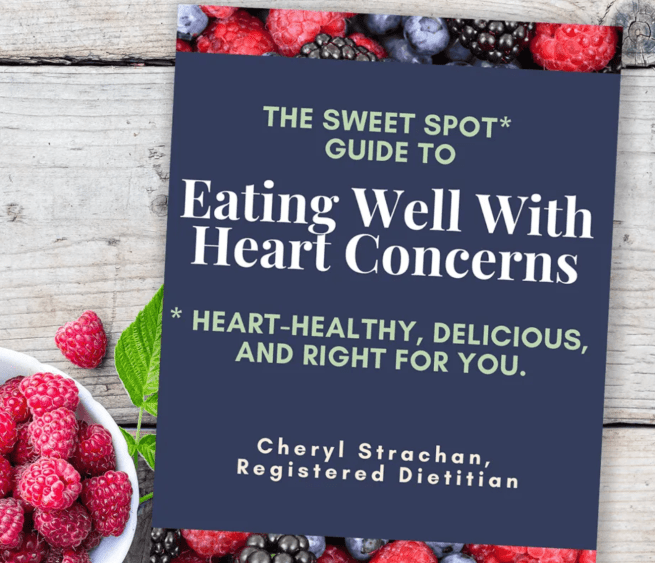 Learn more in Cheryl’s FREE e-book called The Sweet Spot Guide to Eating Well With Heart Concerns .
And remember that Cheryl’s beautiful cookbook, 30-Minute Heart Healthy Cookbook (Delicious Recipes for Easy, Low-Sodium Meals) also makes a useful (and perhaps even life-changing!) holiday gift.
Do you want to learn more about evidence-based heart-healthy eating? Join the many savvy cooks and other learners in Cheryl’s “Sweet Spot Heart-Healthy Cooking Club” on Facebook.
Thank you once again Cheryl for letting my Heart Sisters readers discover great food information from your Sweet Spot Nutrition blog!
♥
©2024 Cheryl Strachan ~ Sweet Spot Nutrition
 Heart Sisters
As I sit here, with a fractured humerus, eating a deviled egg – I thought it a good time to comment on eggs.
My best friend brought over the deviled eggs and some tuna salad for easy 1 armed lunches.
I swear I have read all the egg research and come to my own acceptance that eggs are a good source of nutrition for me. I usually don’t eat them one at a time but have embraced 2 eggs, 2-3 times a week.
According to the combination of specialists I see, I should be on a diet that is:
– low sodium low saturated fat – Cardiology
– low carbohydrate no sugar- Endocrinology (for DM 2)
-low calorie – PCP (for 30 lbs overweight)
-anti-inflammatory- PCP (for arthritis and coronary artery disease)
-high iron – Hematology (for anemia)
-high protein high calcium – Orthopaedic (for bone healing)
My head spins just thinking about it!
I’m seriously considering a meal service. I really don’t enjoy cooking anymore. I buy frozen veggies and through them in the crockpot with a protein.
Or, I have some eggs.
LikeLike
Hello Jill – first of all, your friend is a brilliant, kind genius for coming up with those one-armed lunch ideas!
Second, I hear ya! I like the idea of a meal service (but not the ones that come with un-prepped food in a big box that you have to unpack and then start chopping and cooking). I want the meal service where the table is set, the nice music is on in the background, and the whole place is filled with the heavenly smells of home-cooking when I walk in the door.
There’s a lot to be said about the joys of eggs: for example, they’re portable. They’re reasonably priced. A hard-boiled egg can be popped into a little ziploc bag in your coat pocket in case you feel peckish while outdoors. It doesn’t require fussing. It’s got 8 grams of delicious protein. It tastes yummy no matter how you fix it. And a deviled egg – oh my! That’s an egg with a fancy attitude!
Before I retired, our office would sometimes have working lunches where a big tray of sandwiches was brought into the board room for us. The egg salad ones were always the first to go!
I’m now starting to crave a deviled egg, thanks you you.
Take care – I sure hope that broken bone is healing nicely. ❤️
LikeLike
I once opened the pantry at age 15 and wondered what the heck am I gonna make for dinner? I made a concoction I called “Bean Stuff” my brothers and sisters loved it. And it was made often.
Years later my two sons went to stay a week with my sisters and her kids. She made “Bean Stuff” and my boys loved it and said I wish mom made it.
My sister laughed and called me asking why I never made it. I had forgotten about it. I had to ask her for my recipe!
LikeLike
That’s so funny, Jen! Very creative to invent a whole new culinary masterpiece (that your family loved!) Your “Bean Stuff” story reminded me of a yummy dessert my mother used to make for us when we were little – we remembered it had some kind of very cold creamy pudding-like base with some kind of amazing warm sauce poured over at the last minute. We thought maybe Mum had stopped making it because it was so complicated or finicky. One day, my sister and I were reminiscing about this heavenly memory from our childhood, so we asked Mum if she remembered how to make it.
She said “I remember the recipe exactly! You take your box of Minute Rice, mix it up with a package of Dream Whip, and while that’s cooling in the freezer, you heat up some Aunt Jemima pancake syrup in a little saucepan to pour over the pudding!” Although this recipe was 100% highly processed food-like ingredients, we’d always imagined that our Mum must have spent hours fussing over this extra fancy treat. It was an absolutely delicious “concoction!” 🙂 ❤️
LikeLike
I was rather young when I had my heart event: 46.
I did not have the heart attack, as I was persistent enough to get help before that. Symptoms started on Monday, had emergency open heart surgery on Friday. Yes, my left main was blocked, but the surgeon said with the weirdly shaped vessel coming off my aorta, anyone would have caught cholesterol there.
It was discovered that my heart was left dominant and had almost no vessels on the right side, or what was there were so very tiny. So a triple bypass was performed to bypass my left main and then to add more blood supply on the right. There were no blockages there, just ….no vessels.
That Friday morning, I thought I would die if no intervention, I had gotten significantly weaker all week.
Thankfully I was diagnosed on Thursday, scheduled for the following Monday, but they had to do surgery on Friday instead. My cholesterol at this time I believe was about 200. Not too high.
Well, the reason I tell all this, at age 46 I was still raising kids. Working full time, running a household, and cooking dinner every night.
Part of my recovery was Cardiac Rehab which included cooking classes/ recipes/ reading labels/ shopping the perimeter of the grocery store. I was 46 – and everyone else in the class was over 65.
I grew up in a small town, out in the country. No fast food, no pizza delivery. I was a teenager in the early 70’s. If we wanted fast food, I think there may have been an Arby’s 40 miles away.
My point is, I learned how to cook. We had to. Everything had to be from scratch. I was so surprised to be in a Cardiac Rehab class with women 20 years older than me who couldn’t cook. So many just opened a can of Ravioli or Spaghetti-O’s for dinner.
I am now 65 myself. I did have a roller coaster ride these last 18 years getting my doctors to listen to ME, about how I felt. I also now have an epicardial coronary artery spasm issue – that’s a heart attack until you get the spasm to go away.
But I found a cocktail of meds and supplements that work for me. And now of course, my total cholesterol is about 135.
I eat eggs often. I’m not a huge carb person and that keeps my blood sugars at a A1C of 5.8. Anything in moderation. And when I want butter on my toast, it’s real butter and I slather it on, but how often do I eat toast? Not too often.
There is also a huge difference in being a savory cook rather than a baker. I am not a baker. I can, but then I’d eat all that stuff.
I do have a can of Spaghetti-O’s in my pantry. I also have a 15-yr old grandson living with us who plays football/basketball. I cannot always keep up with his appetite or when he’s hungry and I’ve gone to bed.
But part of cooking regularly is having yummy leftovers in the fridge. The one thing I have now that we didn’t have growing up in the 70’s?… a microwave!.. to heat up yummy leftovers.
He hasn’t opened that can of Spaghetti-O’s yet.
LikeLike
Hello Jen – you were VERY young to undergo emergency TRIPLE BYPASS SURGERY!
I’m glad you mentioned eating eggs – which as Cheryl describes in her article here as “nutrient-rich, relatively affordable protein sources” (8 grams of protein per egg) and they’re delicious! – if you reduced your egg consumption, you’d have to find a comparable protein-rich replacement (e.g. 1/4 cup of dried pumpkin seeds, 1 cup of chickpeas, 1/4 cup of edamame beans, etc).
With your personal experience coming up with homemade meals all those years (plus those lessons from your Cardiac Rehab classes) your experience is one that all recently-diagnosed heart patients could copy!
I identify so much with your own upbringing (I was a farmer’s daughter, a rural farming community miles from any pizza delivery (or ANY retail) locations! I spent every summer picking fruit along with my four siblings all day, every day (free labour!) but as the eldest, at age 12 I started being sent from the orchards into the kitchen at 5 p.m. every afternoon to start making dinner – dinner for seven. From scratch. At first my Mum had prepped everything ahead of time (the meat loaf or chicken casserole would be waiting in the fridge for me to pop into the oven at 5 before making side dishes or salads) but eventually I was put in full charge of meal PLANNING and PREP and making sure the ingredients I needed for tomorrow were in the pantry or the freezer today! Every Day! Age 12!!
I also taught my own two children from an early age that “anybody who can READ can COOK!” Both are excellent and creative cooks now for their own kids. I know what you mean about baking, however! I love our baking adventures these days with my grandkids (but they must take home all the treats afterwards!)
Lastly, your comment about your teenaged grandson reminded me of my own son as a teenager. That boy (and his many friends!) could eat us out of house and home! We learned to make huge bowls of popcorn if the friends were on their way over – to help fill them up! Sometimes a can of Spaghetti-Os comes in handy when you have teenagers!
Thanks for your comment today – take care. . . ❤️
LikeLike