
by Carolyn Thomas ♥ Heart Sisters (on Blue Sky)
What an experience looking back over this past year here at Heart Sisters World Headquarters has been. In the early spring of 2024, for example, my book publisher (Johns Hopkins University Press) asked me out of the blue if I’d write a second edition of the book. I said NO, then I said YES, then I said DEFINITELY NO! (More on that decision chaos in “Throws are Far More Important Than Catches” ) And because I apparently didn’t have enough chaos in my life, I listed my condo for sale about the same time I was pondering the book decision. I did NOT want to move from my tiny perfect apartment, but an unhinged new neighbour upstairs was determined to drive me out with screaming threats, stomping rampages, and swearing outbursts (he also liked to swear at our weekly gardener who was mowing our lawns). The local police became involved. I moved temporarily into my daughter’s guest room for safety. It was your basic nightmare. NOTE: I’m so relieved to report that the unhinged neighbour upstairs moved out! So I took my apartment off the market. Hallelujah!! The website you’re reading right now is powered by a company called WordPress. In 2024, over 40 per cent of all sites on the entire global web were WordPress sites – from big ones run by NASA or Rolling Stone to my own little Heart Sisters blog. The WordPress Happiness Engineers (yes, that is in fact a job title at WordPress) also share ongoing statistics about our sites. These latest stats tell me that I’ve written 49 articles here in 2024 (bringing my all-time total number to 1,080 articles since I launched Heart Sisters in 2009). You can find links to the entire list of all article titles here since Day One on this archives page. If you’re interested in a specific heart-related topic, just click on the word cloud sidebar to the right of your screen for a pull-down list of titles (under topics) . ⇒ That all-time total number doesn’t include writing guest posts for other publications (like my editorial in the British Medical Journal called “Heart Failure: It’s Time to Finally Change the F-word“. I must tell you how exciting that publication project was for me- not only because of its important message (i.e. stop using words that hurt patients), but because it so rarely happens that a prestigious medical journal like the BMJ invites a patient to write an editorial! And for 2024, the Happiness Engineers also reported that this post (originally published here almost 12 years ago) was the surprising most-read winner on Heart Sisters: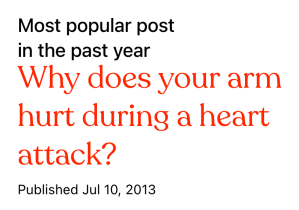 This was a sleeper. Back in 2013 when it was published, it was barely a blip on my stats page. But as the months and years went by, I had to disable the comment feature on this particular article because, despite my repeated disclaimers to readers (“I’m not a physician so cannot offer medical advice!”), most of the incoming reader responses to this article were specifically asking me for medical advice.
I’ve learned that it’s not unusual to see a spike in ]readership when the topic is about a uniquely specific cardiac symptom – like arm pain. It’s what I call the “worried 2 o’clock in the morning question”, which is, inevitably:
This was a sleeper. Back in 2013 when it was published, it was barely a blip on my stats page. But as the months and years went by, I had to disable the comment feature on this particular article because, despite my repeated disclaimers to readers (“I’m not a physician so cannot offer medical advice!”), most of the incoming reader responses to this article were specifically asking me for medical advice.
I’ve learned that it’s not unusual to see a spike in ]readership when the topic is about a uniquely specific cardiac symptom – like arm pain. It’s what I call the “worried 2 o’clock in the morning question”, which is, inevitably:
“Could I be having a frickety-frackin’ heart attack?”
My relentless answer to questions like this continues to be:“I don’t know. Ask a doctor!”
When unfamiliar or scary medical symptoms strike, over 75 per cent of us, according to Belgian researchers, will visit Dr. Google to learn more about what the symptoms might mean.(1) This makes perfect sense. Few if any of us would buy a coffeemaker without Googling first – so OF COURSE, important and often frightening symptoms will propel us toward the same resource. The difference, however, is that symptom questions require credible reliable info from a trusted expert – not quacks. I recommend the Mayo Clinic website for your condition-related questions (also includes links to a helpful Symptom Checker and the free Mayo Clinic Connect Patient Support Groups). I just wish that the Emergency physician who misdiagnosed me (despite my central chest pain, nausea, sweating and pain down my left arm) had simply checked the Mayo Clinic website before he sent me home in mid-heart attack. I also wonder if my article about arm pain during a cardiac event was particularly popular with readers because, let’s face it – not all of them are getting clear, jargon-free, patient-friendly answers from clinicians. See also: Medical Jargon: Do You Need a Translator? Here’s my favourite example of one such messed up doctor-patient communication: an Indiana cardiac surgeon (name withheld to protect his reputation) was responding via the online Q&A site, Health Tap to a female patient’s question. She had asked him about the cause of the unusual arm pain that had accompanied her recent heart attack. Here’s how that cardiac surgeon responded – to a PATIENT (definition: a person who has never been to medical school). His utterly gobbledygook answer to her was this:“The pericardium is innervated by C3,4,5 (Phrenic nerve). There may be some neuronal connections to the intercostobrachial nerves.”
Yes. Seriously. For a jargon-free, patient-friendly answer to that arm pain question, read the article to learn why it’s had 2.3 million views since it was first published here – and this year is even topping the Heart Sisters charts. I usually like to schedule my Sunday morning articles well in advance – but sometimes life happens. Let’s go back in time to the entire summer of 2022. That’s when I had to STOP WRITING about women’s hearts entirely because I needed to recuperate from the bombshell results of the American Heart Association’s latest national survey on women’s awareness of heart disease. Incredibly, the AHA had just announced that women’s awareness of heart disease had significantly declined compared to its last national survey results a decade earlier. Ironically, this appalling result was announced after years of the AHA’s extensive and expensive Red Dress awareness campaigns, Go Red for Women fashion shows, and lighting up downtown buildings and bridges in red every February for Heart Month. (It’s truly a mystery to me, by the way, how shining coloured lights on buildings and bridges can educate anybody about any medical condition). Over half of the women in the AHA survey could not name chest pain as a cardiac symptom! That shocker called for an immediate lie-down. Whatever organizations (or individuals like me) had been doing to try to raise women’s awareness was clearly not working. I felt sick. So instead of writing about women’s hearts as I’d been doing here for several years, I spent that summer writing only about things which bring me joy – rather than despair. I abruptly stopped writing about heart stuff and wrote only about growing roses in balcony pots on a temporary little blog I called The Novice Rose Gardener . Maybe before investing more donor dollars to fund another national awareness-raising campaign, the AHA execs could read the University of Florida study titled “Stop Raising Awareness Already“, which concluded:“Because abundant research shows that people who are simply given more information are unlikely to change their beliefs or behaviors, it’s time for activists and organizations seeking to drive change in the public interest to move beyond just raising awareness.” (2)
Meanwhile, for weird arm pain or any other symptom from neck to navel (especially if that symptom worsens with exertion and eases up with rest), here’s what you might want to do. Instead of asking me (a lowly heart patient with zero medical training and no business offering medical advice to anybody), I recommend that women ask themselves the following question:“What would I do if this symptom were happening to my daughter, or my sister, or my Mum?”
Then immediately take the same action you’d instinctively take to help the people you love – namely, seek professional medical care.And finally, with 2025 lurking, I’d like to add:
Happy New Year and thank you, my dear heart sisters . . .
- for encouraging me throughout that 2022 summer
- for your smart, funny and kind comments/questions/opinions
- for sharing what you learn here with other women in your life
♥
1. Van Riel N. et al. “The Effect of Dr. Google on Doctor-Patient Encounters in Primary Care:” BJGP Open. 2017 May 17;1(2).
2. Christiano, A., & Neimand, A. “Stop Raising Awareness Already.” Stanford Social Innovation Review, 15(2), 34–41. 2017.
.♥ Wishing you a lovely & heart-healthy 2025 ♥
NOTE FROM CAROLYN: I wrote more about arm pain and other surprising cardiac symptoms in women in my book, “A Woman’s Guide to Living with Heart Disease” (Johns Hopkins University Press). You can ask for it at bookstores (please support your local independent bookseller!) or order it online (paperback, hardcover or e-book) at Amazon – or order it directly from my publisher Johns Hopkins University Press (and if you use their code HTWN , you can save 30% off the list price when you order).
.♥
 Heart Sisters
Thank you Carolyn for the important work you do!
I have passed your website onto three women friends I know who have survived heart attacks. Two of them have your book and find it very helpful.
I read your info to prevent getting heart problems, Which I think is really important. Several years ago, I ended up in the local Emergency because I thought I was having a heart attack. It turns out I was wearing a tight bra with a tight under-wire. Now I remove all wires and or buy wireless bras – no problems since!!
thanks again!
LikeLike
Hello Patti and thanks for your kind words – and for sharing a link to this site with your friends. Your amazing story about the tight bra with a tight underwire reminded me of the kinds of bra I used to buy most of my adult life, too. They were torture devices! Taking off those bras at the end of a hard day at work used to reveal all kinds of deep red painful welts on shoulders, ribs, everywhere the torture device dug into my skin.
I’m with you now – no more of those awful things. My sister recommended I order “ShaperMint” brand bras – comfortable yet supportive and NO underwires, plus wider shoulder straps that don’t cut into your skin, and 4 hooks in the back giving a nice smooth back effect even under thin fabrics.
I’m like you now – never go back to bras that are painful enough to mimic heart attack signs!!
Happy New Year to you! ❤️
LikeLike
The weirdest cardiac symptoms I have had was a pain between my shoulder blades that only showed up when in PAT (Paroxysmal Atrial Tachycardia) or during a very brisk walk.
The only reason I even paid attention to it was because it was different than my usual chest pains from angina and Hypertrophic Cardiomyopathy.
My cardiologist took it seriously and scheduled a cardiac cath. It was an 80-90% blockage of the circumflex and required a stent. Seven year post stent anniversary yesterday!
Wishing heath and happiness to all this New Year!
LikeLike
Hello Jill – Happy 7th heart-iversary yesterday… That upper back pain (between shoulder blades) is often mistaken as pulled muscle pain. As a cardiac sign, it’s typically more common in female patients than in males. People like you (who have a history of other types of previous angina) often dismiss it because it DOES feel different than their previous cardiac symptoms.
That difference actually meant good luck in your case – because it was different enough to grab your attention! Hurray!
Happy New Year to you. . . ❤️
LikeLike