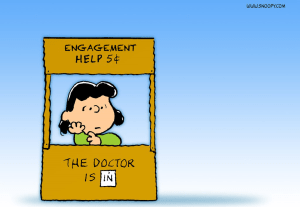
Patient engagement (as described by 31 non-patients)

by Carolyn Thomas  @HeartSisters

I was one of the four patients interviewed for the Center for Advancing Health report called Here to Stay: What Health Care Leaders Say About Patient Engagement.  It’s an interesting, illuminating and frustrating document to read.

The late Dr. Jessie Gruman, president and founder of the CFAH, wrote in her forward to this report:

”  What are people talking about when they say ‘patient engagement’ anyway?  That phrase encompasses so many concepts and ideas that it’s become meaningless.”

As I wrote here, my own concern (as a person who’s pretty darned engaged in my own health care) is not that the phrase is meaningless. It’s more that non-patients, business and industry have co-opted the concept of patient engagement for their own purposes.

And consider once again that, even in this impressive 170-page CFAH document that is all about patient engagement, there were only four patients interviewed – compared to 31 clinicians,  employers/purchaser representatives, health plan administrators, vendors, community health leaders, government organizations,  health care contractors and consultants.
Continue reading “Patient engagement (as described by 31 non-patients)”

Who will take care of you at home if you’re seriously ill?

by Carolyn Thomas     @HeartSisters

It turns out that the hilarious British spoof on the horrors of the Man-Cold might be more true than we ever imagined. The joke reality here is that when a husband gets sick, his wife is naturally expected to become his doting caregiver, but when a wife gets sick, she may feel distinctly on her own.

A study presented at the annual meeting of the Population Association of America reported that the risk of divorce among married couples is more likely to rise when the wife – but not the husband — becomes a heart patient.

Study author Dr. Amelia Karraker, a researcher at the University of Michigan Institute for Social Research, examined how the onset of four serious illnesses – cancer, heart disease, lung disease and stroke – affected the marriages of couples over a 20-year period. Dr. Karraker explained:

”    We found that women are doubly vulnerable to marital dissolution in the face of heart disease.

“They are more likely to be widowed, and if they are the ones who become ill, they are more likely to get divorced.”

Why is this?    Continue reading “Who will take care of you at home if you’re seriously ill?”

Are you a victim or a survivor?

by Carolyn Thomas  @HeartSisters

In Dr. Wayne Sotile’s very useful book for all freshly-diagnosed heart patients called Thriving With Heart Disease, he nails the description of what he calls the patient’s homecoming blues.  It’s that need to adjust from being cared for 24/7 in hospital following a cardiac event to suddenly being booted out the door and sent back home. For example:

“You’re now home from the hospital, and you’re expected to surf a bewildering wave of emotions, anxieties and procedures.

“Moving very slowly, bouts of depression, weeping, social withdrawal or obsessive anxiety about dying – these are all normal during the early stages of heart disease.”

Normal or not, I found “obsessive anxiety about dying” to be an extremely unpleasant way to live in the days following my own heart attack.  Continue reading “Are you a victim or a survivor?”

Hypervigilance: waiting for that second heart attack

binocularsby Carolyn Thomas   ♥   @HeartSisters

Until I had a heart attack, I didn’t know that one of the biggest risk factors for having a cardiac event like mine is having already had one. Heart disease, a chronic and progressive diagnosis, is the gift that just keeps on giving. And as I wrote here, one of the Big Lessons for me has been that, although my doctors can “squish blockages, burn rogue electrical circuits, and implant lifesaving devices” all they like, their heroic efforts do NOT address what originally caused this damage to my coronary arteries in the first place – likely decades before my heart attack struck.  See also: The Cure Myth

In fact, we know that women are significantly more likely than our male counterparts to die within the first year following a heart attack, according to the National Institutes of Health.

No wonder sobering stats like these can drive the freshly-diagnosed female heart patient to an exhausting and fearful state of acute hypervigilance.
Continue reading “Hypervigilance: waiting for that second heart attack”