
by Carolyn Thomas ♥ @HeartSisters

Scar image: Defective Heart Girl
Each surgical scar on my body tells a story. The big long one that tracks across my lower right abdomen tells of an appendix that ruptured on my 16th birthday – and the subsequent month I spent in hospital seriously ill with peritonitis and creepy drainage tubes. Two scars on my right knee tell of surgery after an unfortunate slide down a big pile of gravel. Another meandering zig zag tells of a nasty piece of broken glass once embedded into my left palm, its evidence exquisitely masked by the skilled plastic surgeon who sewed my hand back up.
Women who have survived open heart surgery sometimes have traumatic stories to tell about their very noticeable chest scars, and mixed emotions about whether “to hide or not to hide” this evidence of their cardiac history, particularly in the early weeks and months post-op.
Consider, for example, 45-year-old Myra from New Jersey, who tells this story:
“I had a double bypass open heart surgery five months ago. I feel so sad and stressed about my scar. Sometimes I cry when I’m in the shower, or if I try to wear a shirt and can’t wear it because it shows.
“I watch my friends at the pool wearing bathing suits while I’m sitting on the side watching them, wearing a t-shirt and shorts. I feel out of the group, just don’t want to be there. I wish I could remove my scar. I’m so very stressed about it.”
Another heart patient observes:
“My illness has created more scars than just the physical ones, and these were far worse. I couldn’t – wouldn’t – believe I looked just fine.”
What these women have undergone is called a sternotomy (and keep on reading to learn more about how this surgical procedure works).
You might be surprised to learn that not all patients hate their scars.
One woman, for example, described the long sternotomy scar on her chest from her heart bypass surgery as:
“A map of illness and recovery.”
Another wrote this:
“My scar shows the world what I have survived and overcome. They say this body is far from perfect – but it’s mine.”
And another woman added:
“They are my battle scars earned and gloriously celebrated as such.”
Or this, from a 17-year old girl:
“When I was 18 months old, my twin brother and I had to have open heart surgery. As I grew up, my scar grew with me. It’s about six inches long and very noticeable with low-cut shirts.
“I have lived with the scar my whole life. I am now 17 and it is hard for me having to tell friends and boyfriends how I got the scar. But I’m proud because I am living, so it’s like a battle wound, and I know that it does not matter.
“Scar or no scar, it has made me the person I am today. We should be proud of overcoming, no matter how we got these scars.”
I loved this story from a 44-year old bypass surgery survivor whose chest scar has sometimes attracted unwanted public attention:
“A gentleman walked past me at a local Target. He was staring at my chest pretty intently.
“Well, I ran into this guy at least another two times while shopping, with him walking towards me staring openly at my chest. I think he was trying to get a better look at the scar.
“By the third time, I pointed directly at it and said to him: ‘Bear attack!’ He was VERY embarrassed – and walked away quickly!”
Perhaps the longer we live with our battle scars, the easier it can become to accept them – no matter what the source of those scars. For example:
“I have a scar on my chest from when I had heart surgery as a child. It saved my life. And I have stretch marks from my first pregnancy which I always hated until a friend told me: ‘Yes, but they were created by your son!’ It made me totally re-think my view on them.
“Years later I got a C-section scar after giving birth to Son #2. My scarred-up tummy is beautiful and a reflection of two wonderful little boys and a life saved to have them.
“I may not be wearing crop tops or bikinis now, but I love my scars!”
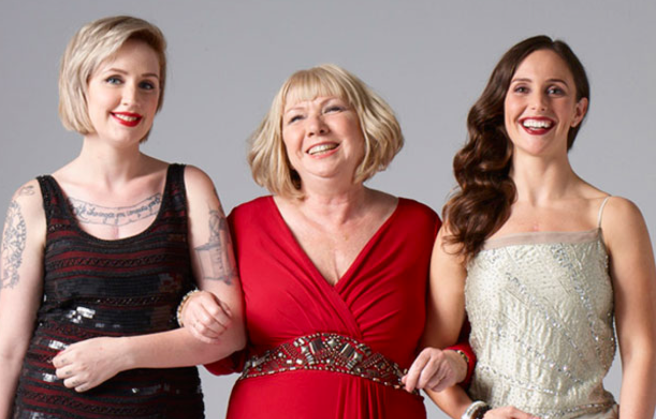
This trio of U.K. heart patients (pictured above) have interesting stories to tell about how they managed to adjust to their own scars. Shell Williams (left) found that showing her scar in a fundraising calendar helped her come to terms with it. Valerie Johnson (centre) went from hating her scar to seeing it as a sign of the life she’s lived. Michelle Houston (right) had heart surgery in her 20s and learned to view her scar as a sign of bravery.
♥
Now, I promised you an explanation of what creates those scars during your open heart surgery while you’re snoozing away in the O.R. – and here goes:
 Your heart rests beneath the sternum – the organ’s skeletal chest armor and the central bone to which ribs are attached. Cracking this bone running down the centre of the chest requires pressure, power and precision, according to Popular Mechanics (yes, you read that right) and their very useful if unlikely guide Extreme How-To: Step By Step Heart Surgery – one of the clearest explanations of this procedure that I’ve seen yet.
The most common type of saw used in heart surgery is an oscillating saw, which moves up and down at a rapid speed and works like a jigsaw, enabling the fine blade to cut curved lines. Sometimes – especially on patients who have had heart procedures done before – surgeons will use a saw that’s like the one used to remove casts. It stops immediately when it senses tissue. Very comforting concept.
Surgeons cut through the sternum either completely or partially, straight down the middle, but they don’t remove it. They then slowly spread apart the cut halves of the sternum with retractors, something similar to a brace. This allows the entire chest and heart to be open before them.
The standard approach to open heart surgery means the entire rib cage is opened and the heart muscle beneath is fully exposed. The patient is then placed on a heart-lung bypass machine which allows oxygenated blood to circulate throughout the body while bypassing the heart, thus allowing the surgeon to stop the heart and perform surgery while the heart muscle is not moving.
In the modified approach, the cardiac surgeon performs the surgery on a beating heart without the use of the heart lung machine, using instead a stabilizing instrument – sometimes used even for multi-vessel bypass surgery – without the need of the heart lung machine. This is sometimes an option for a patient with a good, strong heart muscle because the surgery itself places stress on the heart.
A partial sternotomy can be performed when limited exposure is adequate, frequently used for heart valve surgery. Or some heart patients may be good candidates for Minimally Invasive Direct Coronary Artery Bypass (MIDCAB), a surgical approach that involves a small incision usually on the left anterior portion of the chest wall between the third and fourth or fourth and fifth ribs. In most cases, this incision is made through, not under, the breast.
Once the surgical procedure is completed (replacing blocked coronary arteries, repairing or replacing wonky heart valves, heart transplant), surgeons use customized plates and screws (they used to use wires) to hold the sternum and ribs in place as they heal. Fortunately, because heart surgeons break more bone than even orthopedic surgeons do, repairing the sternum has been the focus of many surgical advances in the past few decades.
BEST RESOURCE EVER! Here are some practical tips from Elizabeth Dole on managing your open heart surgery scar once you get home.
Big or small, let’s let the last word on scars fall to a heart patient who said:
“A scar is never ugly. We must see all scars as beauty. Because take it from me, a scar does not form on the dying. A scar means: I survived!”.
♥
Q: Have you been able to make peace with a major scar?
Scar image from Defective Heart Girl…
I wrote more about adjusting to scars and other cardiac issues in my new book, “A Woman’s Guide to Living with Heart Disease” (Johns Hopkins University, November 2017).

- Britain’s Princess Eugenie shows off her back surgery scar on her Royal Wedding day (October 2018)
 Heart Sisters
I have had heart surgery 4 times starting at age 4 months. I have a lot of scars! I have never been comfortable wearing clothes or bathing suits that show them because I hate the questions and staring.
Since I have had to deal with them my entire life, I wish I felt differently. For some reason it is important for me to say it is from a congenital defect and not a bypass. I don’t know why.
Now I am in my 50s and would like to say I earned them and if you don’t like them, too bad.
LikeLike
Thanks for sharing your story, Karen – you have indeed earned every single one of those scars! Many heart patients feel a bit defensive about their cardiac events (particularly heart attack), believing that others may assume their diagnosis was likely self-inflicted – unlike a congenital defect that “just happens” to an innocent baby. That may help to explain your preference to clarfy your own cardiac history with others. Not that it’s anybody else’s business – yours is the only opinion about YOU that matters.
LikeLiked by 1 person
I like my scar. In fact a little upset that it is not as noticeable now as it was six months after surgery. Dr. did an excellent job and I enjoy every day that I have as extra life.
LikeLiked by 1 person
Interesting perspective, Barry – disappointment as your scar is fading! But it sounds like your gratitude is not fading…
LikeLike
Thanks for your response. I bet we could make a lot of money designing attractive bathing suits for women with sternal incisions.
LikeLiked by 1 person
I agree, Karen! One of my readers sent me this link to show a high-neck bathing suit she had just ordered. I think it’s gorgeous! Turns out there are lots of other gorgeous high-neck suits online.
LikeLike
Karen,
Your comment moved me as it made me reflect: We all have scars, most of them are emotional. It’s part of the human condition which is congenital!
I know that compassion is what heals but it’s been a lifelong struggle to be compassionate with myself.
Thank you for sharing your own struggle.
P.S. I’m glad you have the scars to prove that modern medicine – as primitive as it is – kept you alive to share your story!
LikeLiked by 1 person
Hi! I’m 33 and have had 3 heart surgeries and a kidney transplant. And it’s hard. Not only do I have 7 inch scar from the heart surgeries, but I also have the smaller scars from the chest tubes that they put in, 9 in total. And the small little dots someone mentioned before. So my torso looks like a battlefield.
I’m like most of you, I have good and bad feelings about it. But I am proud of it. I sometime consider myself a soldier for enduring and surviving all of those surgeries. I tend to still wear the low-cut shirts and dresses. I will put a camisole underneath or a really cool, chunky necklace. Or just go without and tell people my story.
I think I will do like someone mentioned earlier and make up cool stories like being attacked by a bear. That was funny! And a great conversation starter.
LikeLiked by 1 person
I love your attitude, Reece. You are indeed like a brave soldier who has emerged from what very few 33 year old women have had to go through. Your scars are your war wounds!
LikeLike
I’ve had open heart surgery November 21,2013 (5-bypass). I went back to work February 7, 2014 (no choice there). I am 60 years old and the job is very stressful and I’m working since last August 2013, with 2 people short. I come home bent over and needing to use the heating pad because I’m in pain/discomfort. My scar has keloid and pulls from the swelling. Is there something I can use to help the swelling and redness go down? I’m using cocoa butter and wheat germ oil. Any ideas?
LikeLike
Cookie, I’m so sorry to hear that you’re having such pain. If you haven’t done so already, see your doctor if symptoms continue or get worse – redness and swelling may be signs of an infection. Unfortunately, keloids tend to occur on “high tension” sites like the chest region. There have been some studies that suggest removing the keloids surgically along with steroid injections may produce promising results. FYI, for other therapies to help relieve discomfort, read “Managing the Open Heart Surgery Scar” at Rehabilitate Your Heart for several helpful tips. I hope that one (or more – combining two or more strategies seems to work best with keloids) will help you.
LikeLike
I had open heart surgery to have six blood clots removed from my lungs. My incision also formed a very painful keloid. I went to a dermatologist and had steroid injections. My incision is flat and painless now. Hope this helps.
LikeLiked by 1 person
That’s great, Julia – thanks for sharing your good results.
LikeLike
On some days I hate my scar – not only my scar but the four large dots underneath, other days I feel great, I get dressed up and show it…
It doesn’t bother me but when people stare too much or are too sympathetic, I feel a bit odd… If I engage in conversation I say I’m ok (I used to make up elaborate stories just for fun). I know that’s lying but after my second recovery it kept me sane ha ha. I think for me anyway I feel self-conscious…. if I feel paranoid and aware but I won’t be upset if I remind myself. It’s just curiosity that’s it.
LikeLiked by 1 person
No, not yet. I have not made peace with my scar. I am 8 1/2 months post-CABG. As I unpack my summer clothes, I am sad that I do not want to wear my v-neck t-shirts and summer dresses. I am not ready yet. I do not think that others want to be exposed to my scar. I don’t mind showing someone if they want to see it, but I don’t want to force it on anyone.
LikeLiked by 1 person
CardioMom, you are not alone. Every person takes as much time as needed to make peace (or not!) with any type of scar. There is no timeline here except yours and what you are most comfortable with. Best of luck to you…
LikeLike
Thank you
LikeLike
I had my second open heart surgery at 44. My first scar was from surgery at 2 and was very faded and unnoticeable. My second scar was in the same alignment and very thin. My problem is I was closed with sternum cables instead of wire so I have 6 bands that are extremely noticeable where these cables are. I think I may have some type of scar tissue also over these areas because they really ache and hurt. I haven’t gone back to the doctor since this doesn’t warrant the 5 hour one way trip. The largest bump where I really feel something kind of sharp and painful is at the very top of my sternum. Just curious if anyone else has experienced anything like this. Thanks
LikeLike
Hi Chris – you didn’t mention how long ago your OHS was. The best resource for cardiac scar healing is this one from Rehabilitate Your Heart.
And unless this is a fairly recently healed incision, pain along your scar is not “normal”, and is your body’s way of saying “This needs to be checked out!”
LikeLike
I am 67 and for my birthday I got five bypasses. (nov 4, 2013) turned down rehab as I mall-walk four times a week, weigh 150 and watch what I eat. No recovery issues at all and for the most part I forget that I had the surgery! No heart damage just a very pretty chest scar that I love to show off. I went to a hospital that does alot of these procedures and not the local bandaid station. No regrets, hoping for a long life and continuing to prosper!
LikeLike
Way to go, Barry!
LikeLike
I was able to make peace with my scar pretty soon after my open heart surgery. My surgeon tried to make it as low and short as possible (it’s about 6 inches) because I am still pretty young (26). The scar actually looked pretty good (except for the tube incisions, those do not look nice) until the wires started to show 6 months later.
I had to have another surgery to get the wires removed but now my scar is wider (not the thin line it used to be) and I am struggling with it, some days more than others. But I know that once it will be fully healed, I’ll be able to look at the mirror and think ‘well that doesn’t look so bad, at least it gives me some cleavage’ 😉
LikeLike
You are very young to have undergone heart surgery, Ophelie, and to have to go back to the O.R. to remove wires must have been so distressing for you. The only bright side of this picture is knowing that young skin will heal faster, since the cells in your epidermis (outer layer of skin) have a faster turnover rate than the skin cells of us older patients. Some studies even suggest that wound healing in young adults is up to 4 times faster than in older patients. I hope that your journey to being “fully healed” will be as short as possible! Thanks for sharing your unique perspective here.
LikeLike
Going to send this to my mom. Ten years later and I think she’s still disgusted with her scar. It hasn’t quite healed right, because there were complications.
LikeLike
Hi ARQ – this is such an individual response, isn’t it? To feel “disgusted” by any part of our body (especially one that is quite permanently a part of us now) is SO not good for our self-esteem.
LikeLike
Here is a piece I wrote about managing your open heart surgery scar – your readers might find it helpful.
LikeLike
Thanks for letting us know – so many helpful tips in your article!
LikeLike
I had a triple-bypass on Nov 19, 2012 and I don’t know where I am supposed to be as far as recovery goes.
My chest aches and I am so sensitive on my scar (which does not bother me in the least!), my left arm aches and in my mind I feel like it was a bad dream because everything happened so fast with the surgery.
The one good thing that came out of this is I had my hair cut off (Jamie Lee Curtis cut) and I don’t have any highlights left in my hair so I have made the decision to go natural from now on – what a relief!!!
Some days I’m good, other days not so good. I guess I think two months is time enough for me to be feeling better, but what do I know!?
LikeLike
Hi Judy and thanks for sharing your story here. According to Mayo Clinic cardiologists, recuperation after bypass surgery takes up to 12 weeks on average, so you are still within those ‘early days’ time parameters. However, if your symptoms get worse, or if any new symptoms arise, see your doctor immediately. If you were not referred for cardiac rehabilitation immediately after hospital discharge, it’s not too late to request a referral now. Very useful program that has been shown to improve our longterm outcomes. And you might also want to talk to a professional therapist about this traumatic event you have survived. This wasn’t just a “bad dream” – go talk to a professional about what you’re going through. Good luck to you, Judy.
LikeLike
thanks for your informations.
LikeLike
Don’t mind my scars at all. Had surgery in the spring … out at the pool in the summer. I saw some people look at the scars… didn’t bother me at all. people are generally curious.
LikeLike
Good for you, Holly!
LikeLike
My original thought, until I read the comment by the incredibly wise 17 year old, was that the older we get the more we accept our imperfections (man-made or otherwise).
Now I’m wondering if for many of us the more distance we have from the surgery/event, we accommodate to what is now normal?
I suppose that it is a combination of many factors, including our own sense of “self”.
LikeLike
I think you’re right, JudyJudith. And our sense of “self” may also be impacted by our culture’s focus on women’s appearance: we shave our armpits, tweeze our brows, dye our grey hair, put coloured polish on our nails – each of which basically says that we’re just not good enough the way Mother Nature made us!
LikeLike
I’m not a heart patient (but I do like reading your articles here regularly because they so often contain some gem that’s perfectly applicable to my life!) This article is a good example.
I do have both (hidden) surgical scars and (very visible) burn scars. The more visible the scar (mine are on my neck and chin area) the harder it is to say something like “I love my scars!” I can’t say I’m there yet, the best I can say is that after years of being painfully aware of people looking at me and then quickly looking away, I’ve learned to try not to take others’ awkwardness or curiosity personally. Still learning every day.
LikeLike
So true, Martie. Everything is relative. There’s a big difference in choosing not to hide a scar that is “hide-able” vs not being able to hide a scar that is always visible. Thanks for sharing a unique story about scars.
LikeLike
Hello Carolyn,
It’s so sad to read some of the first quotes from women who feel so bad about themselves and their bodies and their scars.
Thank you for sharing this kind of information here. It’s useful for ALL kinds of scars and “imperfections” we live with.
Good stuff.
LikeLike
Thanks Scottie. There’s no predicting how we will respond, positively or negatively, to the sight of something so shockingly new, is there? Everybody handles this perception differently.
LikeLike
I don’t have any feeling yet about my scar. I guess still in shock I had surgery maybe. I would like to know I can talk to someone when these feelings start
LikeLike
Thanks for your comment, Sherry. Just take each day as it comes – you may be surprised at what kind of feelings come up as you recuperate – just remember that whatever you feel is “normal”!
LikeLike
I guess I’m just not at the point where I can look proudly at my “battle scar” and feel anything but disgust and concern. I feel very self-conscious and wear only high-neck tops, yes even during the past summer on the hottest days. Maybe I will eventually get used to this like some of these other heart patients say, but right now I doubt it.
LikeLike
Sounds like you are in fairly early days yet, HMZ. Remember that healing means both physical and psychological recovery as Calista mentions below. And getting used to this new look takes time. One day at a time. Best of luck to you.
LikeLike
Thanks Carolyn for this important topic. Nobody warns you when you leave hospital how living with this new very visible scar will feel especially for women who let’s face it have wardrobes that generally tend to expose more skin than most men do. I experienced both ends of the extremes – from being embarrassed and horrified by my scar at the beginning immediately post-op, to being perfectly okay with it (sometimes even unaware!) today.
But this is a long journey both physically and psychologically as you so wisely describe in your other Heart Sisters posts here. THX! 🙂
LikeLike
You are so right. I think we sometimes underestimate how long this journey will take, and nobody can prepare us for something we believe will never happen to us in the first place. Thanks for your perspective on this, Calista.
LikeLike
My heart bypass scar was never a problem for me. Even the over 50 cm long scar in my leg, from where the vein was taken for the bypass. This vein was a good one. It serves my heart since 1983.
LikeLike
Thanks for mentioning the leg scar from the “harvest field” – yet another even more visible scar to be either hidden or celebrated! 1983 – You are a cardiac pioneer, Mirjami! 🙂
LikeLike
I had open heart surgery for a thoracic aortic aneurysm 4 1/2 months ago, Dec. 6th 2018. I love my scar and show it off all the time.
I’m proud I’m alive and doing so good. I call it my zipper. I’m thankful God gave me a 2nd chance in life.
Sometimes it still hurts but I’m sure that will all go away with time. I was so grateful I had something that the doctors could fix. My surgeon was amazing and said an amazing prayer over me before they took me back for my surgery and all that fear I had lifted up out of my chest at that time.
It was something that I had never experience before. God is so good. My life was important. Thank you,
Mary Jo
LikeLiked by 1 person
Hello Mary Jo – you are still in very early days, post-surgery and already your attitude is remarkably positive. I hope your healing will continue uneventfully over time.
Your life is indeed important, just as all lives are (even of course the ones who don’t survive open heart surgery).
LikeLike