
by Carolyn Thomas ♥ @HeartSisters
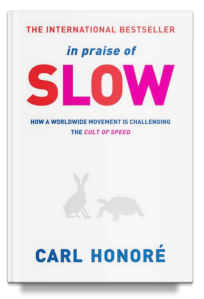 Many years ago, when I worked in corporate public relations, I was on a plane at least two mornings a week, flying off to Very Important Meetings with Very Important People to discuss their Very Important Projects. At the Vancouver airport bookshop one day, I picked up what I thought would be just the perfect thing for somebody as busy as I was: an audiobook of one of those ‘Ten Best Business Books Condensed’. What a great idea! I could save time cramming the Ten Best Business Books into my overstuffed brain while driving out to the airport and back!
But something hit me – a “Eureka!” moment, somewhere between Total Quality Management and Seven Habits:
“This is exactly what’s wrong with my life!”
I realized that I was so busy, I felt no longer able to enjoy settling in with a good book anymore. Even reading – my great love – had turned into just another item on an overloaded To Do list stretched between family, work, home and my bulging daily calendar.
I was a heart attack waiting to happen (which did happen when I survived a misdiagnosed “widow-maker” in my 50s). During most of the year leading up to my heart attack, for example, I’d gone into my office in our hospice & palliative care unit at the hospital every Sunday (i.e. my DAY OFF!) to work on a huge new project that I couldn’t fit into my “normal” packed work week. I even made excuses to my physician and nurse colleagues when they asked me why I was in on the weekend – explaining that I actually got “far more work done on Sundays” without the constant interruptions of meetings and calls – almost as if I thought my new schedule was “normal”.
Meanwhile, that pace was pretty much what had happened to Carl Honoré, too. A Canadian-born author living in London – and a self-professed “speedaholic” – he was in line at the airport in Rome one day, waiting for his flight home. Like far too many of us, he says, at the time he was wired and harried.
“I was a Scrooge with a stopwatch, obsessed with saving every last scrap of time, a minute here, a few seconds there.”
While in line, he was on the phone with his editor, and while chatting, he spotted a newspaper headline in a nearby kiosk: “The One-Minute Bedtime Story.”
The article was a review of a new book in which classic children’s stories are condensed down to 60 seconds. “Eureka!” said Carl. The father of a two-year-old son at the time, he saw the book as a great time-saver. No more speeding through Cat In The Hat at his little boy’s bedtime anymore, skipping lines and even entire pages just to get it over with. As he made a mental note to order the book, he stopped suddenly and asked himself:
“Have I gone completely insane?”
Standing in that lineup, Honoré began to grapple with the questions that lie at the heart of his own subsequent book, In Praise of Slow: How a Worldwide Movement is Challenging the Cult of Speed – which I happened to discover just after my own airport “Eureka!” moment. These were questions like:
“Why are we always in such a rush? What is the cure for time-sickness? Is it possible, or even desirable, to slow down?
“We live in a culture where even instant gratification takes too long. We are living the fast life instead of the good life. Time is scarce, so we speed up towards a finish line that we never reach. For many of us, that pace ends up with a serious illness diagnosis.”
His book’s message is especially important for those concerned about their heart health. Researchers have found that high levels of daily chronic stress releases cortisol into the bloodstream. Cortisol is a powerful stress hormone that’s particularly damaging to our delicate coronary arteries.
According to the Centre For Studies on Human Stress at McGill University in Montréal, repeated exposure to the release of stress hormones can affect both mind and body.
That kind of stress response system was not designed to be constantly activated. This overuse, according to McGill stress researchers, contributes to the decline of many bodily functions, and has been linked to heart disease, high blood pressure, high LDL (bad) cholesterol, Type 2 diabetes, and depression – each of which is known to be an independent risk factor for heart disease.
But the effects of chronic stress are worse for people already at risk for developing these and other health issues. For instance, if you have diabetes, or high blood pressure, or a family history of heart disease, or live a sedentary lifestyle, then chronic stress can effectively flip the switch that turns on other serious health problems.
Hence the need to s-l-o-w down, and pay attention before chronic stress begins to feel normalized.
Honoré adds:
“Speed can be fun, productive and powerful, and we would be poorer without it. What the world needs, and what the Slow Movement offers, is a middle path, a recipe for marrying ‘la dolce vita’ with the dynamism of the information age.”
For many of us, we discovered this balance accidentally when the COVID pandemic affected millions of people worldwide, either directly with devastating consequences, or indirectly through unprecedented changes in how we were able to work, travel, raise our families and live our lives. Some of us learned – because we were forced to learn – just how much we’d been cramming into our over-scheduled and out-of-balance lives for years.
By then, I’d already had my first unplanned course-correction in life balance simply because I’d been living with debilitating cardiac symptoms of chronic coronary microvascular dysfunction for 12 years pre-COVID. Those symptoms meant early retirement for me, which, by the way, taught me overnight that I was clearly NOT as indispensable as I’d somehow believed during all those unpaid Sundays I’d been donating to my employers.
As one of my readers living with heart disease says: “I now have more balance in my life – because I have to!” And after the first year of the pandemic, I wrote about my own surprised response to that year of “aloneness” in Have I Been a Closet Introvert All This Time?
“The secret is balance”, as Carl Honoré reminds us: “Instead of doing everything faster, do everything at the right speed.
“Sometimes fast,
Sometimes slow,
Sometimes in between.”
♥
Q: What have you learned about the unexpected joys of slowing down?
.
NOTE from CAROLYN: I wrote more about the effects of chronic stress on our hearts in A Woman’s Guide to Living with Heart Disease. You can ask for it at your local library or favourite bookshop (please support your neighbourhood independent booksellers!) or order it online (paperback, hardcover or e-book) at Amazon – or order it directly from my publisher, Johns Hopkins University Press (use their code HTWN to save 30% off the list price).
See also:
Got A Minute? Try This Mini-Relaxation For Your Heart Health
You Can’t Pace Yourself – Unless You Plan to Pace
Is Family Stress Hurting Your Heart?
Women’s Heart Disease and Chronic Stress
Is Everyday Stress Gnawing At Your Coronary Arteries? Take This Quiz To Find Out
Poor Marriage = Poor Heart Health for Women
Women’s Heart Disease and Chronic Stress
A Heart Patient’s Guide To The Three Stages of Chronic Stress
 Heart Sisters
Hello Carolyn,
I work for the Board of Elections. I was seasonal then part-time for 16 yrs. I was nick-named the junk drawer, if you need something, could not find something, or did not have time to do your job, I was the one to call. We were not able to stay home during Covid so I did not have to deal with the isolation my husband work at his job also.
When I first started having pains in my neck, I pushed it aside – I was getting ready for an election. After my triple bypass surgery in Jan of 2022, I begged my doctors to let me go back to work after 4 weeks because I needed to get ready for the next election. I was sure that they could not run an election without me.
I learned a very tough lesson, 1. I am not the election, it will go on without me, and 2. I do not need to take everything onto my shoulders.
Today as we get ready for another election I feel great, have energy, but I have let a lot go. I have a great assistant that runs the warehouse for me when I have to be in the office. My co-workers keep a sharp eye on me, so if I get out of hand they reel me back in. I did get a full-time position three years ago. And I thank God everyday for the benefits that came along with the position.
I never thought at 60 that I’d have this scar running down my chest and that I just can’t do what I used to do.
I’m not going to sit down and wait to see what happens to me, I love my job and sometimes I get too intense, but I can step back when I need to. My main focus is my son. I want to enjoy time with him because he is getting to the point that his job is going to take him out of state. So I will slow down and not do so much overtime to be home with him.
Thank you Carolyn for the article. Hope I was not too long-winded but sometimes we have to just step back to see where we were, and where and how we are going to move forward.
Sue
LikeLike
Hello Sue,
I love the conclusion you finally decided upon: “I am not the election!” Many people live their whole careers as if they ARE that job and little else.
I had to laugh while reading your comment because you reminded me of myself! After I had to take early retirement because of ongoing cardiac symptoms, I was shocked that my longtime co-workers seemed to somehow be running the place just fine – even though I was no longer there!
I too loved my job. I was good at what I did, and my colleagues were also my friends – but I wasn’t as indispensable as I once thought.
My late father used to say: “The graveyards of the world are filled with indispensable people”. I wrote more on that here.
Thanks for sharing your unique perspective today! ♥
LikeLike
Carolyn, my father also would tell me that everyone is indispensable. My first job as a teenager would call me to do the dinner shift before I even got home from the lunch shift. I would change uniforms and head out again.
LikeLike
Oh boy, Susan! I’ve had jobs like that too as a teenager – so glad to have a job/any job that I’d say YES to every extra demand no matter how unreasonable!
LikeLike
Funny story Carolyn,
On Tuesday 10/11/23, I was at work teaching a class and I could not catch my breath. I pushed through the rest of the day. That night, I had pain in my chest and back, could not breathe when I was laying down. Got through the night and went to work – you know it’s election time!! By the time my first class was over, I was done. Called my doctor, got right in.
She wanted me to head to the hospital – she was not sure, but thought I had fluid around my heart. Of course my first thought was “Are you kidding? I am in the middle of an election!” I always revert back to “It can’t be done without me!
I did go home, called my husband and was at the hospital within the hour cuz I knew I was sick. I spent 3 days there.
My heart is in great shape. Something is sending my lungs into a frenzy. Our office is in an old hospital that has not been completely renovated. And my warehouse has some air quality problems. It has happened over time – we have been in the building 12 years and I have worked in some questionable areas.
I am on meds and now have some things to look for. Moral of the story “Old habits are hard to break” – LOL
LikeLike
Hello Susan – boy, that “can’t be done without me” gene seems to be amazingly common!
I’m impressed by a number of things you mention that were really smart steps (i.e. going home, calling your husband, and acknowledging that little voice that was telling you: “this is not normal!” That’s progress!
But I’m concerned about why your employer is unable/unwilling to address these air quality issues. Here in Canada, this would be a workplace protection issue (e.g. putting employees in an unsafe environment that could be making them sick).
This is NOT a minor problem. I remember from one of your previous comments that you mentioned an assistant who now helps in the warehouse, so hopefully that limits the time you will need to be in there – but even so, it sounds like an unhealthy place for everybody’s lungs, whether they’re heart patients or not.
Just today I read about a physician who described how he was discouraged by one of his elderly patient’s lack of improvement despite a new drug he’d hoped would help her breathing problems. He couldn’t figure out why the new drug wasn’t making any difference at all. Then, because his hospital had just launched a new holistic program to help staff assess unhealthy environments in their patients’ homes, his next step was to also ask her about specific conditions in or around her home that might be contributing to her worsening symptoms. Turns out that although she did not smoke, several of her longtime neighbours were heavy smokers who gathered right outside her open windows overlooking the front stoop every morning all summer long – she’d been exposed to countless hours of close-up second hand smoke filling her apartment virtually every day. Changes were made as requested (her neighbours didn’t stop smoking – but out of consideration for their old friend, moved farther away across the street to chat!) and her symptoms finally began to improve.
That’s just a small example compared to the potential environmental threats you describe in your workplace environment! I hope you will be able to take some steps with your employer to either address the air quality or to provide staff with protection so your lungs – and the lungs of other co-workers! – won’t be sent “into a frenzy!!”
Please take care – both at home AND at work! ❤️
LikeLike
Carolyn –
Again a very timely post. I am two weeks out from an ablation surgery that gratefully stopped the PVC’s that had me living with constant dizziness and fatigue. I lost a lot of strength in the 5 weeks waiting for the surgery while metoprolol controlled the every-other-beat PVCs, but left me with a resting heart rate of 40 and active (sort of) heart rate of 50. Hard wait.
I’m slowly regaining strength while also (again) looking at what’s important and assessing where I want to spend time. I’ve been pushing myself for decades, in part because of job, kids, home, activism, etc but also because it is a habit learned in family and reinforced culturally.
My intention now is to listen carefully to this body in this moment and not push. Daily meditation, yoga, paying attention to fatigue, mild angina and my recognizing play are my priorities.
Thank you.
Sara
LikeLike
Hello Sara – I’m glad that your ablation procedure – once it finally happened! – was so helpful. You’ve experienced a ‘before and after’ life event here, once you feel stronger, to see if those longheld family and culture “habits” can relax a bit. I grew up in a farm family with four siblings where hard work and “pushing” ourselves non-stop was simply expected from a very early age. Anything less was attacked as laziness. I know I’d still be pushing myself now had I not survived a heart attack!
I love your thoughtful plan to revisit those priorities – good luck to you! ♥
LikeLike
One of my greatest hopes for this world is that each of us slow down and become aware of the beauty of the Process of Living over and above the speedy pursuit of some “imagined to be important” goal.
I was born a slow-moving contemplative youngster. I enjoyed meandering, playing with grass and flowers and worms, imagining great scenarios. But that was not an acceptable way to be. I was chided for being lazy, unfocused, distracted and dreamy. I was pushed to hurry up, move faster, “get things done”.
Finally as I reached adulthood, I relinquished my true self to the way the world wanted me to be. I worked, I achieved, I had job, family, advocacy chairmanships, on and on and on. I began to thrive on emergencies at work and home. Addicted to adrenalin, I was praised for what I was doing and felt proud.
At 42, I broke down in a crisis of “Is this all there is?” I slowed down and began the process of uncovering my True Self. Not a quick process at all, as I had buried it quite deeply. If I unconsciously slipped back into my old ways, saying yes to too many things, filling up time with too many projects, I invariably would get smacked down by physical illness – things like Stress Cardiomyopathy, Open Heart Surgery, Cardiac Stents, Arrhythmias and overwhelming crushing fatigue. All of which FORCED me to slow down. Just like the pandemic did for the world.
At 74, I live the slow contemplative life I was meant to live and enjoy every moment.
I hope that the wisdom of slowing down might dawn on each generation at a much earlier time in their life than it did for me.
LikeLike
Thank you Jill for sharing your wise perspective – I’m sure that many of our readers will be nodding in agreement with your description of those “imagined to be important” goals. I’m reminded of the lesson of the three spinning plates (can you picture that image? Three tall sticks, a spinning plate balanced atop each one?) In life, as I read long ago: “Once once we have mastered balancing three spinning plates, we are “rewarded” with a fourth and then a fifth!”
Yet those “rewards” are so often not the rewards that help us or our relationships or our health, no matter how we may insist that we’re managing it all beautifully. Just this morning a lively chat on the Site-Formerly-Known-As-Twitter between women physicians about the “myth of having it all”, as one doctor wrote in response to a young and beautiful medical resident who had posted a glam photo of herself ready for a night on the town with these words: “For the record, you absolutely can have it all. You can be feminine and beautiful and assertive and badass all at the same time. You can be a kick-ass chief resident working 60+ hour work weeks in an insanely high volume Level 1 trauma center and still make time for dressing up in a little black jumpsuit and celebrating your nurse bestie’s birthday. You can have it all and you will have it all. Don’t ever let anyone tell you otherwise!”
. . .followed by many responses from other female doctors urging a more realistic message e.g.
“Let’s not set up the next generation of #WomenInMedicine to feel like failures while they struggle to have it all. Let’s be honest. You can juggle all the balls, but every day the one you drop will be different. And that’s okay. You’re still amazing. But you won’t have it all.”
Take care, stay safe out there. . .♥
LikeLike
Yes! Society sets us up and then looks down upon the one who choses only one stick and one plate. An absurd way to be
From Jill not Judith LOL
LikeLike
Oh sorry Jill – I’d just been talking about my friend Judith and that’s what came out on my keyboard!! 😦 Clearly not enough coffee. . . have corrected it now!
You are right once again – the expectation is often that we must do MORE (and do it FASTER) than our fair share, or be looked down upon as a slacker!
LikeLike