
by Carolyn Thomas ♥ @HeartSisters
 Well, we’re into the New Year now. For some of us, that’s almost enough time to notice small cracks beginning to appear in the boldly announced resolutions made in the midst of all that post-Christmas excess. This is not new.
When I was one of the volunteer run leaders at our local Y Marathon Clinic during the last century, we’d often hear such resolutions from first-timers starting our training workouts every January – something like “This is the year I’m finally going to quit smoking, lose 20 pounds and run a marathon!”
“Honey,” I would say gently to them: “Pick one!” .
A New Year can be a discouraging time for those living with chronic illness – and those damned resolutions do not help the situation. Many of us make resolutions for self-improvement for the coming 12 months. By the second week of February, however, about 80 per cent of resolutions will already be abandoned, often replaced by the remorse of personal disappointment.
Chronic illness – like heart disease, for example throws a wrench into the best-intentioned resolutions. In the PURE study (Teo et al, JAMA), for example, researchers followed over 7,500 newly-diagnosed heart attack survivors in 17 countries. They found that:
• ♥ 48% of smokers continued to smoke
• ♥ 65% did not exercise
• ♥ over 60% did not improve their diet
• ♥ 14% had not adopted even one lifestyle improvement
These conclusions give us a few guilt-driven reasons every year to make big resolutions to do better.
I suspect, however, that new-onset depression following a cardiac diagnosis has a lot to do with those outcomes. As I warn medical conference audiences at every opportunity, cardiologists must become more aware of the devastating effects of what’s called “situational depression“ on a person’s ability to take their new heart meds, exercise, quit smoking, plan heart-healthy menus or follow any other “doctor’s orders”. But as cardiologist Dr. Sharonne Hayes, founder of the Mayo Women’s Heart Clinic, once described her colleagues:
“Cardiologists may not be comfortable with ‘touchy-feely’ stuff. They want to treat lipids and chest pain. And most are not trained to cope with mental health issues.””
See also: When are Cardiologists Going to Start Talking about Depression?
One of my blog readers recently wrote that she ditched the word “resolutions” in favour of the term “self-care promises”. I like that. It has a kinder, gentler ring to it, and just maybe a higher likelihood of keeping those promises.
Regular readers already know how I feel about non-inspirational advice from motivational “experts” – like “Follow Your Dreams! Reach for the Stars! Eat More Kale!“
The eternal question for me is this: can accomplishing small but still personally meaningful goals actually be better for our health and self-esteem than screwing up yet another list of big New Year’s personal improvement resolutions?
 The realization that true wins are not limited to heroic resolutions is also why I began to change the way I reward myself the shiny sparkly stickers I use to track my daily exercise. ← For example, here’s a picture of one of my old exercise calendar pages. When I first I hung up a little calendar on the inside of my bathroom cabinet door many Januarys ago, my plan was that each hour of exercise I was able to do on good days (such as walking, biking, weight training, gardening, hiking, Zumba classes, whatever) would earn a shiny sparkly sticker. (I find that the shiniest sparkliest ones work best to boost motivation!)
But on bad days, when debilitating cardiac symptoms flare up (central chest pain, shortness of breath or crushing fatigue caused by coronary microvascular disease) – and when doing an hour of almost anything seems utterly impossible – every blank bad day staring out at me from that calendar makes me feel even worse.
So I changed my official sticker award policy.
I started deliberately awarding myself a sticker for small accomplishments on bad days. Even if I was barely able to manage only a slow 10-minute walk around the block, I got a shiny sparkly calendar sticker. You go, girl! Whoooop!
Why? Because those are the days I really deserve an extra pat on the back for even the briefest attempt, because what I really want to do instead on days like that is to crawl back into bed and pull the covers over my head.
As I do every January, I’m starting a new sticker reward calendar – but instead of calling them resolutions, this project is called 52 Small Things. I learned about this a few years ago from The Mighty, an online health community for people living with chronic illness.
It’s important to remember that the kind of resolutions (oops, self-care promises) that sick people tend to make can be very different than those of your average Peloton enthusiast. In fact, people who boast about their own successful dream-following, star-reaching, kale-eating achievements can often make the rest of us feel exhausted and inadequate – instead of motivated.
But I digress: by comparison, the 52 Small Things project works like this:
“Ask yourself, ‘What’s one small thing I want to accomplish this week?’ Keeping your things small simply makes them easier to do. Cleaning your entire house in a week seems overwhelming, but cleaning just one room or spending 10 minutes a day organizing a drawer is likely doable.”
I started my 52 Small Things list this past week. First on my list seems like a very small thing indeed for most people, but one that I’d been avoiding for years: “Sort Christmas decoration storage boxes BEFORE packing them away.” I managed to get two big bins culled down to just one, and loaded the unwanted stuff into the car to donate to the local church thrift shop. A win-win! And a nice sparkly shiny sticker!
When one of my Heart Sisters readers started her own 52 Small Things exercise, she wrote this to me:
“Allowing myself to celebrate mundane tasks — ones that healthy people may take for granted every day — allowed me to tackle increasing my wellness in very small increments. And it helped me look at the positive side of things, instead of always dwelling on the negative. It made me take pride in my ability, instead of feeling the shame of what I wasn’t able to do.”
That practical wisdom brings us to the type of goals we decide upon. Behaviour scientists tell us that the most effective goals are ones that move you toward a particular objective, rather than away from something you’re trying to avoid.
As Dr. Mike Evans likes to remind us, an avoidance goal (“Do this so you won’t get sick”) is far less effective than an approach goal (“Do this so you’ll feel better!) For example, I could decide to head out in the sunshine today for a brisk walk to help me ward off another heart attack (an avoidance goal) or I could go for a walk to enjoy the beautiful sea views off Beach Drive (an approach goal).
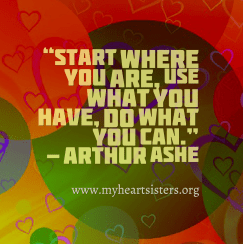
For many of us, it’s also all about small steps. And as the late tennis legend Arthur Ashe once advised:
“Start where you are, use what you have, do what you can.”
♥
Q: Have you thought about your own “self-care promises” for 2024?
.
NOTE FROM CAROLYN: You’ll find much more about goal-setting for heart patients in my book, “A Woman’s Guide to Living with Heart Disease” (Johns Hopkins University Press). You can ask for it at your library or favourite bookshop (please support your local independent booksellers!) or order it online (paperback, hardcover or e-book) at Amazon – or order it directly from Johns Hopkins University Press (and use their code HTWN to save 30% off the list price when you order).
 Heart Sisters
Carolyn,
Thank you for this article. I needed it to remind myself that it is OK to not accomplish everything I thought I was going to do. I love your sticker calendar idea.
If you haven’t already heard/read of Cat Bohanon’s book, Eve:How the Female Body Drove 200 Million Years of Human Evolution – I recommend it.
She is an incredible writer. A fascinating book! She has some YouTube video interviews.
Happy New Year, my friend and former Bus Babe!
Marty
LikeLike
Hello Marty – lovely to hear from you. Thanks for that recommendation of Cat Bohanon’s book, which Iwas not familiar with until today! I will look into it for sure.
Happy New Year to you and your family as well!
Take care. . . ❤️
LikeLike
Hi Carolyn,
This is so great! As you might know (or guess), I gave up on making resolutions years ago, too.
For a while, I did the “choose three guide words” exercise. That one didn’t work for me either. Too confining. Next, I tried affirmations. Better. But… I think I might have an accountability issue!
But seriously, I love your reader’s idea of “self-care promises”. I would make it even gentler by calling them “self-care intentions”. Even more forgiving perhaps.
Why make oneself feel badly if a promise gets broken? I also love the “52 small things” idea. I might have to try that one. However, I guess I’ll have to go with “50 small things” since January is already slipping away.
Thank you for this self-care centered New Year’s post. Love it. Off to share it.
xo
LikeLike
Hello Nancy – thanks for this! I found myself thinking, while writing this post, about how I and my girlfriends (many years ago, I think it was back in our 40s when we were running half-marathons for fun), took these New Year’s resolutions so seriously! Our resolutions were not at all “gentle” or “forgiving” – and usually came with a competitive whiff to them.
By comparison, my Monday morning walking buddy and I were doing an early morning mall walk yesterday (dry and warm on a brutal stormy day) after which we were heading to the food court for our post-walk coffee. She stopped at one point in mid-walk and asked ‘How many steps have we done so far?’ I checked the tracker on my phone – we’d walked about half of our typical steps. Each of us clearly wanted to start those coffees NOW. Walking longer would have been a self-care intention. But when we were mulling over our decision for what seemed like a crazy-long moment (more steps? or more coffee?), that promise part kicked in.
We ended up walking and talking for another 20 minutes or so, too distracted by our chatting to think about how many steps we were aiming for. And we ended up feeling pretty good about ourselves during coffee!
The trick is not to feel too smug when we fulfill every PROMISE, yet not to feel guilty when we don’t! (I did however give myself TWO sparkly shiny stickers on my exercise calendar when I got back home – because I REALLY did NOT want to keep walking at all!!) So, yay me!!!
Take care. . .❤️
LikeLike
Doing something for five minutes can be very powerful. After my heart attack, my cardiologist told me to start walking, which seemed utterly impossible. I told him that. He told me to walk for five minutes — set the timer on my phone for two and a half minutes. Walk down the street for the two and a half minutes, then walk home for two and a half minutes, giving me a five-minute walk.
When that became easy, I was to walk for ten minutes — five minutes away from my house, five minutes back. When a ten-minute walk gets easy, walk fifteen….and just keep increasing.
I can now walk two and a half miles. My heart is in good shape, but developing other health issues. Oh, this aging business is not easy!
LikeLike
Hello Lynn and thanks for sharing your perspective here – such a good example of ‘start slow and gradually increase over time!’
I bet you never believed back in those 5-minute walk days that you’d be one day walking for 2 1/2 miles! And I can relate to the “other health issues” of this aging business that you mentioned: when I was diagnosed with painful osteoarthritis a couple years ago, I was completely stunned! I did NOT see that coming (it seemed an outrage – on top of my ongoing cardiac issues!)
Bette Davis was right when she observed: “Old age is not for sissies!”
LikeLike
Dearest Carolyn,
Thanks for these reminders. Every one of them I know. But, I still get fooled, on low energy days, into berating myself and asking “what is wrong with me? I should be able to do more in a day than just brush my teeth!”
I was never a runner but I used to go out on a nearby trail and easily walk 3 miles several days a week… 20 years, 2 open heart surgeries and a stent later, I am still comparing myself to that fit, energetic, 55 yr old and of course, end up disappointed.
Once, when I was in tears about my fatigue, I emailed my Cardiologist at Mayo and he said, “Stop, start over and begin with just 5 mins of walking” That was an “Aha!” moment for me… that only doing 5 mins of walking was OKAY!
Because my abilities vary so much from day to day… I don’t set specific exercise goals anymore. However, I do like to remind myself that…
“I love Life…Every day is a dance… I will move as the day moves me and no one is watching but God and my Self.”
Happy New Year!
LikeLike
Hello Jill – I really like your Mayo cardiologist’s advice! It’s almost like my go-to computer trouble-shooting solution: “Shut it off, then start again!”
The temptation to compare how we used to be with how we are now is so common and very understandable, especially as we age!
And I suspect that the more exercise we were able to do in the past (like your 3-mile trail walks several times a week!), the greater the gap between then and now – and the more we feel the stark disappointment of no longer being ‘that person’ anymore.
I remember being shocked in my Cardiac Rehab class when a number of the (older, male) participants mentioned that they had NOT experienced any chest pain before their double, triple or quadruple bypass surgery (in each case, their heart disease had been diagnosed after persistent but vague “unwell” symptoms. But in every case, they’d been so sedentary in the past that they simply had never exerted themselves enough to put an extra load on their heart to cause angina pain!
Thank you Jill for that “Every day is a dance, and I’ll move as the day moves me!” reminder.
Take care, HAPPY NEW YEAR to you, too! ❤️
LikeLike
Peggy Cappy, who has been doing yoga for 50 years, has a new video 5 minute yoga Fix.
It’s stretching and chair yoga. Exercises you can do in small increments. There are a few stretches you can do before getting up.
I also checked with my health club. They are offering a 2 month program for a person to work with you to design things you “can do”. The person I spoke with suggested a 5 minute warm up, 10 minutes of treadmill, walking, 5 minutes of cool down totaling 20 minutes.
I am in early stages of heart failure and don’t know what I can do. A lot of fatigue.
LikeLike
Hello Sandy – it sounds like you are starting the New Year with a good plan – which is the most important step!
Thanks for the Peggy Cappy 5-minute yoga recommendation. Five minutes is a perfect goal for beginners, or for heart patients who wonder about incorporating those “small increments” into their usual routine. The Cleveland Clinic has a good article you might enjoy – on exercise and activity for HF patients
It seems counter-intuitive to decide that doing something/anything (especially when we feel so fatigued) is almost always the step that will help to make us feel better, little by little!
A few years ago, one of my readers recommended the free “30-Minute Full Body Pain Relief Workout” from Essentrics. She also told me that when she skips a day, she can really tell the difference – which encouraged me to keep it up because this kind of movement almost always makes me feel better.
When I first started, I thought “This is so s-l-o-w and so gentle that it can’t be doing much!” And just as that thought was going through my brain, the lovely instructor Sara was saying: “This may feel like you’re not doing anything!” but she encouraged us to just “keep moving”. Now, I do these every morning in my jammies. It has also made a remarkable difference in reducing joint pain from osteoarthritis.
I really like that observation about doing what we “can do” instead of all the things we CAN’T do anymore.
Take care, good luck to you! ❤️
LikeLike