
by Carolyn Thomas ♥ @HeartSisters
 Well, we’re into the New Year now. For some of us, that’s almost enough time to notice small cracks beginning to appear in the boldly announced resolutions made in the midst of all that post-Christmas excess. I’ve already, for example, ditched the Lettuce Leaf Diet I was contemplating for 2025 after all that Christmas feasting.
During the last century, when I was one of the volunteer run leaders at our local Y Marathon Training Clinic, we’d often hear lofty New Year’s resolutions from first-timers signed up for our 10-month training program each January – something like:
“This is the year I’m finally going to quit smoking, lose 20 pounds and run a marathon!”
“Honey,” I would say gently to them: “Pick one!” .
By the second week of February, about 80 per cent of our resolutions will already be abandoned, likely replaced by remorse. New Year’s resolutions can be unrealistically burdensome, or unrealistically vague: “Follow your dreams! Reach for the stars! Eat more kale!”
And heart disease can throw a wrench into even the best-intentioned resolutions. In the PURE study, for example, researchers followed over 7,500 freshly-diagnosed heart attack survivors in 17 countries. Here’s what they found:
• ♥ 48% of smokers continued to smoke
• ♥ 65% did not exercise
• ♥ over 60% did not improve their diet
• ♥ 14% had not adopted even one lifestyle improvement
Physicians may reflexively label such patients as “non-compliant” (an annoying descriptor, by the way, that makes heart patients cringe!)
But I now invite medical conference audiences at every opportunity to consider that what these people are suffering may well reflect the devastating impact of what’s called post-heart attack “situational depression“. As cardiologist Dr. Sharonne Hayes, founder of the Mayo Women’s Heart Clinic, once described her cardiac colleagues:
“Cardiologists may not be comfortable with ‘touchy-feely’ stuff. They want to treat lipids and chest pain. And most are not trained to cope with mental health issues.”
See also: When are Cardiologists Going to Start Talking about Depression?
One of my blog readers recently wrote that she’d ditched the word “resolutions” in favour of the term “self-care promises”. I like that. It has a kinder, gentler ring to it, and just maybe a better likelihood of keeping those promises.
Whatever you stop calling them, I like the concept of 52 Small Things. I learned about this a few years ago from The Mighty, an online health community for people living with chronic illness. The 52 Small Things project works like this:
“Ask yourself, ‘What’s one small thing I want to accomplish this week?’ Keeping your things small simply makes them easier to do. Cleaning your entire house in a week seems overwhelming, but cleaning just one room or spending 10 minutes a day organizing a drawer is likely doable.”
Another Heart Sisters reader wrote this to me about starting her own 52 Small Things exercise:
“Allowing myself to celebrate mundane tasks — ones that healthy people may take for granted every day — allowed me to tackle increasing my wellness in very small increments. And it helped me look at the positive side of things, instead of always dwelling on the negative. It made me take pride in my ability, instead of feeling the shame of what I wasn’t able to do.”
As Toronto’s Dr. Mike Evans likes to remind us, an avoidance goal (“Do this so you won’t get sick”) is far less effective than an approach goal (“Do this so you’ll feel better!) For example, I could decide to go for a long walk today to help me ward off another heart attack (an avoidance goal) or I could go for a long walk because I love watching the waves crashing off Beach Drive (an approach goal).
It’s important to remember that the kind of resolutions (oops, self-care promises) that people living with chronic illness tend to make can be very different than those of your average perky Peloton influencer. In fact, people who boast about their own successful dream-following, star-reaching, kale-eating achievements can often make the rest of us feel exhausted and inadequate instead of motivated.
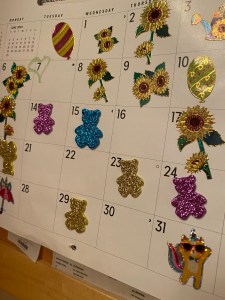 The realization that true wins are not limited to heroic resolutions is also why I changed how I track my daily exercise. ← For example, here’s a picture of one of my exercise calendar pages. My original plan: a shiny sparkly sticker earned for each hour of exercise I’m able to do on good days (such as walking, biking, gardening, hiking, lifting heavy things, etc.) P.S. I find that the shiniest sparkliest award stickers work best to boost motivation!
But on bad days, when debilitating cardiac symptoms can flare up (central chest pain, shortness of breath or crushing fatigue caused by coronary microvascular disease), every blank square staring out at me from that calendar makes things seem even worse.
So I changed my official shiny sparkly sticker award policy.
I started pro-actively awarding myself a sticker for small accomplishments on bad days. Even if I were barely able to manage a slow walk around the block on one of those days, I get a shiny sparkly calendar sticker. You go, girl!
Why? Because those are the days I really deserve an extra pat on the back for even the briefest attempt, and because what I really want to do instead on those days is to crawl back into bed and pull the covers over my head – a scenario that does indeed happen on occasion, and is nicely explained at the end of my favourite kids’ book, “Alexander and the Terrible, Horrible, No Good, Very Bad Day” – when Alexander’s mother says:
“Some days are like that!”
The key self-care promise is: “I appreciate every effort possible!” Here’s an example:
I moved into my Tiny Perfect apartment almost 18 years ago. One of my first renovations was replacing the old avocado green bathtub (yes, a popular bathroom fixture colour in the 70s!) It came out, and an oversized 5-foot wide shower went in.
But I discovered a particular quirk of our older building: the hot water heating system takes a while to start producing hot water first thing every morning. So when I first turned the shower taps on, the water would run ice cold for a few minutes. I figured I could do something constructive while standing around naked. So just for fun, I started doing 10 standing push-ups leaning against the far wall of the shower while I was waiting.. Easy-peasey. And I’ve done 10 wall push-ups each morning ever since.
Fast forward to the present: I’m sitting in our local pharmacist’s office getting ready for my annual flu shot. The pharmacist is happily chatting, her hand resting on my left shoulder, when she suddenly stops mid-sentence, squeezes my shoulder and says:
“My goodness! Your deltoid muscle is amazingly strong!”
I answer (blushing modestly): “I do 10 push-ups every morning!”
Pharmacist (surprised): “Really? Straight-leg floor push-ups?”
Me: (as if) “No, I do 10 wall push-ups!
The pharmacist (impressed now): “Whaaat?! You have deltoids like this just doing wall push-ups?”
Me: ” Well, I’ve been doing 10 wall push-ups every day for 18 years!”
For many of us, it’s all about those small steps built into a simple daily routine – over and over and over again. And as the late tennis legend Arthur Ashe advised us:
“Start where you are, use what you have, do what you can.”
♥
Q: What kind of “self-care promises” are you planning for 2025?
.
NOTE FROM CAROLYN: You’ll find much more about becoming a heart patient in my book, “A Woman’s Guide to Living with Heart Disease” (Johns Hopkins University Press). You can ask for it at your library or favourite bookshop (please support your local independent booksellers!) or order it online (paperback, hardcover or e-book) at Amazon – or order it directly from Johns Hopkins University Press (and use their code HTWN to save 30% off the list price when you order).
 Heart Sisters
I love this idea of “self-care promises.”
I really need to work on that very thing and I love the idea of small positive steps. Right now, I’m doing a lot of thinking about “what’s working, what’s not, and how to implement changes” — in my health (following cancer in the fall), my terrible household management (can’t stand the clutter anymore!), and my new author business (debut novel self-published in October, second one in final edits).
I will incorporate small steps as I go, so hopefully I won’t set myself up for failure — like I did in October, claiming it was my “Cardiotober” and resolving to exercise 30 minutes every day that month. (That resolution fell apart along about the second day. 🙄 Sigh.)
And I had to laugh about resolving to eat more kale because I’m actually doing that! Up until this Thanksgiving I didn’t eat any at all, but then I was introduced to pre-packaged, pre-measured chopped salads, many of which do include kale along with other veggies. One bag is the perfect size to split between my husband and me. I can whip together a crunchy tasty salad in minutes with almost no prep — total win-win!
I can’t believe I’m actually eating kale these days after years of not knowing what to do with it. Hope this helps someone else stick to their resolution to eat more kale, or just to eat healthier in general.
God bless! ~~
Meghan McComb
LikeLiked by 2 people
Hello Meghan – You have a lot on your plate these days (recovering from cancer last fall, plus managing that clutter, plus writing not one but TWO books – congrats on those!) That busy workload alone can modify even the most determined resolution-maker!
Fun fact about your KALE: did you know as recently as 2012, the main buyer of kale was the Pizza Hut restaurant chain – not for eating, but to decorate their salad bars!
I do get the appeal of those bagged kale salads (there’s one in particular that is SO yummy – kale, broccoli, Brussels sprouts, cranberries, pumpkin seeds). I just found a DIY recipe that I’m going to try out on my family.
Good luck and Happy New Year to you! ❤️
LikeLike
I love the idea of small goals and logically know why they work.
However as a chronic overachiever, I have a really hard time sticking to just the small steps!
Latest example: my intention for 2025 is to make eating healthy what I do and not what I HAVE to do – plan is to use the intention as the platform for a year of small changes.
And then … I saw an ad for a visioning workshop and immediately went to “Oh yes and I can write, get super fit within the limits of my disease, lose more weight, embrace a spiritual practice, embed a gratitude practice…
This post was timely; thank you!
LikeLike
Hello Simona – I had to laugh at your chronic overachiever descriptor! “Sticking to just the small steps” is NOT generally what overachievers like to do!
You might enjoy this amusing observation written by one of my readers who described herself to me as a classic “recovering Type A” personality. For example:
“My heart attack occurred two weeks after starting a new job. I ended up being out of work for six months, because no way was I returning to the scene of the crime.
“What a relief it was to learn that there is plenty to obsess about in recovery!
‘I stayed in touch with my Type A inner child by furiously studying nutrition and learning to prepare ultra-heart-healthy meals.
“Instead of resting, neighbours would find me frantically freezing individual portions in little Ziploc bags (like that “I Love Lucy” episode with the conveyor belt in the chocolate factory). I still do this on Sundays. I also went through 10 years of Cooking Light magazines, tore out the healthy recipes (a lot of them aren’t) and put them into plastic sheets in a binder.*
“Then cardiac rehab! More great stuff to obsess about! My heart attack occurred two weeks after starting a new job. I ended up being out of work for six months, because no way was I returning to the scene of the crime.
“What a relief it was to learn that there is plenty to obsess about in recovery! I stayed in touch with my Type A inner child by furiously studying nutrition and learning to prepare ultra-heart-healthy meals. Instead of resting, neighbours would find me frantically freezing individual portions in little Ziploc bags (like the “I Love Lucy” episode with the conveyor belt in the chocolate factory). I still do this on Sundays. I also went through 10 years of Cooking Light magazines, tore out the truly healthy recipes (a lot of them aren’t) and put them into plastic sheets in a binder.
She ended by suggesting “If you redirect your Type A tendencies toward slightly healthier pursuits, you can still recover fine (and maybe even write a cookbook!!” 🙂
I suspect that you’re not going to be changing your entire over-achieving personality all at once (or ever!) – but you just might start feeling less stressed with a lighter load of smaller steps. In other words, you don’t have to be THE ONE running the workshop (even when you might harbour a strong conviction that you CAN do a better job. 🙂
Take care. . . ❤️
LikeLike
Today all I can manage is to plan to make a plan and that’s okay. Your 10 wall push ups are an inspiration!
One of the hardest things for me has been letting go of what I was able to do in the past.
I was never a distance runner like yourself. However, at one point I regularly walked a 3 mile trail 3-4 days a week. It seems like I’m constantly making plans to incorporate more activity into the day, and end up disappointed in myself.
At this point anything over zero activity is a win for me. I guess I’m having a real problem with motivation… self cheering doesn’t seem to be doing the trick.
I Have a list from my physical therapist of 5 exercises I am to do to get function back in my previously fractured arm. Three sets of 10 repetitions each. I have yet to begin.
However, each day is new and I have faith I will find my Arthur Ashe soon.
LikeLike
Hello Jill – My personal view is that “3 sets of 10 reps” is the kind of standard physio advice that’s commonly suggested when “healthy privilege” is at play. For example, my (now former) longtime GP once asked me if I couldn’t just “push through” my ongoing cardiac symptoms.
I suspect that the part of my wall push-up story that made the difference for me was that it was so effortless – for years! No thinking, just doing. My former running buddies, by comparison, often sounded like we all hated running, even though we ran regularly together for 19 years! We used to joke about our own frequent attempts to avoid running at all times: “It’s too early. It’s too late. I’m too hungry. I’m too full. It’s too hot. It’s too cold…I think I’m getting a blister…” And this was from our regular running group – healthy people who signed up because we apparently WANTED to run!
If you get to the point where you might start considering that physio advice, I’d try slicing and dicing those recommendations if I were in your shoes – to make it more “Jill-sized”: e.g. 1 set of 5 reps instead of 3 sets of 10, or 2 sets of 2 reps, gradually (VERY gradually) aiming for a little bit more over a long time as your muscles and joints begin to improve. I like the advice of Dr. Scott Lear, a Vancouver professor of Health Science, who recently wrote: “Any amount of exercise you do is better than none. And it’s clear that even small amounts of exercise are beneficial.” He also talks about “exercise snacks” – short 20-second moments of activity, done anywhere, at any time.
Meanwhile, I too have faith that you will find your inner Arthur Ashe soon! ❤️
LikeLike
Somehow I missed your article on healthy privilege. It is great and really hit the spot.
I spend a lot of time with my son who is disabled by neurological issues which are not visible. He often needs to remind me that because he could handle a task on his own yesterday, does not mean he is able to handle it today. Which, I should KNOW from my own daily experience!
Knowing our own abilities and not feeling like we must meet other’s expectations is essential to feeling well even in a state of chronic health issues.
Thank you for all of your beautifully researched articles!
LikeLike
Hi again Jill – that study on healthy privilege really grabbed my attention when I first
came across Dr. Ann Becker-Schutte’s research! As she astutely concluded about all people with mental health conditions and most people with physical health conditions:
“Someone who is casually looking at you might not be able to see the level of pain you experience. And they probably don’t understand the effort that goes into a ‘normal’ day.”
Woooo – that is SO true! You’re so right about expectations – all those “shoulds” out there!
Take care . . .❤️
LikeLike