
by Carolyn Thomas ♥ Heart Sisters (on Blue Sky)
It’s been in use for thousands of years. In Ancient Greece, the famous physician and philosopher Hippocrates (also called the father of modern medicine) commented on the healing properties of this popular medicine made of the active ingredients from an extract of willow tree bark. But it would take several centuries for this extract to become a staple in most bathroom medicine cabinets.
An early version of what we now know as aspirin was introduced by the Bayer company in Germany in the mid-1800s as a promising fever and pain medicine. The Bayer factory must have seemed an unlikely venue at the beginning, because it was founded by two friends who had no interest in medicine, but were very interested in the textile dye industry. Friedrich Bayer was a dye salesman, and Johann Weskott was a master dyer.
At the time, the natural coloured dyes that until then had been used for centuries in European textiles were now scarce and expensive. New inventions like the synthetic coal tar dyes coming out of the Bayer research lab led to a boom in building dye factories, but only innovative companies with their own research facilities – like the Bayer lab – managed to survive.
Bayer’s lab opened up unexpected business opportunities for the still-young chemical industry. Their target market at first was their original textile industry, which was growing rapidly. The size of the Bayer workforce, for example, grew from three people in 1863 to more than 300 in 1881.
The Bayer lab also set new standards in industrial research. Their efforts included work on chemicals, dyes and (most importantly to our story) pharmaceutical drugs.
Meanwhile, a German pharmacist named Felix Hoffmann had a keen interest in chemistry – so keen in fact that he decided to quit his pharmacy job and return to the University of Munich to complete a doctorate in chemistry. After finishing school, he joined the Bayer company as a chemist in their famous research laboratory.
And three years later, according to Bayer, Hoffmann hit the jackpot.
He made what the Bayer company website now calls “a discovery of historic significance – mostly by chance.” He had succeeded in creating what’s known as acetylsalicylic acid (ASA) in a chemically pure and stable form.
But wait – there’s more!
Within a two-week period, Hoffmann had synthesized both aspirin and heroin in the Bayer research lab.
Several large-scale studies to assess aspirin’s quality and safety were then launched, each concluding that Hoffmann had discovered a pain-relieving, fever-lowering and anti-inflammatory medicine – or what the Bayer company called at the time “the drug of the century.”
That discovery was followed by developing a cost-effective production line that would allow the promising active ingredients to become a viable pharmaceutical product. Bayer launched a pharmaceutical group for creating new drugs, and a pharmacology group for testing those drugs. In 1899, aspirin was sold for the first time under the trade name aspirin, initially as a powder supplied in glass bottles.
In 1904, the original powder form of aspirin was replaced with a tablet (stamped with the distinctive Bayer cross) to allow exact dosage. Aspirin was soon to became part of everyday life.
Fast forward to 1939 – and a pair of American scientists who would address a problem for some of the patients taking “the drug of the century”. Both Dr. William “Shorty” Paul, MD and Joseph Routh, PhD were University of Iowa (UI) faculty members whose collaboration resulted in two new aspirin-based remedies.
One of their colleagues at UI was Dr. Kate Daum, head of the Department of Nutrition. One day, Dr. Daum arrived at work despite a severe headache, but she said NO to their offer of an aspirin tablet because it would upset her stomach.
To help out their friend, Drs. Paul and Routh went back to the research lab to see if they could come up with a way to add an antacid buffering agent to the aspirin formula. Their collaboration resulted in two new pain remedies specifically designed to minimize stomach side effects: Bufferin tablets and chewable Rolaids.
According to the UI Research Foundation history, the two inventors never applied for a patent, nor did they receive any royalties since (unlike today) the University of Iowa did not have a patent policy at the time.
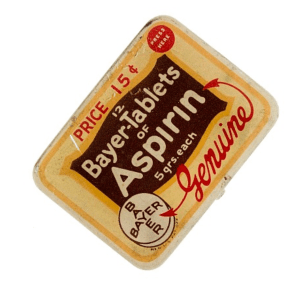 Speaking of patents, Bayer received a patent for their drug in the United States in 1900, and also registered the trademark name, Aspirin®. The patent expired in 1917, and the trademark was partly struck down in a 1921 court ruling after a judge ruled that by then the aspirin name was already part of the public domain, so packages of 50 or fewer tablets could be sold to the public as “aspirin” no matter the manufacturer. The red script “Genuine,” as featured on this small pocket tin, appeared in Bayer Tablets of Aspirin ads shortly after the 1921 ruling. Aspirin® is still Bayer’s registered trademark in more than 80 countries.
Bayer aspirin (or generic ASA) tablets are widely sold as an over-the-counter medication today, but newer analgesic/anti-inflammatory drugs have rapidly outpaced Bayer aspirin sales.
The drug’s competition out there has so far included:
Ibuprofen drugs: (e.g. Motrin, Advil, Aleve – which became available without prescription in the 1980s)
Acetaminophen drugs: (e.g. liquid Tylenol in 1955, Tylenol pills in 1958; Excedrin’s multi-ingredient formula with acetaminophen, aspirin and 65 mg. of caffeine in 1960). By the late 1960s, Tylenol was available without a prescription. Because it didn’t cause gastric irritation, acetaminophen soon overtook aspirin marketing.
During that time, aspirin sales were also hit hard when doctors warned parents that aspirin had been linked to a very serious condition called Reye’s syndrome in children or teenagers who had been given aspirin after being diagnosed with a viral infection like the flu or chicken pox. P.S. Do NOT give children or teenagers aspirin to treat fever or pain. Mayo Clinic now suggests instead trying infants’ or children’s acetaminophen (Tylenol etc.) or ibuprofen (Advil, Motrin, etc).
Aspirin’s link to heart disease prevention:
It seems like the whole world is now routinely taking a low-dose (81mg) aspirin every day to ward off heart attack or stroke. Manufacturers of ASA-based drugs advertise this routine because if you buy more, they’ll sell more. But because we know that aspirin also carries a risk for serious bleeding problems, we must view this routine critically. Aspirin is not a benign drug, and daily aspirin is not for everyone.(1, 2) Please talk to your doctor so you can make an informed choice. While you’re waiting for that doctor’s appointment, read what the experts at Mayo Clinic are advising us. My favourite part of that advice, by the way, is about taking aspirin at the first signs of a heart attack. For example:
“Take aspirin, if recommended. Do NOT delay calling 911 because you’re looking for the aspirin. Always call for emergency help first!”
And YES! – in case you thought I’d forgotten our promising title: in 1950, aspirin did indeed earn a place in the Guinness Book of World Records as the “most popular painkiller sold worldwide”.
♥
1. ASPREE Study: Aspirin in Reducing Events in the Elderly”. Effect of Aspirin on All-Cause Mortality in the Healthy Elderly”. “September 16, 2018. N Engl J Med 2018; 379:1519-152
2. ASCEND Study: “Effects of Aspirin for Primary Prevention in Persons with Diabetes Mellitus.” August 26, 2018. N Engl J Med 2018; 379:1529-153
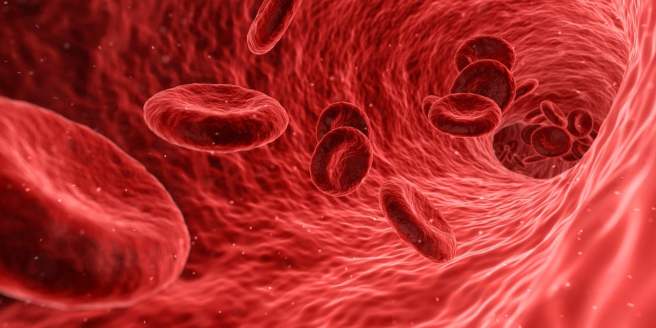
Image of blood flow inside a coronary artery: Arek Socha from Pixabay
♥
Q: Has your physician recommended aspirin for you?
♥
NOTE from CAROLYN: I wrote more about cardiac medications in my book, “A Woman’s Guide to Living with Heart Disease”. You can ask for it at your local library or bookshop, or order it online (paperback, hardcover or e-book) at Amazon – or order it directly from my publisher, Johns Hopkins University Press (use their code HTWN to save 30% off the list price).
 Heart Sisters
Just a side note: Indigenous people of North America used willow bark for pain and fever relief. In the 1600’s missionary Jean Brebeuf, wrote about the Huron-wendat, who lived in the St Lawrence River valley and around the Great Lakes, using it to heal all sorts of illnesses.
While that’s much later than Hippocrates, it’s possible, given the age of Indigenous cultures, that willow bark was helping people feel better before the Greeks mentioned it.
LikeLike
Hi Deborah! I think you’re exactly right! Indigenous traditions all over the world have managed to heal the sick with remedies that many of us “modern” white people would automatically dismiss.
While I was researching this history of aspirin, a number of studies I found mentioned traditional plant sources of healing medicines among First Nations communities.
Speaking of the St. Lawrence River valley, have you read the classic pioneer memoir called “ Roughing it in the Bush” by Susanna Moodie?
In the early 1800s, she and her sister Catharine Parr-Trail (and their two clueless upper class British husbands) emigrated from England to what is now the Peterborough area in Ontario – Susanna tells so many amazing (and funny!) true stories about the local First Nations women who lived nearby and befriended these utterly helpless white families who would have died for sure in their first Canadian winter had it not been for the generosity, food, clothing, blankets, firewood, medicine, and midwifery skills shared by their native neighbours.
Thanks for that important reminder of thousands of years of First Nations healing traditions.
Take care . . . ❤️
LikeLike